
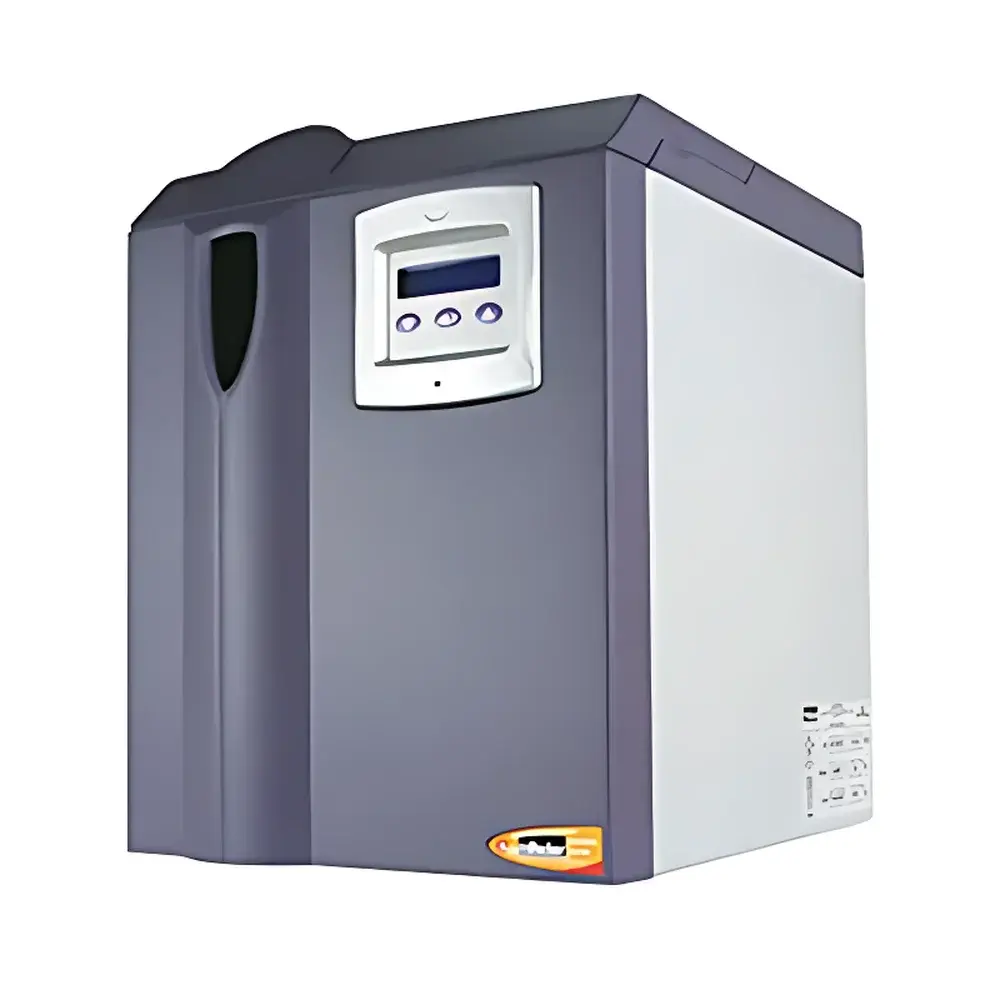
Parker Domnick Hunter H-Series High-Purity Hydrogen Generator
| Brand | Parker Domnick Hunter DH |
|---|---|
| Origin | United Kingdom |
| Model | Hunter H |
| Hydrogen Generation Principle | Pure Water Electrolysis |
| Output Pressure | 5–100 psi |
| Hydrogen Purity | >99.99995% |
| Power Consumption | 100 W |
| Certifications | CE, UL |
| Water Reservoir Capacity | 5 L |
| Continuous Operation | 24/7, 365 days/year |
| Safety Features | Automatic H₂ Leak Detection, Water Level & Conductivity Monitoring, Self-Diagnostic System, Eco-Friendly Filter |
| Optional | Auto-Refill Function |
| Compliance | ISO 9001 certified manufacturer |
Overview
The Parker Domnick Hunter H-Series High-Purity Hydrogen Generator is an engineered solution for laboratories requiring continuous, on-demand hydrogen supply at ultra-high purity (>99.99995%) and low risk. Utilizing membrane-separated pure water electrolysis — a zero-carbon, catalyst-free process — the system generates hydrogen gas directly from deionized water without chemical reagents or metal hydride cartridges. This electrochemical method ensures stable output pressure (5–100 psi) with no pulsation or contamination from lubricants, hydrocarbons, or ambient air ingress. Designed for integration with analytical instruments such as GC-FID, GC-TCD, and hydrogen-fueled fuel cells, the H-Series eliminates dependency on high-pressure cylinders, mitigating safety hazards associated with cylinder handling, storage, and potential leaks. With over 60 years of gas generation expertise and ISO 9001-certified manufacturing in the UK, Parker Domnick Hunter delivers reproducible performance aligned with GLP and GMP laboratory requirements.
Key Features
- Ultra-high purity hydrogen output (>99.99995% v/v), verified by real-time purity monitoring and trace-level impurity suppression (O₂ < 0.1 ppm, H₂O < 1 ppm, total hydrocarbons < 0.1 ppm)
- Electrolytic cell architecture with PEM (Proton Exchange Membrane) technology, ensuring rapid start-up, minimal warm-up time, and long service life under continuous operation
- Integrated 5-liter deionized water reservoir enabling uninterrupted operation for up to 3–4 weeks depending on flow demand
- Intelligent microprocessor control with LCD interface for real-time monitoring of pressure, water level, conductivity, temperature, and system status
- Comprehensive safety suite: automatic hydrogen leak detection via catalytic sensor, over-pressure relief valve, dry-run protection, and fault-triggered shutdown with event logging
- Compact footprint (W × D × H ≈ 350 × 450 × 500 mm) optimized for benchtop or under-bench installation in regulated lab environments
- CE and UL listed; designed and tested per IEC 61010-1 for electrical safety and EN 60079-0 for explosive atmosphere compatibility where applicable
- Optional auto-refill module compatible with centralized DI water networks for fully unattended operation
Sample Compatibility & Compliance
The H-Series is compatible with all major hydrogen-dependent analytical platforms, including gas chromatographs (Agilent, Thermo Fisher, Shimadzu), residual gas analyzers (RGAs), and hydrogen-powered detectors requiring Class 5.5 or higher purity per ISO 8573-1:2010. Its output meets ASTM D6299 and USP specifications for carrier and fuel gas purity in chromatographic applications. The system adheres to FDA 21 CFR Part 11 requirements when paired with compliant data acquisition software, supporting audit trails, electronic signatures, and secure user access levels. All wetted materials are electropolished 316L stainless steel or PTFE-lined, eliminating leachable metals and ensuring compliance with ISO 10109 for cleanroom-grade gas delivery.
Software & Data Management
While the base H-Series operates via embedded firmware without external PC dependency, optional RS-232 or Ethernet connectivity enables integration into LabVantage, STARLIMS, or custom LIMS environments. Logged parameters — including runtime hours, total H₂ volume generated, water conductivity trends, and alarm history — are exportable in CSV format. Firmware updates are performed via secure USB interface with version-controlled release notes. All diagnostic logs include timestamps, error codes per IEC 62443-2-4, and root-cause indicators to support preventive maintenance scheduling and regulatory inspection readiness.
Applications
- GC carrier and detector fuel gas for FID, TCD, and HID systems requiring consistent, ultra-pure hydrogen
- Hydrogen supply for online catalytic reactors and isotopic labeling studies
- Calibration gas generation in environmental monitoring labs (e.g., EPA Method TO-15, ASTM D5502)
- Supporting hydrogen-based fuel cell testing and material science research under inert atmospheres
- Replacement of cylinder-based supply in pharmaceutical QC labs operating under Annex 1 and EU GMP guidelines
- Continuous feed for FTIR purge systems and vacuum chamber purging where oxygen exclusion is critical
FAQ
What is the minimum water quality requirement for optimal operation?
Deionized water with resistivity ≥18.2 MΩ·cm and total organic carbon (TOC) < 5 ppb is required. Integrated water conductivity monitoring alerts users if feed water exceeds 1 µS/cm threshold.
Can the generator be integrated into a central lab gas network?
Yes — with optional pressure-regulated manifold kits and flow-balancing valves, multiple H-Series units can feed a dedicated hydrogen loop meeting ISO 8573-1 Class 1 compressed air equivalency standards.
How frequently does the electrolytic cell require maintenance?
Under typical lab use (≤8 hrs/day), the PEM stack requires no scheduled replacement for ≥5 years; annual verification of seal integrity and diaphragm resistance is recommended per Parker’s Service Bulletin H-GEN-SV-2023.
Is remote monitoring supported out-of-the-box?
Standard models include local LCD diagnostics only; remote supervision requires optional communication module (P/N H-COM-ETH) and configuration via Modbus TCP or BACnet/IP protocols.
Does the system meet explosion-proof requirements for hazardous locations?
The base unit is not rated for Zone 1/Div 1; however, it may be installed in adjacent safe areas with hydrogen concentration monitoring (e.g., Honeywell XNX) and forced ventilation per NFPA 55 guidelines.



