
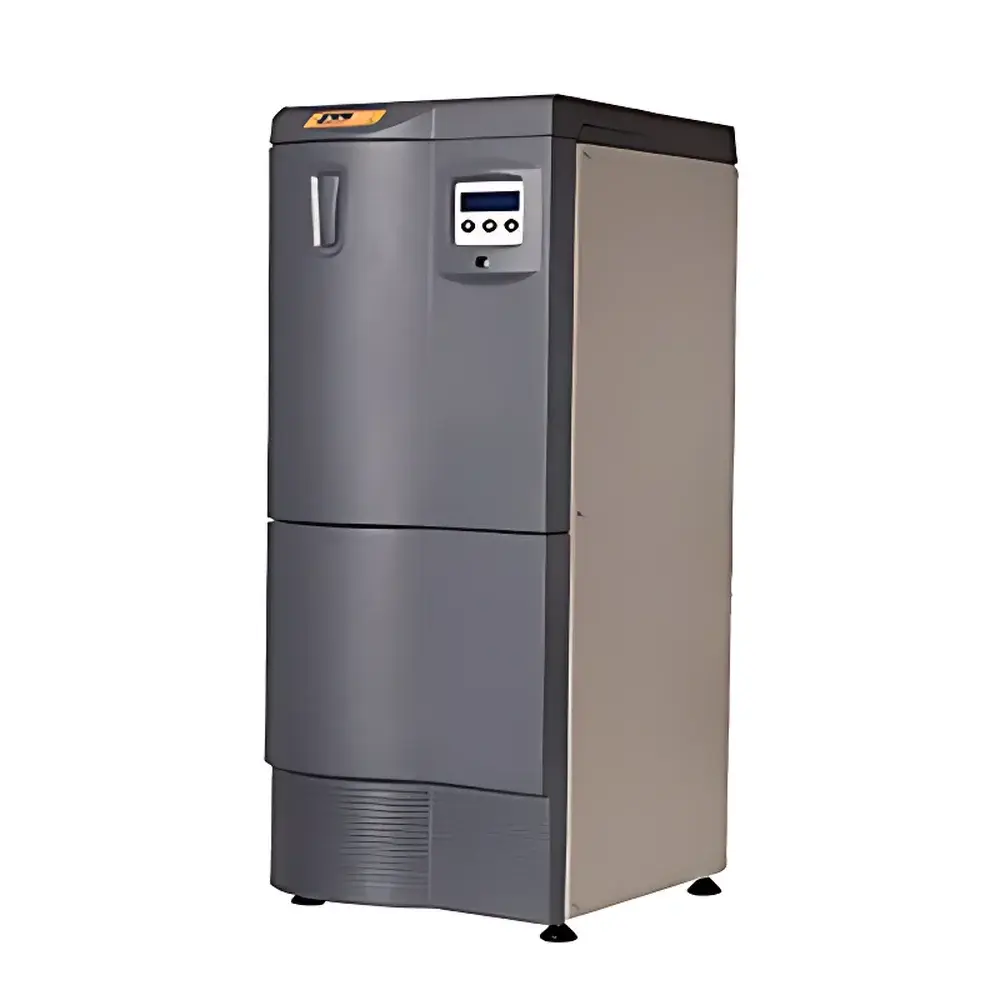
Parker Domnick Hunter UHPN2 Series Ultra-High-Purity Nitrogen Generator
| Brand | Parker Domnick Hunter |
|---|---|
| Origin | United Kingdom |
| Model | UHPN2 |
| Nitrogen Generation Principle | Pressure Swing Adsorption (PSA) |
| Output Flow Rate | 1 L/min |
| Output Pressure | 100 psi (5 bar) |
| Nitrogen Purity | >99.9995% |
| Dew Point | −62 °C |
| Hydrocarbon Content | <0.1 ppm |
| Particulate Class | ISO 8573-1:2010 Class 2 |
| Certifications | CE, UL |
| Compressor Type | Integrated Oil-Free Modular Air Compressor |
| Control Interface | LCD Microprocessor Controller |
| Operating Mode | ECO Adaptive Demand-Based Operation |
| Regeneration | Fully Auto-Regenerating PSA System |
| Molecular Sieve Technology | Snowstorm™ Packing |
| Noise Reduction | Acoustically Enclosed Compressor Housing |
| Monitoring | Three Independent Pressure Gauges |
| Maintenance Alert | Real-Time Predictive Maintenance Notification |
Overview
The Parker Domnick Hunter UHPN2 Series Ultra-High-Purity Nitrogen Generator is an engineered solution for laboratories requiring continuous, on-demand nitrogen gas with exceptional purity and stability. Utilizing pressure swing adsorption (PSA) technology, the UHPN2 separates nitrogen from compressed ambient air by selective adsorption of oxygen, carbon dioxide, moisture, and trace hydrocarbons on carbon molecular sieve (CMS) beds. Unlike membrane or cryogenic systems, PSA delivers consistent ultra-high-purity output without consumables or external liquid nitrogen supply. The integrated oil-free modular compressor eliminates dependency on facility-supplied compressed air—ensuring operational independence, enhanced safety, and reduced infrastructure complexity. Designed for uninterrupted 24/7 operation across 365 days per year, the UHPN2 meets stringent analytical requirements for gas chromatography (GC), mass spectrometry (MS), electron capture detection (ECD), and other sensitive instrumentation where background interference must be minimized.
Key Features
- Fully auto-regenerating PSA system with Snowstorm™ molecular sieve packing—ensures uniform bed density, extended CMS service life, and reproducible separation efficiency over thousands of cycles
- Integrated oil-free air compressor with acoustic enclosure—reduces operational noise to <55 dB(A) and eliminates risk of oil contamination in the nitrogen stream
- LCD microprocessor controller with real-time display of pressure, flow, purity status, and maintenance countdown—enabling intuitive local operation and diagnostics
- ECO adaptive demand-based mode—dynamically adjusts compressor speed and PSA cycle timing in response to actual nitrogen consumption, reducing energy use by up to 40% during low-demand periods
- Onboard catalytic hydrocarbon cracking unit—thermally decomposes residual hydrocarbons to sub-ppm levels (<0.1 ppm total HC), producing true zero-grade nitrogen compliant with ASTM D6866 and ISO 8573-1 Class 2 particulate specifications
- Triple independent pressure monitoring—comprising inlet air pressure, PSA bed pressure, and regulated output pressure—provides redundant verification of system integrity
- Predictive maintenance alerts—based on cumulative runtime, pressure differential trends, and CMS saturation modeling—to support GLP/GMP-aligned preventive maintenance scheduling
Sample Compatibility & Compliance
The UHPN2 is validated for compatibility with all major GC platforms—including Agilent, Thermo Fisher, Shimadzu, and PerkinElmer—as both carrier and detector assist gas. Its output meets or exceeds the gas quality requirements specified in USP , EP 2.2.46, and ICH Q5C for residual solvent analysis. The nitrogen stream complies with ISO 8573-1:2010 Class 2 (particulates), Class 2 (water), and Class 1 (oil aerosol), and achieves a dew point of −62 °C, ensuring condensation-free delivery even under low-temperature column oven conditions. All electrical components are certified to CE and UL 61010-1 standards for laboratory equipment safety. The system architecture supports audit-ready documentation for FDA 21 CFR Part 11 compliance when integrated with validated LIMS or ELN environments.
Software & Data Management
While the UHPN2 operates autonomously via its embedded microcontroller, it features an RS-232 serial interface for optional integration into centralized lab infrastructure. Through third-party SCADA or laboratory management software, users can log operational parameters—including runtime hours, pressure transients, alarm history, and predictive maintenance triggers—for trend analysis and regulatory reporting. Audit trails are maintained locally with timestamped event logging, supporting GLP-compliant record retention. No proprietary software installation is required for basic operation; configuration changes and calibration adjustments are performed exclusively through the front-panel interface to minimize cybersecurity exposure.
Applications
- Carrier gas for capillary GC and GC-MS systems requiring stable, ultra-dry, hydrocarbon-free nitrogen
- Make-up and collision gas in triple quadrupole and time-of-flight mass spectrometers
- Blank gas for electron capture detectors (ECD) and thermal conductivity detectors (TCD)
- Zero-air generation support in ambient air monitoring and calibration laboratories
- Protective blanketing in sample preparation workflows involving oxidation-sensitive analytes
- Long-term unattended operation in remote or automated analytical facilities where cylinder logistics are impractical
FAQ
What is the expected lifetime of the carbon molecular sieve (CMS) under normal operating conditions?
CMS life is typically ≥20,000 hours (≈2.3 years of continuous operation) when operated within specified inlet air quality limits (ISO 8573-1 Class 3–4); replacement intervals are tracked automatically and signaled via the maintenance alert system.
Can the UHPN2 be used as a direct replacement for liquid nitrogen dewars in GC applications?
Yes—provided the instrument’s nitrogen demand does not exceed 1 L/min at regulated 100 psi; the system’s pressure regulation and purity stability eliminate the need for secondary purification or dewar vaporization hardware.
Is external drying or filtration required upstream of the UHPN2?
No—the integrated compressor includes coalescing and refrigerated pre-filtration stages meeting ISO 8573-1 Class 4 for water and particulates; additional external treatment is unnecessary and may impair ECO mode responsiveness.
How does the catalytic hydrocarbon removal stage function?
A heated precious-metal catalyst (Pt/Pd) oxidizes residual C1–C4 hydrocarbons at ~350 °C, converting them to CO₂ and H₂O, which are subsequently removed by downstream desiccant and adsorbent beds.
Does the UHPN2 support remote monitoring via Ethernet or Wi-Fi?
No—it uses RS-232 only; network connectivity requires an external protocol converter compatible with Modbus RTU or ASCII command sets.



