
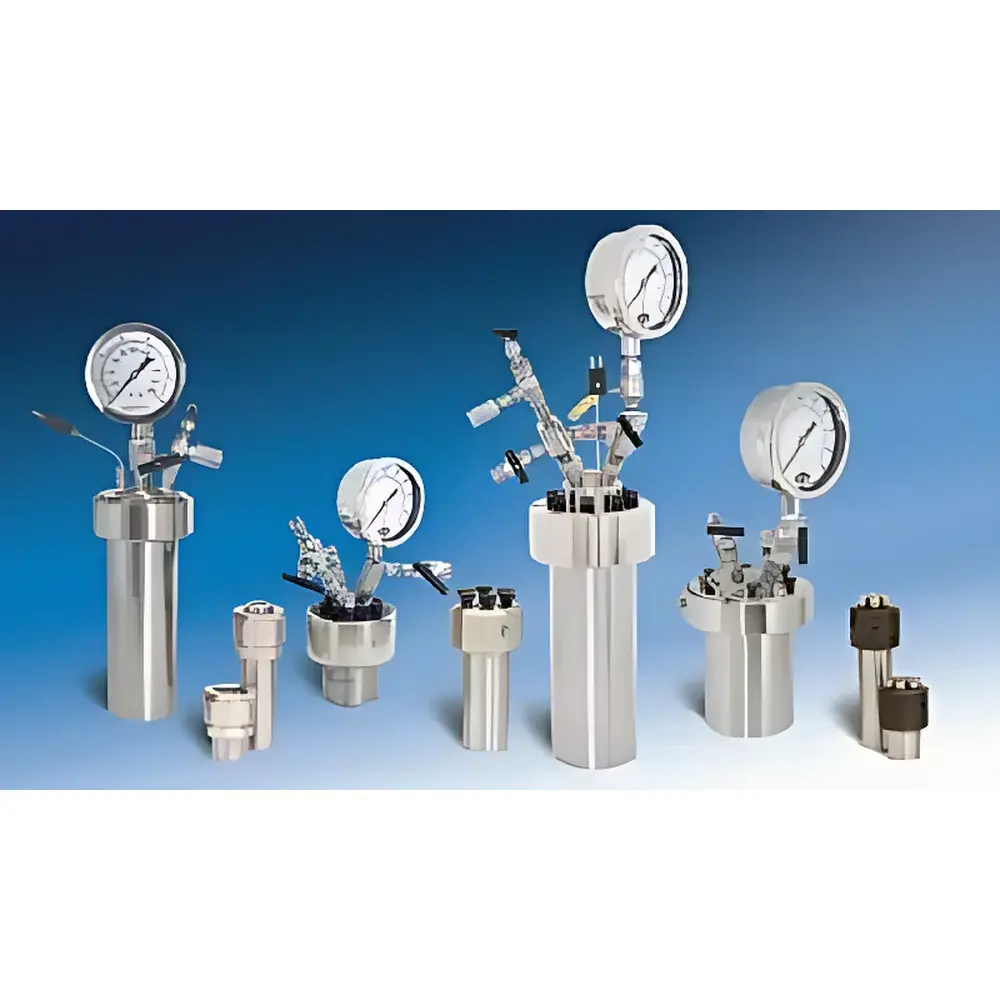
Parr Non-Stirred Reactor Model 4600/4700 Series
| Brand | Parr |
|---|---|
| Origin | USA |
| Model | 4600 / 4700 Series |
| Vessel Volume Range | 22 mL – 20 L |
| Maximum Operating Temperature | 250°C – 500°C |
| Maximum Operating Pressure | 115 bar (1700 psi) – 345 bar (5000 psi) |
| Construction Materials | Stainless Steel (316, 304), Alloy 400, Hastelloy C-276/B3, Titanium Grades 2/4/7, Monel 400, Nickel 200, Zirconium 702/705, Inconel 600, Carbon Steel |
| Configuration | Benchtop & Mobile (Vehicle-Mounted) |
| Stirring | Non-Stirred (Static Reaction Vessel) |
| Compliance | Designed to ASME BPVC Section VIII Div. 1, PED 2014/68/EU, ISO 9001 Manufacturing Environment |
Overview
The Parr Non-Stirred Reactor Model 4600/4700 Series is a precision-engineered static pressure vessel system designed for controlled high-temperature, high-pressure chemical synthesis, catalytic testing, hydrothermal processing, and material stability studies under inert or reactive atmospheres. Unlike stirred reactors that rely on mechanical agitation, this series employs a sealed, non-agitated configuration—ideal for experiments where shear sensitivity, solid-phase deposition, heterogeneous catalyst evaluation, or long-duration static equilibration is required. Each reactor is constructed in accordance with ASME Boiler and Pressure Vessel Code Section VIII Division 1 standards and certified for use under the European Pressure Equipment Directive (PED 2014/68/EU). The modular design supports rapid customization of volume (22 mL to 20 L), temperature rating (250°C to 500°C), pressure class (115–345 bar), and alloy selection—enabling strict alignment with process chemistry requirements while maintaining full traceability and audit readiness for GLP and GMP environments.
Key Features
- Static reaction geometry eliminates mechanical seals, shafts, and drive systems—reducing failure points and enhancing long-term pressure integrity.
- Multiple alloy options—including ASTM-certified 316 stainless steel, Hastelloy C-276, titanium grades 2/4/7, zirconium 702/705, and nickel 200—permit compatibility with highly corrosive reagents (e.g., HF, HCl, molten salts, supercritical fluids).
- Robust dual-seal closure system with conical sealing surfaces and torque-controlled clamping ensures leak-tight performance across full operating ranges.
- Benchtop and vehicle-mounted configurations support both laboratory-scale screening and field-deployable reaction studies (e.g., geothermal simulation, mobile catalysis labs).
- Standardized flange interfaces (ANSI B16.5, DIN 2501) and optional instrumentation ports (thermocouple wells, pressure transducer taps, gas inlet/outlet valves) facilitate integration into automated control and data acquisition platforms.
- Each unit undergoes hydrostatic proof testing at 1.5× maximum allowable working pressure (MAWP) and non-destructive examination (NDE) per ASME Section V prior to shipment.
Sample Compatibility & Compliance
The Parr 4600/4700 Non-Stirred Reactors accommodate a broad spectrum of sample types—including slurries, powders, gels, multiphase mixtures, and solid-supported catalysts—without risk of particle attrition or seal contamination from rotating components. Their static architecture is especially suited for hydrothermal crystallization, supercritical CO₂ extraction validation, hydrogenation aging tests, and accelerated corrosion studies per ASTM G31 and ISO 9223. All units are manufactured in an ISO 9001-certified facility, with full material test reports (MTRs), heat treatment records, and pressure test documentation supplied. Optional third-party certification (TÜV, Lloyd’s Register) is available for applications requiring FDA 21 CFR Part 11–compliant validation packages or nuclear-grade QA documentation.
Software & Data Management
While the base reactor operates as a standalone pressure vessel, it is fully compatible with Parr’s optional digital monitoring ecosystem—including the Parr 4872 Digital Pressure/Temperature Controller and the Parr 4880 Multi-Channel Data Logger. These systems provide real-time logging of internal pressure, head temperature, and jacket temperature with 0.1% FS accuracy, automatic alarm thresholds, and timestamped CSV export. Audit trails comply with FDA 21 CFR Part 11 requirements when configured with user access controls, electronic signatures, and immutable record storage. Data files may be imported directly into LIMS platforms or MATLAB/Python for kinetic modeling and Arrhenius analysis.
Applications
- Hydrothermal synthesis of metal oxides, MOFs, and nanomaterials under reproducible T/P conditions.
- Catalyst deactivation and sintering studies via extended isothermal holds at elevated pressures.
- Thermodynamic equilibrium measurements (e.g., gas solubility, phase behavior) in closed static systems.
- Corrosion testing of candidate alloys in aggressive media per NACE TM0169 and ASTM G1.
- Stability assessment of pharmaceutical intermediates, energetic materials, and battery electrolytes under accelerated aging protocols.
- Validation of reaction kinetics models where mixing artifacts must be excluded—e.g., autocatalytic decomposition or surface-limited oxidation pathways.
FAQ
Can the 4600/4700 series be used for exothermic reactions without active cooling?
Yes—when operated within its rated pressure and temperature limits, the thick-walled construction provides sufficient thermal mass and passive dissipation for many low-to-moderate exotherms. For highly energetic systems, optional external cooling jackets or cryogenic quench ports are available.
Is third-party calibration and certification included with purchase?
Standard units ship with factory hydrotest and dimensional verification. NIST-traceable calibration certificates and TÜV/PED conformity declarations are available as add-on services.
What safety interlocks are integrated into the system?
No electronic interlocks are built-in by default, as the reactor is a passive vessel. However, it is routinely deployed with external safety-rated controllers (e.g., Parr 4872) featuring redundant pressure relief triggers, thermal cutoffs, and remote emergency venting capability.
How is maintenance performed on a non-stirred reactor?
Maintenance is limited to periodic inspection of sealing surfaces, O-rings (supplied with each unit), and valve actuation mechanisms. No lubrication, bearing replacement, or shaft alignment is required—significantly reducing scheduled downtime and technician training burden.



