
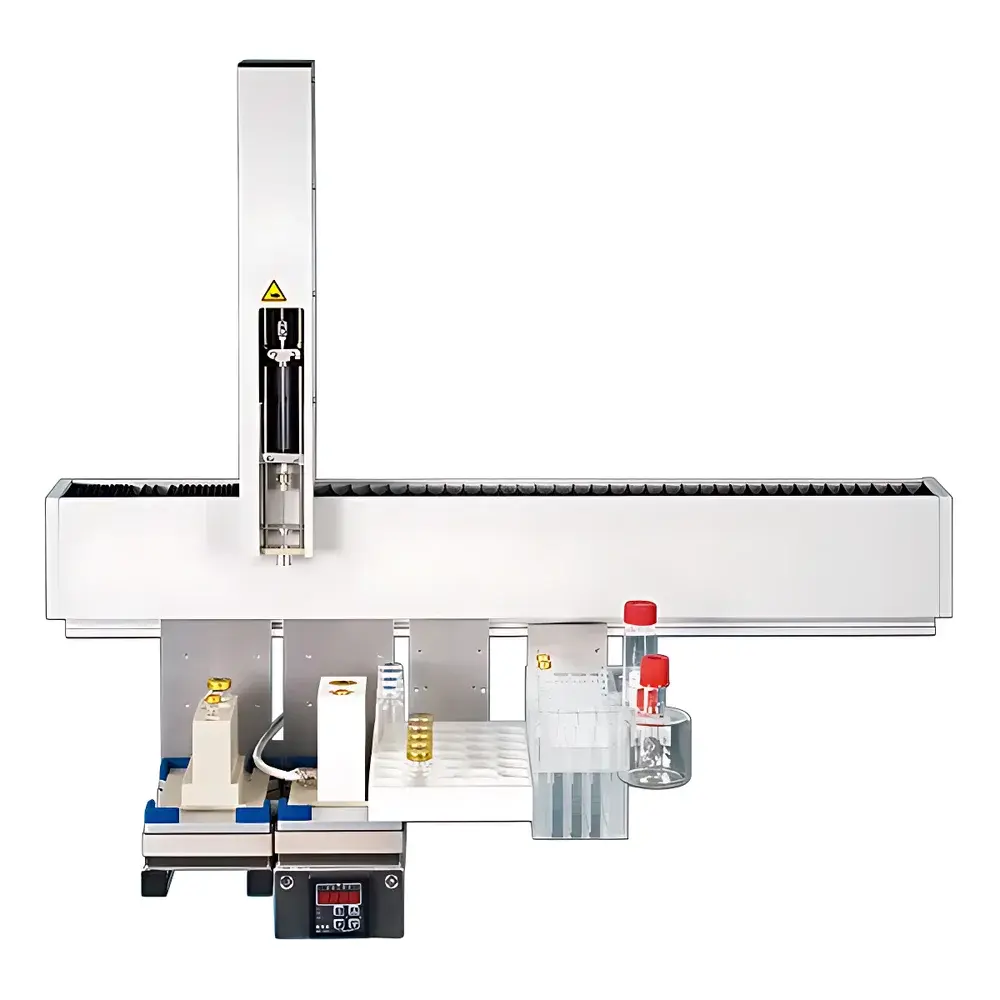
PAS CONCEPT MIS Multifunctional Autosampler for Gas Chromatography
| Brand | PAS |
|---|---|
| Origin | Germany |
| Model | CONCEPT MIS |
| Instrument Type | GC Autosampler |
| Minimum Injection Volume | 1 µL |
| Positioning Accuracy | <0.3 mm |
| Motion System | XYZ Three-Axis |
| Needle Wash | Internal and External Wall Cleaning (Unlimited Cycles) |
| Re-injection Capability | Unlimited |
| Sample Introduction Modes | Liquid Injection (LI), Liquid–Liquid Extraction (LLE), Static/Dynamic Headspace (HS), Needle Trap (NT), Solid-Phase Microextraction (SPME), On-line Derivatization |
| Compliance | Designed for GLP/GMP environments with audit-trail-ready software architecture |
Overview
The PAS CONCEPT MIS Multifunctional Autosampler is an advanced, modular automation platform engineered specifically for gas chromatography (GC) and GC–mass spectrometry (GC–MS) workflows. Unlike conventional single-mode autosamplers, the CONCEPT MIS implements a unified hardware architecture capable of executing multiple sample introduction techniques—including liquid injection, static/dynamic headspace, needle trap microextraction (NT), solid-phase microextraction (SPME), liquid–liquid extraction (LLE), and on-line derivatization—within a single instrument frame. Its core design principle follows the Couette–Taylor flow and controlled vapor-phase transport principles common to high-fidelity headspace and microextraction systems, ensuring reproducible mass transfer kinetics across all supported modes. The system is built around a high-precision XYZ robotic arm with sub-0.3 mm positional repeatability, enabling accurate placement of sampling probes, vials, and derivatization reactors under programmable thermal control. As a German-engineered solution developed in collaboration with Prof. Janusz Pawliszyn’s research group—the pioneer of SPME—the CONCEPT MIS reflects deep integration of fundamental analytical chemistry with industrial-grade automation.
Key Features
- Modular multi-technique support: Seamlessly switch between LI, HS, NT, SPME, LLE, and on-line derivatization without hardware reconfiguration
- True XYZ three-axis motion system with <0.3 mm positioning accuracy and thermal-stable linear guides
- Integrated dual-wash station: Simultaneous internal and external needle rinsing using solvent-selectable protocols; wash cycles are fully programmable and unrestricted
- 1 µL minimum injection volume with syringe-based quantitative loop delivery—compatible with standard GC inlet configurations (split/splitless, PTV, cold-on-column)
- On-board temperature-controlled zones: Independent heating/cooling modules for vial racks (4–150 °C), SPME fiber desorption ovens (up to 300 °C), and derivatization reactors
- Gas-tight fluidic architecture compliant with ISO 17025 traceability requirements for volatile organic compound (VOC) analysis
Sample Compatibility & Compliance
The CONCEPT MIS accommodates standard 10–22 mm OD vials (including crimp-top, screw-cap, and magnetic cap formats), SPME fiber holders, NT cartridges, and custom reaction vessels up to 50 mL. It supports aqueous, viscous, particulate-laden, and highly volatile matrices without cross-contamination risk due to its positive-pressure purge design and disposable needle options. From a regulatory standpoint, the system is architected to meet key compliance frameworks: data integrity is ensured via 21 CFR Part 11–compliant software (with electronic signatures, audit trails, and user role management); method validation aligns with ASTM D6866, ISO 16000-6, and USP for residual solvents; and mechanical performance adheres to IEC 61000-6-2/6-4 electromagnetic compatibility standards. Routine operation satisfies GLP and GMP documentation requirements for pharmaceutical QC, environmental monitoring labs, and contract research organizations.
Software & Data Management
The CONCEPT Control Suite is a Windows-based application offering method editor, sequence scheduler, real-time status dashboard, and integrated calibration manager. All methods store full parameter metadata—including temperature ramps, agitation speed, purge gas flow rates, and wash solvent selection—enabling full traceability from raw signal to final report. Raw data export is compatible with Agilent ChemStation, Thermo Xcalibur, and Shimadzu GCMSsolution via standardized .CDF and .MXD formats. Audit trails record every user action—including method modification, sequence start/stop, and error recovery—with immutable timestamps and operator IDs. Optional LIMS integration is available via ASTM E1578-compliant API endpoints, supporting automated sample ID propagation and result backfill.
Applications
The CONCEPT MIS delivers validated performance across regulated and research-driven domains: food safety labs use it for pesticide residue screening via SPME–GC–MS; pharmaceutical QA teams deploy it for residual solvent quantification per ICH Q3C guidelines; environmental agencies apply dynamic headspace–GC for VOC profiling in soil gas and indoor air; forensic toxicology units rely on NT–GC–MS for low-concentration drug metabolite detection in biological fluids; and polymer R&D facilities employ on-line derivatization–GC for aldehyde quantification in epoxy curing reactions. Its flexibility eliminates the need for parallel instrumentation stacks, reducing footprint, maintenance overhead, and inter-method variability.
FAQ
Does the CONCEPT MIS support unattended overnight operation?
Yes—equipped with full sequence scheduling, power-failure recovery, and real-time hardware diagnostics, it supports continuous 24/7 operation across mixed-mode sequences.
Can SPME fibers be aged and conditioned directly on the instrument?
Yes—the integrated fiber oven supports programmable conditioning protocols up to 300 °C with inert gas purging.
Is method transfer possible between different CONCEPT platforms (e.g., CONCEPT 96 or CONCEPT NT)?
Method files are backward-compatible within the CONCEPT series; minor adjustments may be required for hardware-specific parameters such as vial rack geometry or thermal ramp limits.
What level of validation support is provided for regulated laboratories?
PAS supplies IQ/OQ documentation templates, installation qualification checklists, and performance verification protocols aligned with ASTM E2500 and EU Annex 11 requirements.
Are consumables such as NT cartridges and SPME fibers supplied through PAS or third-party vendors?
PAS offers certified NT cartridges and SPME fibers co-developed with original equipment manufacturers; third-party alternatives meeting ISO 17034 criteria may also be used with documented equivalence testing.





