
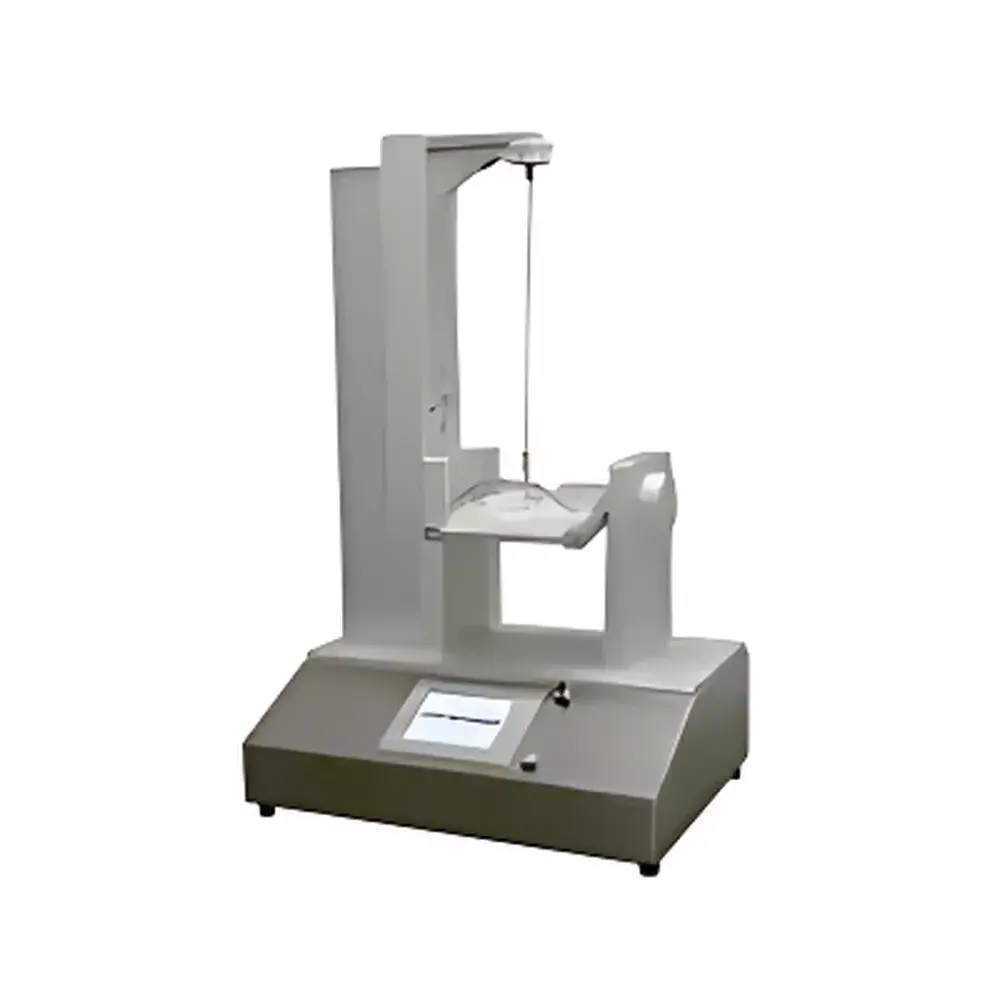
PAT-Series Easy-Open Lid Peel Force and Full-Opening Force Tester
| Origin | Guangdong, China |
|---|---|
| Manufacturer Type | Authorized Distributor |
| Origin Category | Domestic (China) |
| Model | PAT-1000 / PAT-2100 |
| Sensor Capacity | 100 N (standard), 200 N (PAT-2100 optional) |
| Power Supply | 12 V DC (standard), 24 V DC (PAT-2100) |
| Input | 100–240 V AC, 50–60 Hz |
| Force Accuracy | ±0.25% of full scale |
| Sampling Rate | 1000 Hz |
| Force Units | N, kgf, lbf |
| Test Range | Ø52–105 mm (PAT-1000) |
| Dimensions (W × D × H) | 400 × 360 × 560 mm |
| Interface | RS-232 |
| Measurement Parameters | Initial Break Force, Full Opening Force, Tab Tensile Strength, Tab Detachment Force |
Overview
The PAT-Series Easy-Open Lid Peel Force and Full-Opening Force Tester is an engineered mechanical testing system designed for quantitative evaluation of functional performance in metal and composite easy-open closures used across food, beverage, pharmaceutical, and aerosol packaging industries. It operates on the principle of controlled uniaxial tensile displacement, applying calibrated linear force to simulate real-world consumer opening actions—specifically the initial tab lift (break force), continuous lid peeling (peel resistance), and complete separation (full-opening force). The instrument employs high-stiffness load cells with digital signal conditioning and real-time sampling at 1000 Hz to capture transient force peaks and dynamic response profiles. Its rigid frame architecture minimizes deflection under load, ensuring measurement integrity across repeated cycles. Unlike manual or semi-automated methods, the PAT-Series eliminates operator-dependent variability through programmable test sequences, fixed fixture geometry, and automatic peak detection—enabling compliance with standardized physical testing protocols for closure validation.
Key Features
- Two-model platform: PAT-1000 for standard round lids (Ø52–105 mm); PAT-2100 for extended geometry testing—including oversized round lids (up to Ø153 mm), rectangular lids, and can-integrated closures—with dual sensor options (100 N standard, 200 N optional)
- High-resolution force transduction: ±0.25% full-scale accuracy over the entire measurement range, traceable to national metrological standards
- Dual-voltage compatibility: 12 V DC operation for PAT-1000; 24 V DC for PAT-2100—both supported by universal AC input (100–240 V, 50–60 Hz)
- RS-232 serial interface for direct integration into laboratory data acquisition networks or LIMS environments
- Multi-language UI support (English, Spanish, French, German, Chinese) with configurable unit display (N, kgf, lbf)
- Fixed-height, adjustable clamping fixtures with non-marring jaws to prevent deformation of lid flanges during pre-load stabilization
Sample Compatibility & Compliance
The PAT-Series accommodates a broad spectrum of commercially deployed easy-open closure designs—including stay-on-tab (SOT), full-aperture, and ring-pull variants—fabricated from aluminum, tinplate, or laminated steel substrates. Fixture adaptability supports both flat-lid configurations and curved can-mounted specimens without requiring custom tooling. Test methodology aligns with ASTM F88 (Standard Test Method for Seal Strength of Flexible Barrier Materials), ISO 11607-2 (Packaging for terminally sterilized medical devices), and relevant sections of USP (Package Integrity Evaluation). Data output meets GLP/GMP documentation requirements, with timestamped force-time curves and discrete parameter reporting (initial break, full opening, tab strength, detachment force) suitable for regulatory submissions and internal quality audits.
Software & Data Management
The instrument operates with embedded firmware that enables standalone test execution, while optional PC-based software provides advanced analysis capabilities—including force-time curve overlay, statistical process control (SPC) charting, pass/fail threshold configuration, and batch report generation in PDF/CSV formats. All measurements include automatic audit trail metadata: operator ID, test date/time, sample ID, fixture configuration, and calibration status. Software complies with FDA 21 CFR Part 11 requirements when configured with electronic signatures, role-based access controls, and immutable data logging—ensuring data integrity throughout the product lifecycle.
Applications
- Quality assurance of closure performance prior to can filling and sterilization
- Validation of lid material thickness, scoring depth, and tab geometry against design specifications
- Comparative assessment of sealant formulations and lacquer adhesion strength
- Root-cause analysis of field complaints related to difficult opening or premature tab failure
- Supplier qualification and incoming inspection of closure components
- Development-stage testing for new lid designs undergoing accelerated aging or thermal cycling
FAQ
What is the difference between initial break force and full-opening force?
Initial break force is the peak load required to initiate tab movement and sever the score line; full-opening force is the maximum sustained load measured during continuous lid peeling until complete separation.
Can the PAT-Series test non-circular lids?
Yes—the PAT-2100 model includes adjustable lateral fixtures and extended travel range to accommodate rectangular lids and irregularly shaped closures mounted on cans.
Is calibration certification included with shipment?
Each unit ships with a factory calibration certificate traceable to NIM (National Institute of Metrology, China); ISO/IEC 17025-accredited calibration services are available upon request.
How is data exported for long-term storage?
Raw force-time data and summary metrics export via RS-232 to external databases or spreadsheet applications; CSV format ensures compatibility with statistical analysis tools such as Minitab or JMP.
Does the system support automated pass/fail decision logic?
Yes—user-defined upper/lower limits for each measured parameter trigger visual alerts and log status flags during test execution, supporting inline QC workflows.



