
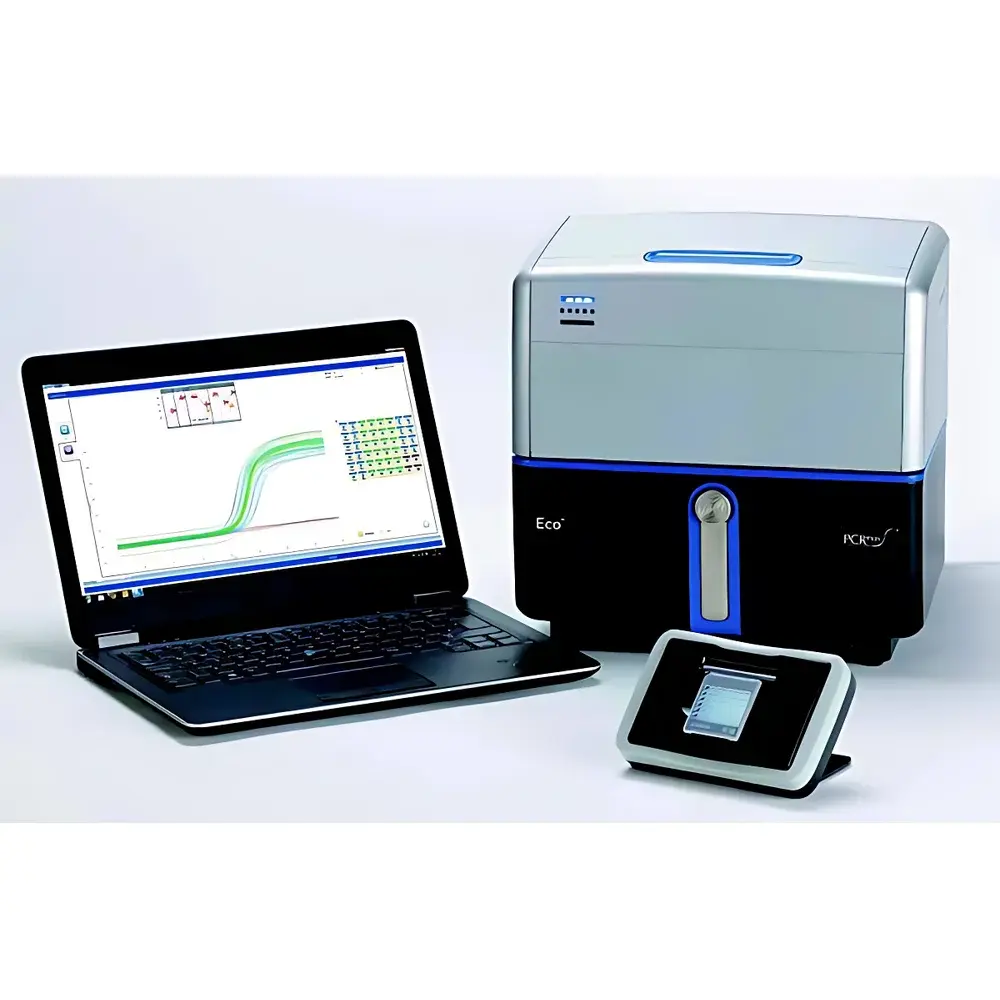
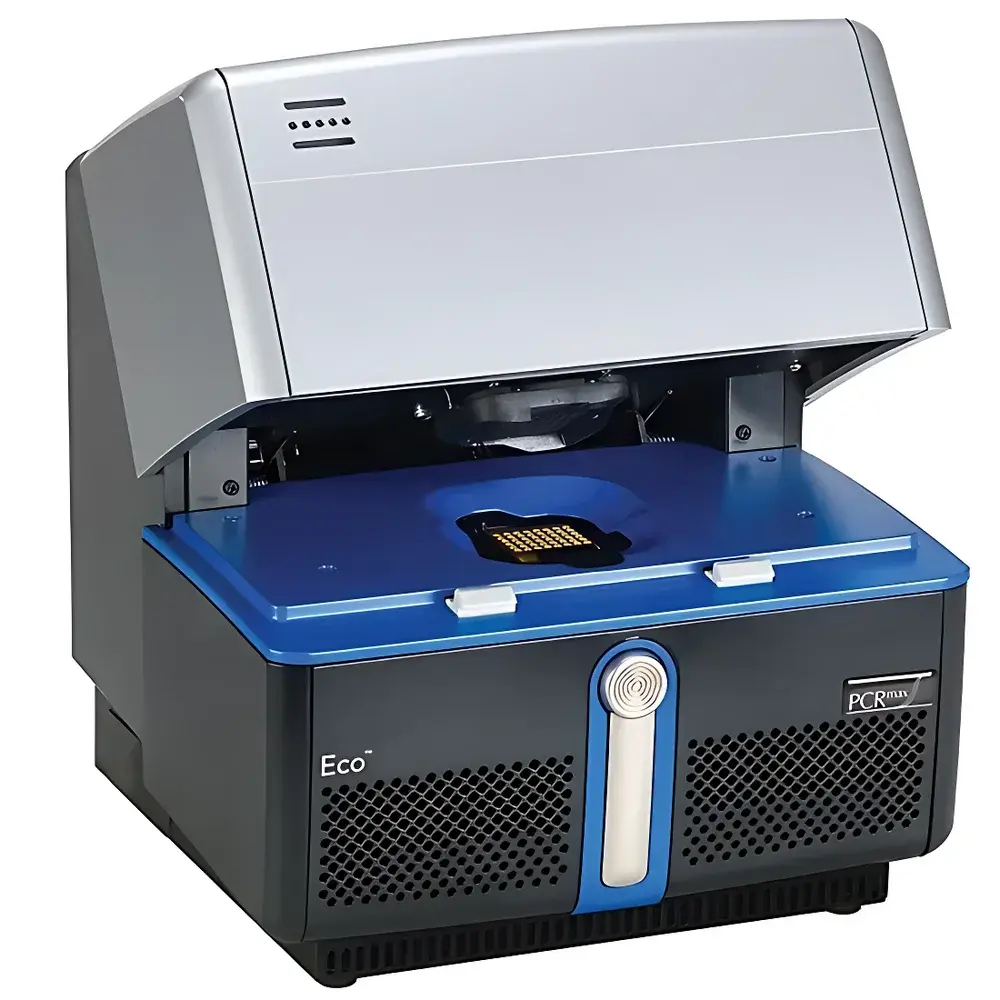
PCRmax Eco 48 Real-Time Fluorescence Quantitative PCR System
| Brand | PCRmax |
|---|---|
| Origin | United Kingdom |
| Model | Eco 48 |
| Instrument Type | Real-Time Quantitative PCR System |
| Sample Throughput | 48-well |
| Heating Rate | 5.5 °C/sec |
| Inter-Well Temperature Uniformity | ±0.1 °C (measured at 95 °C, without pre-equilibration) |
Overview
The PCRmax Eco 48 Real-Time Fluorescence Quantitative PCR System is a compact, high-precision thermal cycler engineered for robust nucleic acid quantification using SYBR Green and probe-based chemistries. It operates on the principle of real-time fluorescence detection during exponential amplification—capturing fluorescent signal intensity cycle-by-cycle to determine quantitative thresholds (Cq), melting curve profiles, and allelic discrimination endpoints. Unlike conventional 96-well platforms, the Eco 48 utilizes a proprietary 48-well polypropylene plate format derived from a quartered 384-well geometry—reducing reaction volume by up to 75% while maintaining analytical sensitivity equivalent to standard 96-well assays. This architecture minimizes thermal mass and enhances heat transfer efficiency, directly contributing to its industry-leading inter-well temperature uniformity of ±0.1 °C at 95 °C—critical for reproducible Cq values, accurate HRM analysis, and low-copy-number detection down to single-template molecules.
Key Features
- Thermal block design: Hollow silver-plated aluminum block with internal liquid thermal coupling medium ensures rapid, uniform heat distribution across all 48 wells.
- Optical system: Dual 48-position LED excitation arrays (452–486 nm and 542–582 nm) coupled with a cooled CCD detector and four fixed-bandpass emission filters (505–545 nm, 562–596 nm, 604–644 nm, 665–705 nm) enable simultaneous four-color detection without spectral overlap or manual filter switching.
- Pre-calibrated dye support: Factory-aligned for SYBR Green, FAM, HEX, VIC, ROX, and Cy5; no user calibration required for routine use.
- High-speed cycling: Achieves 40-cycle amplification in under 40 minutes (standard mode) or under 20 minutes (fast mode), enabled by a maximum ramp rate of 5.5 °C/sec and optimized thermal inertia management.
- Dynamic range: >9 log-linear decades (1–109 copies), validated per MIQE guidelines for absolute and relative quantification workflows.
- Passive reference dye compatibility: ROX supported as a built-in normalization channel; alternative passive dyes may be configured within software-defined spectral windows.
- Plug-and-play installation: No external calibration tools or service engineer intervention required; operational readiness achieved within 15 minutes of unboxing.
Sample Compatibility & Compliance
The Eco 48 accepts standardized 48-well qPCR plates and optically clear sealing films—compatible with all major commercial master mixes, including hot-start Taq polymerases, reverse transcription reagents, and digital PCR-compatible chemistries. Its thermal performance meets ISO/IEC 17025-relevant criteria for inter-well uniformity and ramp accuracy, supporting GLP/GMP-compliant workflows when paired with audit-trail-enabled software configurations. The system adheres to MIQE (Minimum Information for Publication of Quantitative Real-Time PCR Experiments) reporting standards, with embedded metadata capture for reaction volume (5–20 µL), dye assignment, and melt curve acquisition parameters. While not FDA 21 CFR Part 11-certified out-of-the-box, the EcoControl and EcoStudy software suite supports configurable user access levels, electronic signature logging, and exportable raw data files (.ecf, .csv) suitable for regulatory submission packages.
Software & Data Management
EcoControl (instrument control) and EcoStudy (analysis) are integrated into a single Windows-based application suite shipped with every unit. The interface follows a linear workflow: plate setup → protocol definition → run initiation → real-time monitoring → post-run analysis. All raw fluorescence data—including full-spectrum acquisition across all four channels per cycle—are stored in vendor-neutral binary format and can be re-analyzed with modified baselines, threshold settings, or melt curve smoothing algorithms without re-running experiments. HRM analysis employs derivative peak calling with adjustable noise filtering and cluster-based genotype classification. Multi-user configuration allows role-based permissions (e.g., operator vs. administrator), and data exports comply with LIMS interoperability standards via CSV, Excel, and PDF report generation. No cloud dependency: all processing occurs locally, ensuring data sovereignty and compliance with institutional IT policies.
Applications
- Absolute quantification of viral load, gene expression, and microbiome targets using standard curves or digital PCR cross-validation.
- Relative quantification (ΔΔCq) across tissue types, time-course studies, or drug treatment cohorts.
- High-resolution melting (HRM) for SNP genotyping (Class IV discrimination), methylation screening, and amplicon species identification—achieving >99.9% concordance in blinded validation studies.
- Allele-specific amplification and probe-based pathogen detection (e.g., SARS-CoV-2 N/E genes, HPV genotyping).
- Low-input applications: forensic samples, circulating tumor DNA (ctDNA), single-cell lysates, and FFPE-derived RNA where template conservation is critical.
- Platform lab deployment: compact footprint (34.5 × 31 × 32 cm, closed) enables integration into shared core facilities without dedicated HVAC or vibration isolation.
FAQ
Does the Eco 48 require optical calibration before first use?
No. All excitation/emission pathways are factory-aligned for SYBR Green, FAM, HEX, ROX, and Cy5. Additional dyes within the instrument’s spectral bands do not require recalibration.
Can I perform multiplex assays with four targets in one well?
Yes—the four-channel optical system supports simultaneous detection of up to four spectrally resolvable dyes per well, provided appropriate probe design and emission separation are implemented.
Is HRM functionality included in the base software license?
Yes. High-resolution melting analysis is a standard feature in EcoStudy, with no add-on modules or subscription fees required.
What is the minimum recommended sample volume?
5 µL is the validated lower limit for reliable quantification and melt curve resolution; volumes below this may compromise thermal equilibration and signal-to-noise ratio.
Does the system support remote monitoring or networked operation?
Local network connectivity (Ethernet) is supported for file transfer and remote desktop-assisted troubleshooting, but real-time web-based monitoring is not implemented in the current firmware version.
Related Products





