
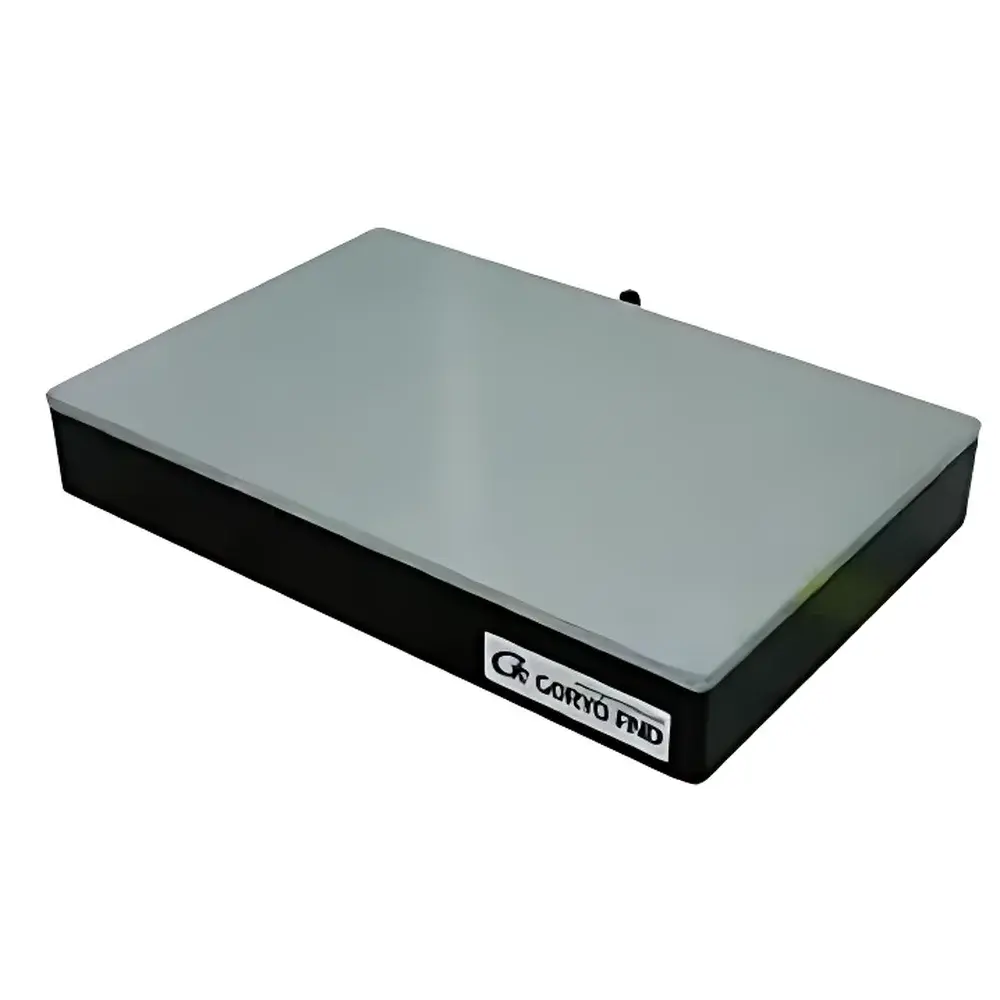
PDTM Series Desktop Optical Vibration Isolation Platform
| Origin | South Korea |
|---|---|
| Manufacturer Type | Authorized Distributor |
| Origin Category | Imported |
| Model | PDTM Series Desktop Vibration Isolation Platform |
| Pricing | Available Upon Request |
Overview
The PDTM Series Desktop Optical Vibration Isolation Platform is an engineered passive pneumatic isolation system designed for high-sensitivity optical and metrological applications in laboratory and cleanroom environments. Based on the principle of low-frequency pneumatic spring isolation—utilizing compressed air to create a compliant suspension between the platform surface and base—it achieves effective attenuation of floor-borne vibrations above 1–2 Hz. The system integrates self-leveling via integrated pressure-regulated air chambers, enabling rapid stabilization (<30 seconds) after placement on a stable horizontal surface. Unlike active isolation platforms requiring external power and complex feedback control, the PDTM series relies solely on mechanical compliance and gas dynamics, ensuring long-term operational stability, zero electromagnetic interference, and compatibility with ESD-sensitive instrumentation. Its compact footprint and tabletop form factor make it ideal for space-constrained optical workstations where integration with microscopes, interferometers, profilometers, or precision weighing systems is required without structural floor modifications.
Key Features
- Self-leveling pneumatic isolation: Automatic leveling achieved through differential air pressure regulation across four independent support legs, eliminating manual shimming.
- Cleanroom-compatible design: Constructed with non-outgassing stainless steel components and sealed elastomeric seals; suitable for ISO Class 5–7 environments.
- Low natural frequency performance: Tuned resonance frequency typically <2.5 Hz (vertical) and 90% vibration transmissibility reduction at frequencies >5 Hz.
- High static load capacity: Supports up to 50 kg (model-dependent) with minimal static deflection (<0.5 mm), maintaining dimensional stability under sustained loading.
- Modular air interface: Equipped with standard 6 mm push-to-connect fittings compatible with common lab-grade oil-free air compressors or centralized clean air supply lines (recommended pressure: 0.4–0.6 MPa).
- Vibration-damped top plate: 20 mm thick black anodized aluminum honeycomb core with M6 threaded mounting holes (25 mm grid spacing) for secure, repeatable optical component positioning.
Sample Compatibility & Compliance
The PDTM platform is validated for use with instruments requiring sub-micron positional stability, including inverted and confocal optical microscopes, laser scanning vibrometers, digital holographic interferometers, PCB automated optical inspection (AOI) systems, analytical balances (0.1 mg resolution), and white-light interferometric surface profilers. It conforms to mechanical interface requirements outlined in ISO 10816-1 (vibration severity evaluation) and supports GLP-compliant experimental setups where environmental perturbation must be documented and controlled. While not certified to ISO 14644 cleanroom construction standards itself, its material selection and assembly process meet ASTM F2459 (standard guide for evaluating cleanroom-compatible materials) criteria. No electrical certification (e.g., UL, CE) applies, as the system contains no powered components.
Software & Data Management
As a purely mechanical isolation device, the PDTM Series requires no embedded firmware, driver installation, or software interface. System status is monitored visually via integrated pressure gauges and leveling indicators. For traceability in regulated environments (e.g., ISO/IEC 17025-accredited labs), users may log air supply pressure, ambient temperature, and platform load during instrument qualification protocols. The absence of digital electronics ensures full compliance with FDA 21 CFR Part 11 requirements for audit trails—no electronic records are generated, eliminating validation overhead associated with software-based platforms. Maintenance records (e.g., filter replacement, leak checks) are retained manually per institutional SOPs.
Applications
- Stabilization of high-magnification optical microscopes used in semiconductor wafer defect analysis and biological live-cell imaging.
- Vibration mitigation for laser-based metrology systems including heterodyne interferometers and femtosecond frequency comb referenced length measurements.
- Isolation of precision mass measurement systems (e.g., microbalances in nanomaterial gravimetric analysis) where acoustic and footfall-induced noise compromises repeatability.
- Support platform for optical coherence tomography (OCT) and Raman spectroscopy benchtop systems requiring stationary sample illumination geometry.
- Integration into modular optical tables where localized isolation is needed for specific subsystems without replacing the entire table structure.
FAQ
What compressed air specifications are required?
A clean, dry, oil-free air supply at 0.4–0.6 MPa (60–90 psi) with particulate filtration ≤5 µm is recommended. A desiccant dryer and coalescing filter are advised for humid environments.
Can the platform be used on uneven floors?
No. The unit must be placed on a rigid, level surface (flatness tolerance ±0.1 mm over 1 m). Self-leveling compensates only for minor tilt—not structural slope.
Is vacuum operation possible?
No. The system operates exclusively on positive-pressure pneumatic suspension and is not rated for vacuum or negative-pressure conditions.
How often does maintenance require air filter replacement?
Under typical lab conditions, inlet filters should be inspected quarterly and replaced annually—or more frequently if supply air quality is unverified.
Does the platform attenuate acoustic noise?
No. Acoustic waves in air are not mechanically coupled to the platform’s isolation mechanism; separate acoustic enclosures are required for sound-sensitive measurements.





