
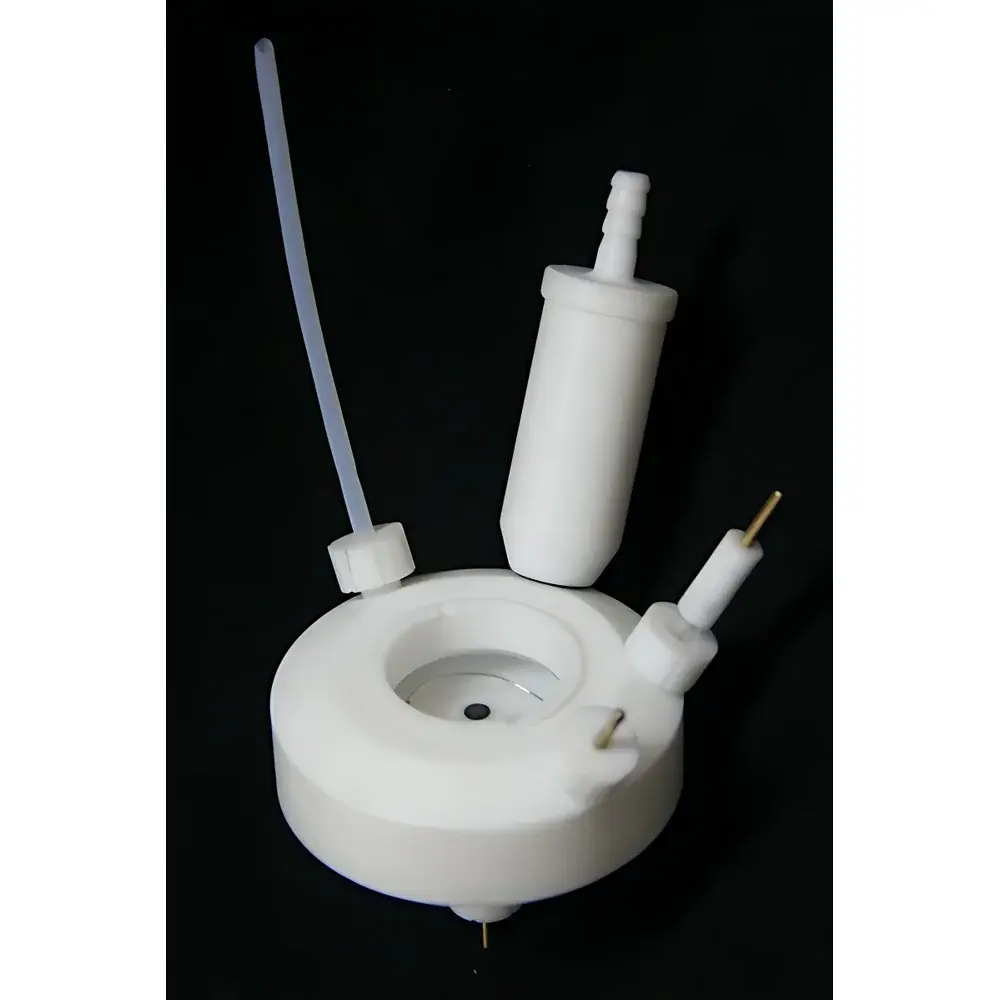
PECK06 In-situ Raman Spectroelectrochemical Cell (Sealed Type)
| Brand | Cinch Instruments |
|---|---|
| Origin | Beijing, China |
| Manufacturer Type | Direct Manufacturer |
| Origin Category | Domestic |
| Model | PECK06 |
| Component Category | Optical Component |
| Cell Volume | <5 mL |
| Electrode Configuration | Pt wire counter electrode, Ag/AgCl reference electrode, Pt disk working electrode |
| Construction Material | Machined PTFE body with fused silica optical window |
| Optical Window | UV-grade fused silica (transmission range: 180–2500 nm) |
| Working Electrode-to-Window Distance | Adjustable (range: 0.5–5.0 mm) |
| Gas Inlet/Outlet Ports | Dual stainless steel Swagelok® fittings (1/4"-28 UNF) |
| Sealing | O-ring sealed, vacuum-tight to 1 × 10⁻³ mbar |
Overview
The PECK06 In-situ Raman Spectroelectrochemical Cell (Sealed Type) is a precision-engineered optical-electrochemical interface designed for real-time, molecular-level monitoring of electrochemical processes via Raman spectroscopy. Built upon the fundamental principle of inelastic light scattering—where incident monochromatic laser photons interact with vibrational modes of adsorbed or solution-phase species—the PECK06 enables direct correlation between applied potential and spectral evolution of reaction intermediates, surface-bound species, and electrolyte decomposition products. Its sealed architecture ensures strict control over the electrochemical environment, eliminating atmospheric interference (e.g., O₂ quenching, CO₂ absorption, moisture condensation) that compromises spectral fidelity—particularly critical for low-intensity Raman signals from transient surface species such as metal oxides, adsorbed CO, or proton-coupled electron transfer intermediates. The cell integrates seamlessly into standard Raman microspectrometers equipped with XYZ motorized stages and confocal optics, supporting both backscattering and side-scattering configurations.
Key Features
- Machined PTFE (polytetrafluoroethylene) cell body offering exceptional chemical inertness against strong acids, bases, halogens, and organic solvents—compatible with electrolytes including 0.1 M H₂SO₄, 1 M KOH, LiPF₆ in EC/DMC, and [BMIM][PF₆] ionic liquids.
- UV-grade fused silica optical window (10 mm diameter, 2 mm thickness) with certified transmission >90% from 180 nm to 2500 nm—enabling resonance Raman studies using UV (244 nm, 325 nm) and visible (532 nm, 633 nm) excitation lasers.
- Precisely adjustable working electrode-to-window distance (0.5–5.0 mm), calibrated via micrometer-driven translation stage, ensuring optimal signal-to-noise ratio while minimizing fluorescence background and laser-induced heating artifacts.
- Dual gas-tight Swagelok® ports (1/4″-28 UNF) allow controlled purging (N₂, Ar, H₂, O₂) or dynamic gas flow during operando measurements—essential for studying fuel cell catalysts, CO₂ reduction, or oxygen evolution reactions.
- Vacuum-compatible O-ring sealing (Viton® or Kalrez® options available) achieves leak rates <1 × 10⁻³ mbar, validated by helium mass spectrometry—meeting requirements for ultra-high-purity electrochemical environments per ASTM D3924 and ISO 8502-9.
Sample Compatibility & Compliance
The PECK06 accommodates standard three-electrode electrochemical configurations without modification: a 3 mm Pt disk working electrode (polished to <0.05 µm Ra), a coiled Pt wire counter electrode (10 cm length, 0.5 mm diameter), and a miniature Ag/AgCl (3 M KCl) reference electrode with ceramic frit junction (liquid junction potential < ±5 mV). It supports liquid electrolytes (aqueous and non-aqueous), thin-film polymer electrolytes (e.g., Nafion® membranes), and solid-state interfacial systems when used with pressure-assisted sealing. The cell complies with ISO/IEC 17025:2017 requirements for measurement traceability in electroanalytical laboratories and is routinely employed in GLP-compliant battery interface characterization workflows aligned with USP Analytical Instrument Qualification.
Software & Data Management
While the PECK06 is a passive optical-electrochemical interface, it is fully compatible with industry-standard potentiostats (e.g., BioLogic SP-300, Metrohm Autolab PGSTAT302N) and Raman acquisition platforms (e.g., Horiba LabRAM XploRA, Renishaw inVia). Synchronized data acquisition is achieved via TTL triggering and analog voltage output interfaces. All experimental metadata—including timestamped potential sweeps, current transients, laser power logs, and spectral accumulation parameters—are stored in HDF5 format using open-source frameworks such as PyMca or commercial packages like WiRE 6.0, ensuring FAIR (Findable, Accessible, Interoperable, Reusable) data principles. Audit trails for instrument calibration and environmental conditions (temperature, gas composition) are maintained per FDA 21 CFR Part 11 requirements when deployed in regulated QC/QA settings.
Applications
- In-situ identification of surface oxides on Ni-, Co-, and Mn-based cathode materials during lithium-ion battery charge/discharge cycling.
- Monitoring adsorption/desorption kinetics of CO, NO, and CN⁻ on single-crystal Pt(hkl) electrodes under controlled potential steps.
- Probing protonation states of nitrogen-containing carbon catalysts in acidic PEM electrolyzers via pH-dependent band shifts (e.g., C=N stretch at 1640 cm⁻¹).
- Tracking structural evolution of conductive polymers (e.g., polyaniline, PEDOT:PSS) during redox switching across multiple cycles.
- Quantifying local pH gradients near electrode surfaces using ratiometric Raman dyes (e.g., fluorescein isothiocyanate derivatives) immobilized on ITO-coated windows.
FAQ
Can the PECK06 be used with 244 nm UV laser excitation?
Yes—the UV-grade fused silica window provides high transmission and minimal autofluorescence at 244 nm, enabling resonance Raman studies of aromatic intermediates and metal-ligand charge-transfer bands.
Is temperature control integrated into the cell design?
No—temperature regulation requires external integration via a Peltier stage or circulating coolant jacket; the PTFE body supports thermal coupling up to 80 °C continuously.
What is the maximum recommended scan rate for synchronized electrochemical-Raman experiments?
For stable spectral acquisition with ≥100 ms integration time per spectrum, linear sweep rates should not exceed 10 mV/s to maintain temporal alignment between potential steps and Raman frame capture.
Are custom electrode geometries supported?
Yes—working electrodes with diameters from 0.5 mm to 5 mm and alternative materials (Au, GC, Ni foam) can be mounted using the standardized 3-axis kinematic holder with reproducible positioning repeatability of ±2 µm.
Does the cell meet CE or RoHS compliance?
As a component-level laboratory device without embedded electronics or power supply, the PECK06 falls outside CE marking scope; however, all materials (PTFE, fused silica, 316 stainless steel) conform to RoHS Directive 2011/65/EU Annex II substance restrictions.






