
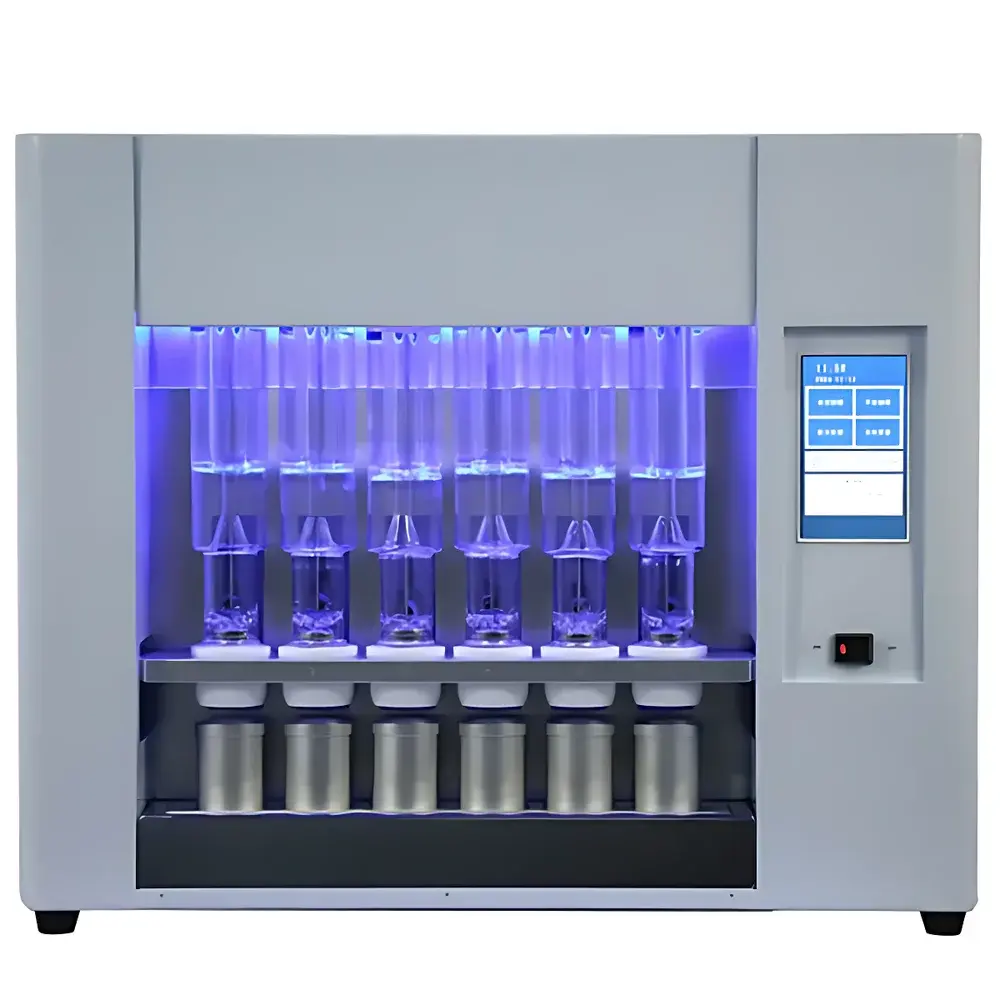
Peiou PQZF-1000 Fully Automated Fat Extractor
| Brand | Peiou |
|---|---|
| Origin | Shanghai, China |
| Manufacturer Type | Authorized Distributor |
| Country of Origin | China |
| Model | PQZF-1000 |
| Pricing | Available Upon Request |
| Extraction Principle | Soxhlet Extraction (Gravimetric) |
| Compliance | GB 5009.6–2016, GB/T 6433–2006, SN/T 0800.2–1999 |
| Display | 4.7-inch Full-Color TFT Touchscreen |
| Extraction Modes | Soxhlet, Hot Extraction, Soxhlet-Hot Hybrid, Continuous Flow, Spot Flow, Standard Hot Extraction |
| Sample Capacity | 6 samples per run |
| Sample Mass Range | 0.5–15 g |
| Solvent Cup Volume | 150 mL |
| Temperature Control Range | RT+5 °C to 300 °C |
| Temperature Accuracy | ±1 °C |
| Solvent Recovery Rate | ≥85% |
| Heating Power | 2000 W |
| Power Supply | 220 V ±10%, 50 Hz |
| Safety Features | Petroleum Ether Leak Detection & Auto-Shutdown |
| Cooling System | Smart Temperature-Controlled Inlet/Outlet Water Flow |
| Heating Method | Integrated Metal Bath with Programmable Ramp Heating |
Overview
The Peiou PQZF-1000 Fully Automated Fat Extractor is a gravimetric analytical instrument engineered for precise, reproducible determination of total fat content in food, feed, and agricultural commodities. It operates on the classical Soxhlet extraction principle—where solid samples are continuously extracted with organic solvents (e.g., petroleum ether or diethyl ether) under reflux conditions—followed by solvent evaporation and residue gravimetry. Designed to meet stringent regulatory requirements, the PQZF-1000 fully complies with major international and national standards including GB 5009.6–2016 (National Food Safety Standard for Fat Determination in Foods), GB/T 6433–2006 (Crude Fat Determination in Feeds), and SN/T 0800.2–1999 (Import/Export Grain and Feed Testing). Its fully automated architecture eliminates manual intervention during critical phases—such as filter cup positioning, solvent valve actuation, heating ramp initiation, reflux timing, and condensate management—thereby minimizing operator variability and enhancing inter-laboratory reproducibility.
Key Features
- Integrated 4.7-inch full-color TFT touchscreen interface with intuitive icon-driven navigation, enabling rapid method selection and real-time monitoring of temperature, time, and status indicators.
- Six pre-programmed extraction protocols: classic Soxhlet, hot extraction, Soxhlet-hot hybrid, continuous flow, spot-flow (pulse-mode), and standardized hot extraction—each configurable via user-defined parameters.
- Motorized lift-and-clamp mechanism ensures consistent filter cup compression and solvent seal integrity across all six positions, reducing risk of vapor leakage and cross-contamination.
- One-touch workflow execution: initiates sequence-controlled steps—cup sealing, solvent heating, soaking, extraction, reflux termination, and cooling—without manual valve manipulation or cup repositioning.
- Multi-mode solvent valve control: electromagnetic valves support timed, point-actuated, or manual opening/closing, optimizing solvent contact time and mass transfer efficiency for heterogeneous matrices.
- Automated filter cup rack elevation ensures uniform immersion depth of all samples into the boiling solvent phase, improving extraction homogeneity and result consistency.
- Monolithic metal bath heating system provides uniform thermal distribution, low thermal inertia, and enhanced durability versus traditional water or oil baths.
- Programmable solvent heating profile: supports ramp-and-soak, fixed-temperature hold, elapsed-time, or event-triggered temperature transitions—critical for thermally labile samples or method validation studies.
- Intelligent cooling water management: inlet/outlet temperature sensing enables dynamic flow modulation, reducing water consumption by up to 40% compared to fixed-flow systems.
- Integrated petroleum ether leak detection sensor with immediate thermal cutoff and audible/visual alarm—meeting IEC 61000-6-4 EMI immunity and functional safety expectations for Class II laboratory environments.
Sample Compatibility & Compliance
The PQZF-1000 accommodates a broad range of solid and semi-solid matrices, including cereal grains, milled flour, dairy powders, meat products, pet food, oilseeds, and botanical materials. Each 150 mL solvent cup supports sample masses from 0.5 g to 15 g, permitting both high-sensitivity analysis of low-fat foods (detection limit ~0.1% w/w) and robust quantification of lipid-rich materials (up to 100% w/w). All operational parameters—including temperature setpoints, soak durations, reflux cycles, and solvent recovery thresholds—are fully traceable and modifiable within audit-compliant log files. The system’s design aligns with GLP documentation practices and supports integration into LIMS environments via RS-232 or optional USB data export. While not FDA 21 CFR Part 11–certified out-of-the-box, its electronic record structure (timestamped method logs, parameter history, and error flags) facilitates internal validation for regulated QC/QA laboratories.
Software & Data Management
The embedded firmware stores up to 100 user-defined methods with full parameter recall (temperature ramps, valve sequences, timing logic). Each extraction run generates a timestamped report containing start/stop times, peak temperature, solvent volume consumed, estimated recovery rate, and final dry residue mass. Data export is supported via USB flash drive in CSV format—compatible with Excel, JMP, and statistical process control (SPC) platforms. No proprietary software installation is required; reports are human-readable and machine-parseable. Audit trails include operator ID (optional PIN entry), method version, and anomaly flags (e.g., “leak detected at T=122°C”). Firmware updates are delivered via secure USB media with SHA-256 checksum verification.
Applications
- Quality control laboratories in food manufacturing: routine fat specification verification per Codex Alimentarius or customer contractual limits.
- Feed formulation R&D: crude fat profiling across raw material batches to optimize energy density calculations.
- Academic research: comparative lipid extraction efficiency studies across solvent types, particle sizes, or pretreatment methods.
- Government testing labs: statutory compliance testing for national food surveillance programs under GB 5009.6–2016.
- Contract testing organizations: high-throughput processing of multi-client samples with method traceability and report standardization.
FAQ
What solvent types are compatible with the PQZF-1000?
Petroleum ether (bp 30–60 °C or 60–90 °C), diethyl ether, and hexane are routinely used. Chlorinated solvents (e.g., chloroform) are not recommended due to corrosion risk and regulatory restrictions.
Is calibration required before first use?
No factory calibration is needed; however, users must verify temperature accuracy using a NIST-traceable thermometer at three points (80 °C, 120 °C, 200 °C) and document results per internal SOP.
Can the instrument be integrated into an existing LIMS?
Yes—via ASCII-formatted CSV export. Custom API integration requires third-party middleware and is subject to local IT security review.
What maintenance intervals are recommended?
Daily: visual inspection of seals and solvent lines. Quarterly: valve function test and bath cleaning. Annually: full thermal calibration and leak sensor verification.
Does the system support unattended overnight operation?
Yes—provided ambient ventilation meets solvent vapor dispersion requirements (minimum 10 air changes/hour) and leak detection remains active throughout the run.





