
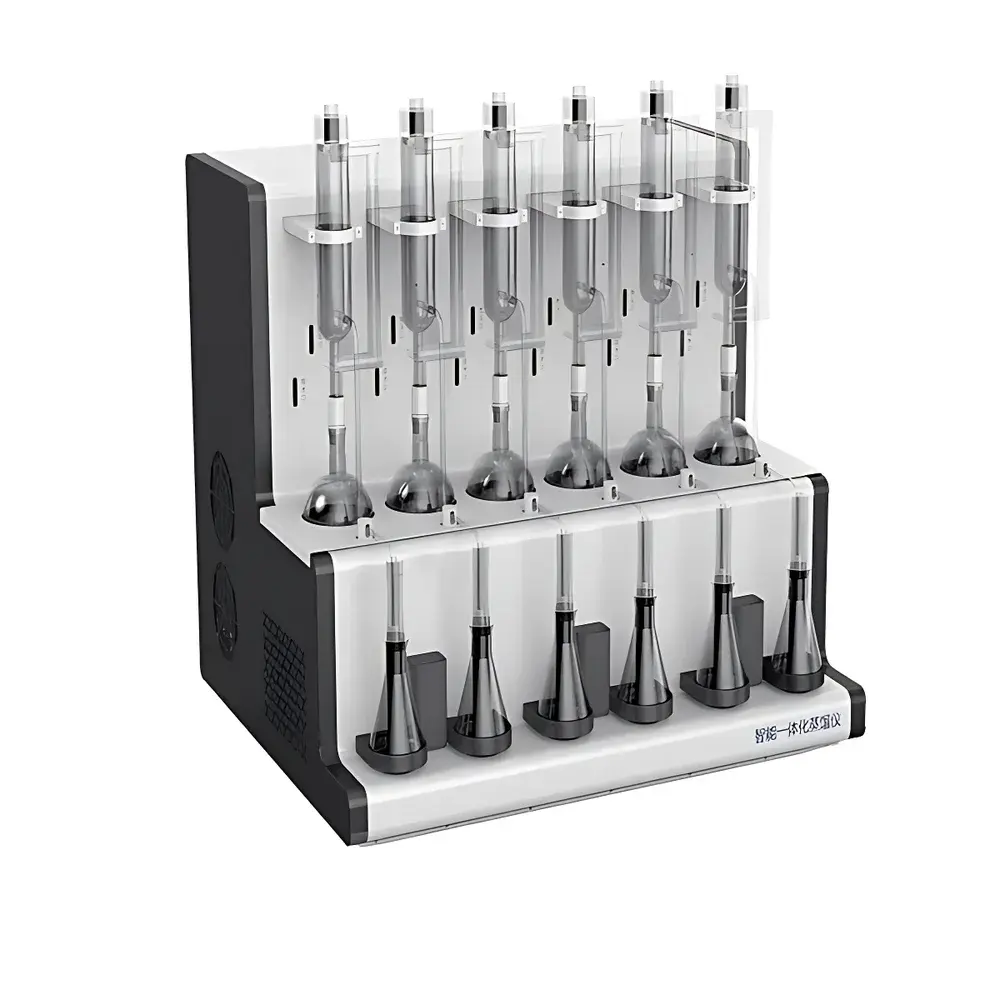
Peiou PQZL-1000W Smart Integrated Distillation System with External Refrigerated Circulator
| Brand | Peiou |
|---|---|
| Origin | Shanghai, China |
| Model | PQZL-1000W |
| Heating Method | Far-infrared Ceramic Radiant Heating |
| Temperature Range | Ambient to 300°C |
| Heating Channels | 6 Independent |
| Control Interface | 7-inch HD Touchscreen LCD |
| Control Core | Microcontroller-based Embedded System |
| Distillation Modes | Gravimetric (1–600 g, ±2 g accuracy) & Timed (1–600 min) |
| Cooling | External Compressor-based Refrigerated Circulator |
| Auto-endpoint Detection | Dual-mode (mass-based + timer-based) |
| Anti-suckback Protection | Integrated Solenoid Valve & Flow Locking Mechanism |
| Auto-cleaning Function | Built-in Peristaltic Cleaning Pump |
| Preloaded Methods | 7 Standard Protocols + User-Defined Method Storage |
| Single-Channel Independence | Yes |
| Warm-up Time | <8 min |
Overview
The Peiou PQZL-1000W Smart Integrated Distillation System is an automated, microcontroller-driven laboratory distillation platform engineered for precision, repeatability, and unattended operation in environmental, food, pharmaceutical, and regulatory testing laboratories. It implements a dual-mode endpoint detection architecture—combining high-resolution gravimetric measurement (±2 g accuracy) with programmable timed distillation—to ensure strict adherence to standardized procedures such as EPA Method 1620, ISO 5667-16, and AOAC 973.42 for volatile compound recovery. Unlike conventional steam distillation apparatuses, the PQZL-1000W integrates far-infrared ceramic radiant heating elements—eliminating open flames, reducing thermal overshoot, and delivering uniform energy distribution across all six independent reaction zones. Its external refrigerated circulator provides closed-loop coolant circulation at stable sub-ambient temperatures, minimizing water consumption and enabling consistent condensation efficiency across extended operational cycles.
Key Features
- Six-channel independent control: Each distillation position features isolated power regulation, temperature setpoint assignment, and endpoint logic—enabling heterogeneous sample processing within a single run.
- Far-infrared ceramic heating modules: Non-contact, corrosion-resistant, and flameless; deliver rapid thermal response (<8 min to 300°C) with minimal thermal inertia and reduced risk of bumping or superheating.
- Dual-mode endpoint detection: Gravimetric mode uses calibrated load cells to terminate distillation upon reaching user-defined mass thresholds (1–600 g); timed mode supports precise duration control (1–600 min), both configurable per channel.
- Integrated anti-suckback protection: A solenoid-actuated flow lock and pressure-balanced check valve engage automatically at endpoint—preventing backflow into distillate receivers without manual intervention.
- One-touch cleaning cycle: An internal peristaltic pump circulates cleaning solution through vapor pathways and condenser tubing; no disassembly required, reducing cross-contamination risk and operator exposure.
- Embedded method library: Seven pre-validated protocols—including Kjeldahl nitrogen distillation, cyanide liberation, phenol extraction, and volatile acidity determination—are stored onboard; users may edit, save, and recall custom methods with full parameter retention.
- Real-time process monitoring: The 7-inch capacitive touchscreen displays live mass accumulation, elapsed time, current temperature, and status flags for each channel—supporting GLP-compliant data visibility during execution.
Sample Compatibility & Compliance
The PQZL-1000W accommodates standard 500 mL round-bottom flasks, 250 mL volumetric receivers, and ASTM D129-compliant digestion vessels. Its inert ceramic heating surface and PTFE-coated condenser pathways resist degradation from acidic, alkaline, or halogenated matrices. The system meets mechanical safety requirements per IEC 61010-1 and electromagnetic compatibility standards (EN 61326-1). While not certified for FDA 21 CFR Part 11 out-of-the-box, its embedded logging engine records timestamped events—including method selection, parameter changes, endpoint triggers, and cleaning cycles—in non-editable binary format, supporting audit-ready documentation under GLP and ISO/IEC 17025 frameworks.
Software & Data Management
Operation is fully managed via an embedded real-time OS with no external PC dependency. All method parameters—including ramp rates, hold times, target masses, cooling setpoints, and alarm thresholds—are stored in non-volatile flash memory. Data export is supported via USB 2.0 port in CSV format, containing channel ID, start/stop timestamps, final mass, deviation from setpoint, and system error codes. Audit trail functionality logs operator login (if enabled via optional password module), method version history, and firmware revision—facilitating traceability in regulated environments.
Applications
- Environmental analysis: Ammonia, cyanide, phenol, and volatile organic compounds (VOCs) recovery from wastewater per EPA 410.4 and ISO 6439.
- Food & beverage QA/QC: Determination of alcohol content (AOAC 920.112), total volatile acidity (AOAC 942.05), and dimethyl sulfide (DMS) in beer and wine.
- Agricultural chemistry: Kjeldahl nitrogen distillation (ISO 5983-2) and crude protein quantification in feedstuffs and soil extracts.
- Pharmaceutical stability testing: Volatile residue profiling in excipients and active pharmaceutical ingredients (APIs) per USP <467>.
- Academic research: Controlled solvent removal, fractional distillation optimization, and method development for novel analyte isolation workflows.
FAQ
Is the PQZL-1000W compatible with third-party cooling circulators?
Yes—the system uses standard 6 mm quick-connect fittings and accepts inlet/outlet coolant temperatures between 0°C and 15°C at flow rates of 1.5–3.0 L/min.
Can distillation methods be exported or backed up externally?
Method configurations can be saved to USB drive in encrypted binary format; restoration requires re-import via the touchscreen interface.
What maintenance is required for the built-in cleaning pump?
The peristaltic pump tubing should be inspected every 200 cycles and replaced annually or after 500 hours of cumulative operation.
Does the system support remote monitoring or network connectivity?
No Ethernet or Wi-Fi interface is included; however, optional RS-485 Modbus RTU output is available for integration into centralized lab automation systems.
How is calibration traceability maintained for the gravimetric sensors?
Load cells are factory-calibrated against NIST-traceable weights; users may perform verification checks using certified test masses (not supplied) via the diagnostic menu.



