
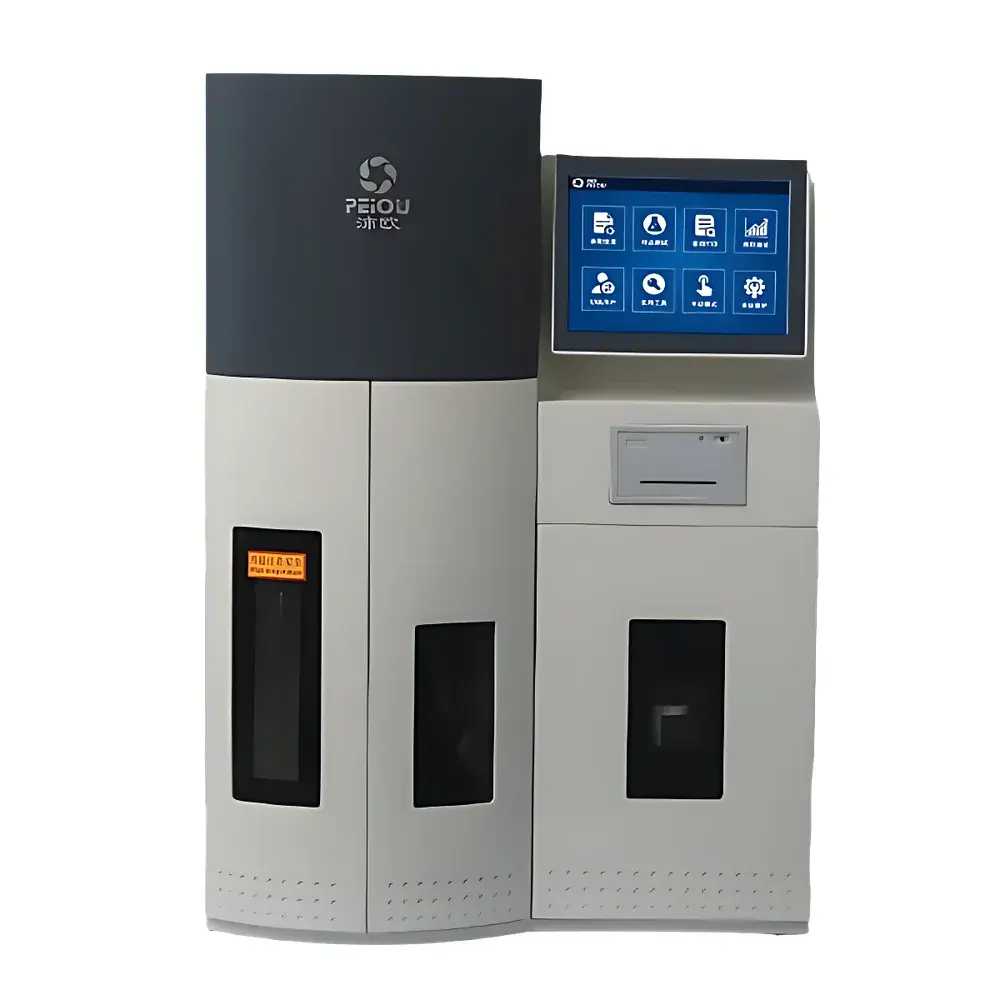
Peiou SKD-1000 Fully Automated Kjeldahl Nitrogen Determinator
| Brand | Peiou |
|---|---|
| Origin | Shanghai, China |
| Model | SKD-1000 |
| Automation Level | Fully Automated |
| Nitrogen Determination Range | 0.1–240 mg N per sample |
| Distillation Time | 3–8 min/sample |
| Repeatability | RSD ≤ 0.5% |
| Sample Weight Capacity | ≤6 g (solid) or ≤20 mL (liquid) |
| Nitrogen Recovery Rate | >99.5% |
| Dimensions (L×W×H) | 500 × 350 × 720 mm |
| Titration Resolution | 0.8 µL/step (auto-adjusted by titrant concentration) |
Overview
The Peiou SKD-1000 Fully Automated Kjeldahl Nitrogen Determinator is an engineered solution for precise, traceable, and compliant total nitrogen and protein quantification in accordance with ISO 8968, AOAC 981.10, ASTM D1142, and USP <467>. Based on classical Kjeldahl digestion–distillation–titration methodology, the SKD-1000 automates the complete analytical workflow — from acid/alkali reagent dosing and controlled steam distillation to colorimetric endpoint detection and result calculation — eliminating manual intervention while maintaining metrological integrity. Its core architecture integrates a microprocessor-controlled distillation unit with real-time thermal monitoring of the digestion cup, dual-level liquid sensing to prevent dry-burn conditions, and a high-resolution syringe pump-driven titration system calibrated to deliver sub-microliter dispensing accuracy. Designed for routine QC/QA laboratories in food, feed, agricultural, environmental, and chemical sectors, the instrument delivers reproducible nitrogen recovery across heterogeneous matrices — including viscous dairy products, high-fat feeds, acidic beverages, and nitrogen-poor soil extracts — without compromising method fidelity.
Key Features
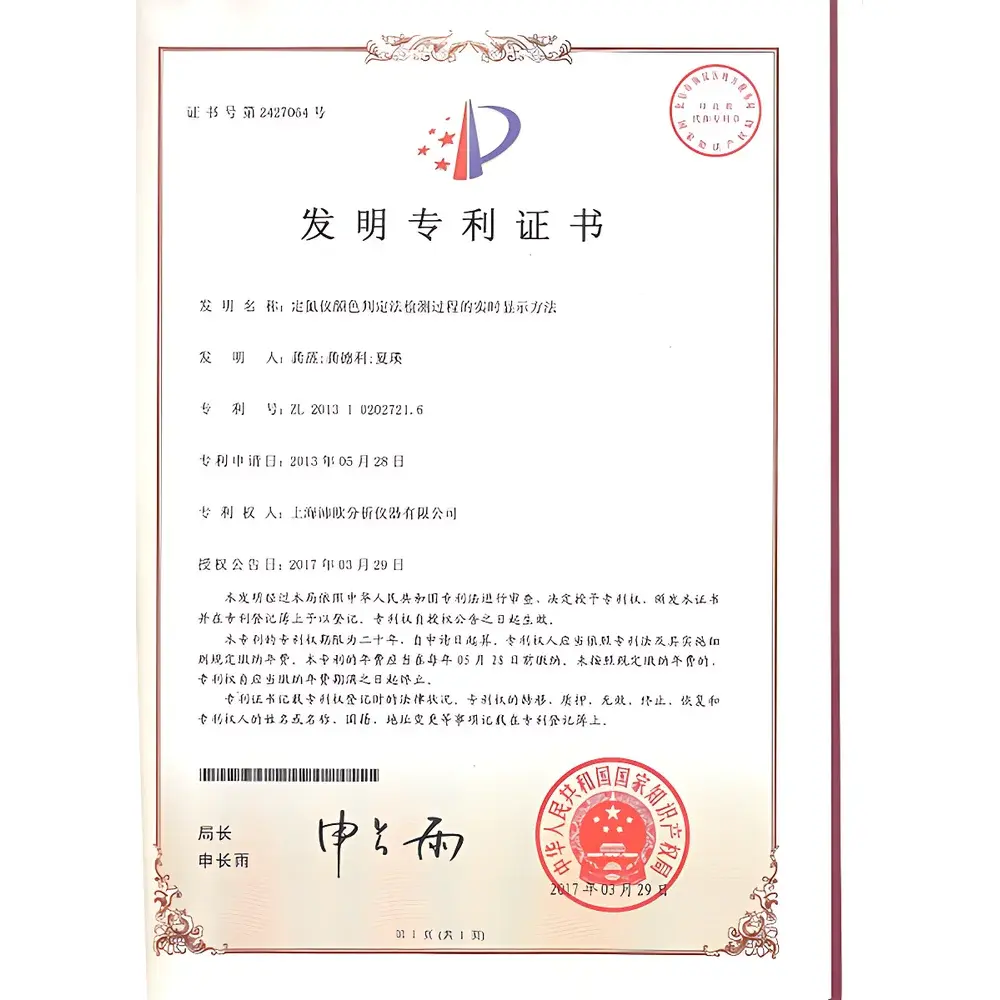
- RGB colorimetric endpoint detection with real-time spectral curve visualization (red/green/blue channels), enabling objective, operator-independent titration termination aligned with ICH Q2(R2) precision requirements.
- Adaptive titration resolution: minimum step volume automatically optimized between 0.8 µL and 2.5 µL based on standardized HCl concentration (0.1–0.4 mol/L), ensuring optimal sensitivity across low- and high-nitrogen samples.
- Dual safety-critical liquid level monitoring in the distillation chamber — primary float sensor + secondary conductive probe — integrated with predictive thermal modeling to preempt dry-burn events before temperature deviation exceeds ±2°C.
- Modulated alkali addition via programmable multi-stage injection (1–10 pulses, 0–15 s inter-pulse delay), suppressing exothermic runaway during neutralization and minimizing ammonia loss under low-steam conditions.
- Continuous steam generation with uninterrupted vapor flow during water replenishment, achieved through dual-reservoir design and pressure-compensated boiler control — critical for quantitative NH₃ transfer in extended distillations (e.g., nitrate-rich samples requiring 1800 s delay).
- Integrated cooling water flow/pressure monitoring with automatic sample hold and alarm-triggered shutdown if flow drops below 1.2 L/min or differential pressure falls below 0.15 bar.
- Corrosion-resistant fluidic path: all wetted components constructed from PTFE-lined peristaltic tubing, ceramic-coated syringe barrels, and ABS engineering polymer chassis (IP54-rated enclosure, 3-year warranty on fluidic assembly).
Sample Compatibility & Compliance
The SKD-1000 accommodates solid samples up to 6 g (e.g., whole grain flour, dried biomass) and liquids up to 20 mL (e.g., milk, fermentation broth, fertilizer solutions) using standard 300–650 mL digestion tubes. Its adaptive power modulation (1500 W, continuously adjustable) ensures efficient volatilization of ammonia from low-concentration matrices (e.g., purified water, pharmaceutical excipients) while preventing bumping in high-salt or high-viscosity samples. The system complies with GLP data integrity requirements: all operations are timestamped, user-authenticated, and stored with full audit trail (including reagent lot numbers, distillation temperature logs, titration curves, and endpoint confirmation flags). Optional RS232/USB interface supports 21 CFR Part 11–compliant electronic signatures when paired with validated LIMS software.
Software & Data Management
The embedded 7-inch capacitive touchscreen runs a deterministic real-time OS with bilingual (English/Chinese) GUI and context-aware soft keys. Method templates store up to 99 protocols with independent settings for digestion time, alkali volume, steam ramp rate, titrant concentration, and delay intervals. All raw data — including RGB intensity traces, cumulative titrant volume vs. time, and thermal profiles — are exported in CSV format. Optional PC software enables remote calibration validation, trend analysis of RSD over 30-day periods, and automated report generation compliant with ISO/IEC 17025 clause 7.8.2. Data encryption (AES-256) and role-based access control (admin/operator/auditor) are available in enterprise firmware versions.
Applications
- Food & Dairy: Crude protein determination in cheese, infant formula, plant-based meat analogs, and cereal blends per AOAC 991.20.
- Animal Feed: Validation of guaranteed analysis claims for soybean meal, fishmeal, and premixes under EU Regulation (EC) No 152/2009.
- Agriculture: Total nitrogen quantification in compost, manure, and soil extracts per ISO 11261.
- Environmental: Kjeldahl nitrogen in wastewater sludge and digester effluent per EPA Method 351.2.
- Pharmaceuticals: Residual ammonium salt assay in active pharmaceutical ingredients (APIs) per USP <467> residual solvents guidance.
FAQ
What regulatory standards does the SKD-1000 support for method validation?
It meets performance criteria defined in AOAC 981.10 (repeatability ≤0.5% RSD), ISO 8968-1:2014 (recovery ≥99.5%), and ASTM D1142-19 (linearity across 0.1–240 mg N range). Full validation documentation packages are provided upon request.
Can the SKD-1000 integrate with laboratory information management systems (LIMS)?
Yes — via ASCII-based serial protocol (RS232) or USB virtual COM port. Pre-built drivers are available for Thermo Fisher SampleManager, LabVantage, and STARLIMS v12+ with configurable field mapping and digital signature handshaking.
Is digestion performed on-board or externally?
Digestion is conducted off-instrument using standard block digesters or microwave systems. The SKD-1000 accepts pre-digested samples in standard 300–650 mL Kjeldahl tubes and initiates distillation upon tube insertion and door closure verification.
How is carryover contamination prevented between runs?
Automated post-titration rinse cycles flush the condenser tip, distillation head, and titration nozzle with deionized water at 85°C for 45 seconds, followed by air purge. A dedicated “deep clean” mode executes triple-rinse sequences for high-fat or high-protein residue removal.
What maintenance is required for long-term operational reliability?
Monthly verification of RGB sensor baseline drift using certified neutral reference filters; quarterly calibration of titrant delivery volume against gravimetric standard; annual replacement of steam trap membrane and condenser gasket kit (PN: SKD-MAINT-KIT-01).




