
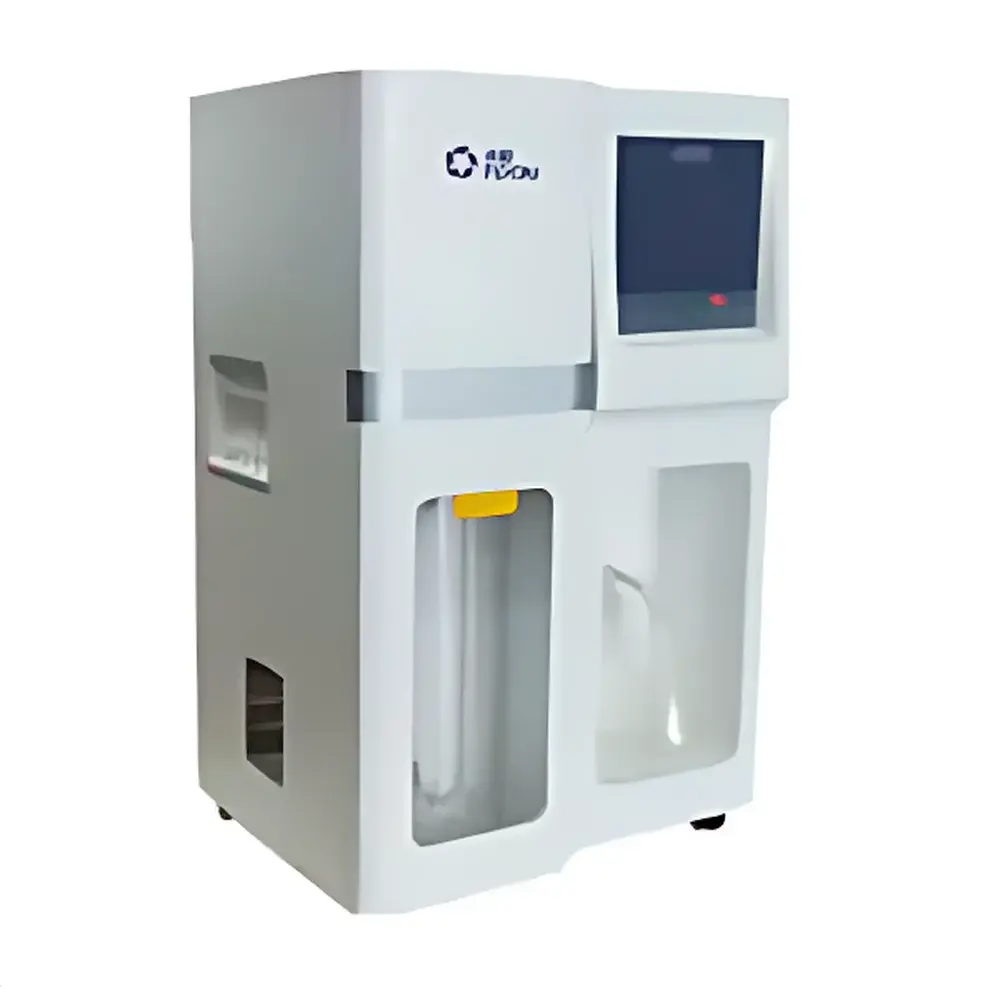
Peiou SKD-200 Automated Kjeldahl Nitrogen Analyzer
| Brand | Peiou |
|---|---|
| Origin | Shanghai, China |
| Model | SKD-200 |
| Measurement Range | 0.1–240 mg N |
| Nitrogen Recovery Rate | >99.5% |
| Repeatability | ≤0.5% CV |
| Sample Capacity | ≤6 g (solid) or ≤16 mL (liquid) |
| Distillation Time | 0–99 min (programmable) |
| Distillation Speed | 3–8 min/sample |
| Alkali/Acid Delivery | Pressure-driven constant-pressure dosing system |
| Cleaning Mode | Automated post-distillation rinse cycle |
| Safety Protection | Dry-run detection with automatic water-level cutoff |
| Operating Modes | Auto & Manual |
| Display | LED digital interface |
| Method Storage | 10 programmable methods (alkali volume, acid volume, distillation time) |
| Compliance | GB/T 10511–1989, GB/T 2441.1–2001, GB 10209.1–2001, GB/T 3595–2000 |
Overview
The Peiou SKD-200 Automated Kjeldahl Nitrogen Analyzer is a benchtop instrument engineered for precise, reproducible quantification of total nitrogen content in organic and inorganic samples via the classical Kjeldahl digestion–distillation–titration methodology. It implements a fully automated distillation sequence following acid digestion (performed separately in a digestion block), enabling accurate determination of nitrogen concentration in accordance with internationally recognized wet chemistry standards. The system operates on the principle of alkaline steam distillation: after digestion, the sample solution is rendered strongly alkaline to convert ammonium ions into volatile ammonia gas, which is then swept by steam into a boric acid trapping solution. Subsequent titration—either manual or interfaced with an automatic titrator—yields nitrogen content based on stoichiometric equivalence. Designed for routine analysis in agricultural, food, feed, environmental, and fertilizer laboratories, the SKD-200 delivers robust performance under high-throughput conditions while maintaining strict adherence to method-defined procedural integrity.
Key Features
- Chemically inert ABS engineering plastic chassis — resistant to concentrated H₂SO₄, NaOH, and H₃BO₃; eliminates corrosion-related housing degradation and ensures long-term structural integrity.
- High-stability fluid handling architecture: alkali and boric acid reagents delivered via pressure-driven constant-pressure dosing (not peristaltic or diaphragm pumps), eliminating pump wear, chemical leakage, and volumetric drift across repeated cycles.
- Programmable distillation parameters: user-definable distillation duration (0–99 minutes), alkali addition volume, and acid reception volume — stored as up to 10 independent method profiles.
- Integrated self-cleaning function: automated post-distillation water flush of condenser, delivery lines, and reaction chamber to prevent cross-contamination and residue buildup.
- Dual-mode operation: seamless switching between fully automated sequence control and manual step-by-step execution for method development or troubleshooting.
- Real-time safety interlocks: dry-run detection triggers immediate cessation of heating and steam generation if coolant or trap solution levels fall below operational thresholds.
- LED-based digital interface with intuitive parameter navigation and status feedback — no touchscreen dependency, optimized for glove-compatible laboratory use.
Sample Compatibility & Compliance
The SKD-200 accommodates solid samples up to 6 g and liquid samples up to 16 mL per run, supporting standard Kjeldahl digestion tubes (e.g., 100–300 mL borosilicate glass digesters). Its design conforms to multiple national standard specifications governing nitrogen analysis in agricultural and industrial materials, including GB/T 10511–1989 (determination of total nitrogen in compound fertilizers), GB/T 2441.1–2001 (nitrogen content in urea), GB 10209.1–2001 (ammonium phosphate), and GB/T 3595–2000 (nitrogen in compound feeds). While not certified to ISO/IEC 17025 or FDA 21 CFR Part 11 out-of-the-box, its deterministic reagent delivery, fixed timing logic, and non-volatile memory storage support GLP-aligned documentation when integrated into validated laboratory workflows. All internal tubing is constructed from fluoropolymer-reinforced silicone rated for continuous exposure to ≥5 mol/L NaOH and ≥4 mol/L H₃BO₃ at elevated temperatures.
Software & Data Management
The SKD-200 operates without embedded firmware-based software or network connectivity. All operational logic resides in hardened microcontroller firmware with EEPROM-persistent method storage. Parameter settings—including alkali volume (mL), boric acid volume (mL), distillation time (min), and rinse duration—are entered directly via membrane keypad and confirmed with LED feedback. No external PC interface is provided; data output is limited to visual display during operation and manual transcription. For laboratories requiring electronic records, the instrument may be paired with third-party titrators featuring RS-232 or USB output (e.g., Metrohm 809, Hanna HI84532), enabling timestamped result capture within LIMS or ELN platforms. Audit trail functionality must be implemented externally, consistent with GMP/GLP requirements for regulated environments.
Applications
The SKD-200 serves as a core analytical tool in quality control and research settings where nitrogen quantification supports nutritional labeling, fertilizer formulation, soil health assessment, and feedstuff evaluation. Typical applications include: protein estimation in cereal grains and legumes (using standard nitrogen-to-protein conversion factors); total Kjeldahl nitrogen (TKN) determination in wastewater sludge and compost; ammoniacal nitrogen verification in nitrogenous fertilizers; and crude protein validation in animal feed formulations. Its 3–8 minute distillation cycle enables throughput of 6–12 samples per hour under continuous operation, making it suitable for mid-volume testing labs with daily sample loads of 20–80 specimens. The instrument does not perform digestion or titration natively but is fully compatible with standard digestion blocks (e.g., SKD-100 series) and autotitrators meeting AOAC or ISO 5983–1 specifications.
FAQ
Does the SKD-200 include digestion or titration capability?
No. The SKD-200 performs only the distillation step of the Kjeldahl method. Sample digestion must be completed separately using a dedicated digestion block, and nitrogen quantification requires subsequent titration—either manually or via an external automatic titrator.
What maintenance intervals are recommended for tubing and seals?
All fluid-handling tubing is rated for ≥3 years of continuous service under standard operating conditions (≤8 hrs/day, ambient lab temperature). No scheduled replacement is required unless physical damage or chemical swelling is observed.
Can the SKD-200 be integrated into a LIMS environment?
Direct integration is not supported. However, when used with a compliant titrator that provides ASCII-formatted serial output, results can be captured and logged via external data acquisition software or middleware.
Is the instrument compliant with ISO 5983 or AOAC 984.13?
It meets the instrumental performance criteria specified in those methods—particularly nitrogen recovery (>99.5%) and repeatability (≤0.5% CV)—but formal method validation must be conducted by the end user in situ, per ISO/IEC 17025 clause 7.2.2.
What safety certifications does the SKD-200 carry?
The unit complies with GB 4793.1–2007 (safety requirements for electrical equipment for measurement, control, and laboratory use) and includes dual thermal cutouts, ground-fault protection, and emergency stop functionality per IEC 61000-6-2/6-3 EMI immunity standards. CE marking is not applicable as the device is manufactured and sold exclusively for the domestic Chinese market.
Related Products



