
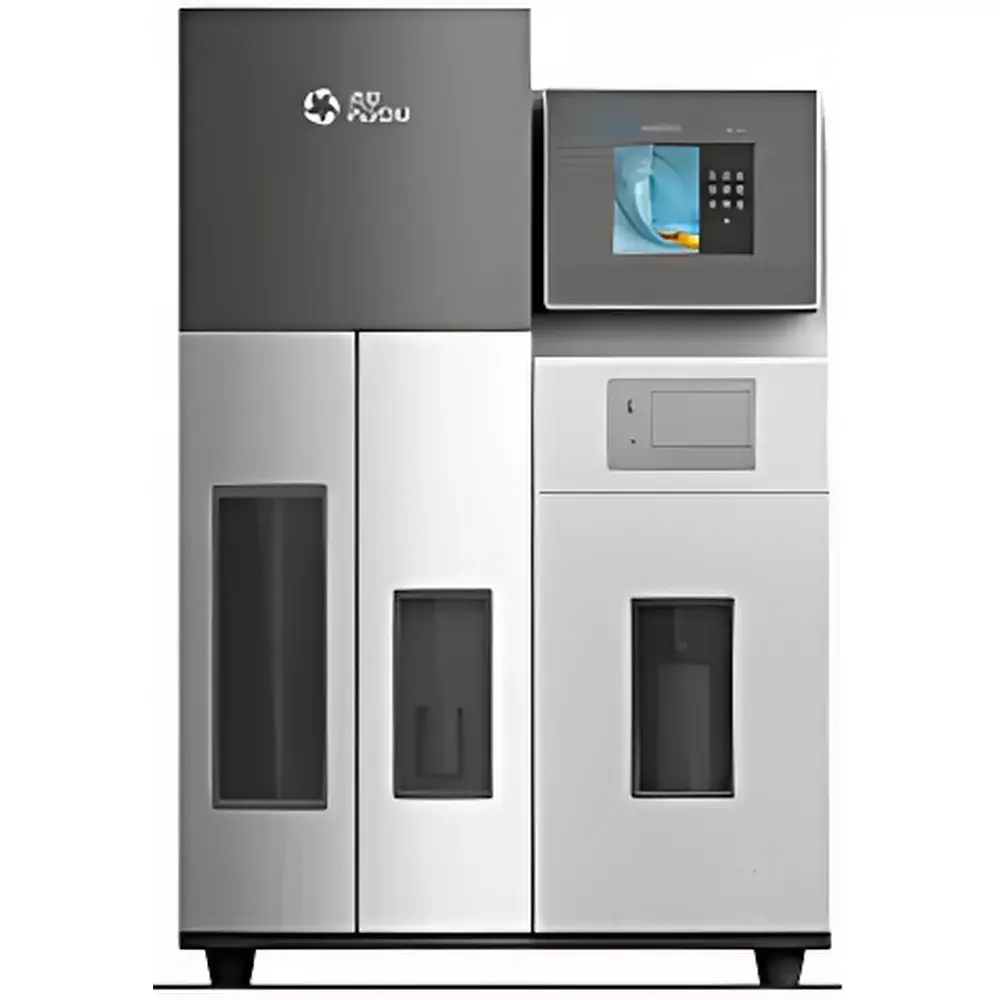
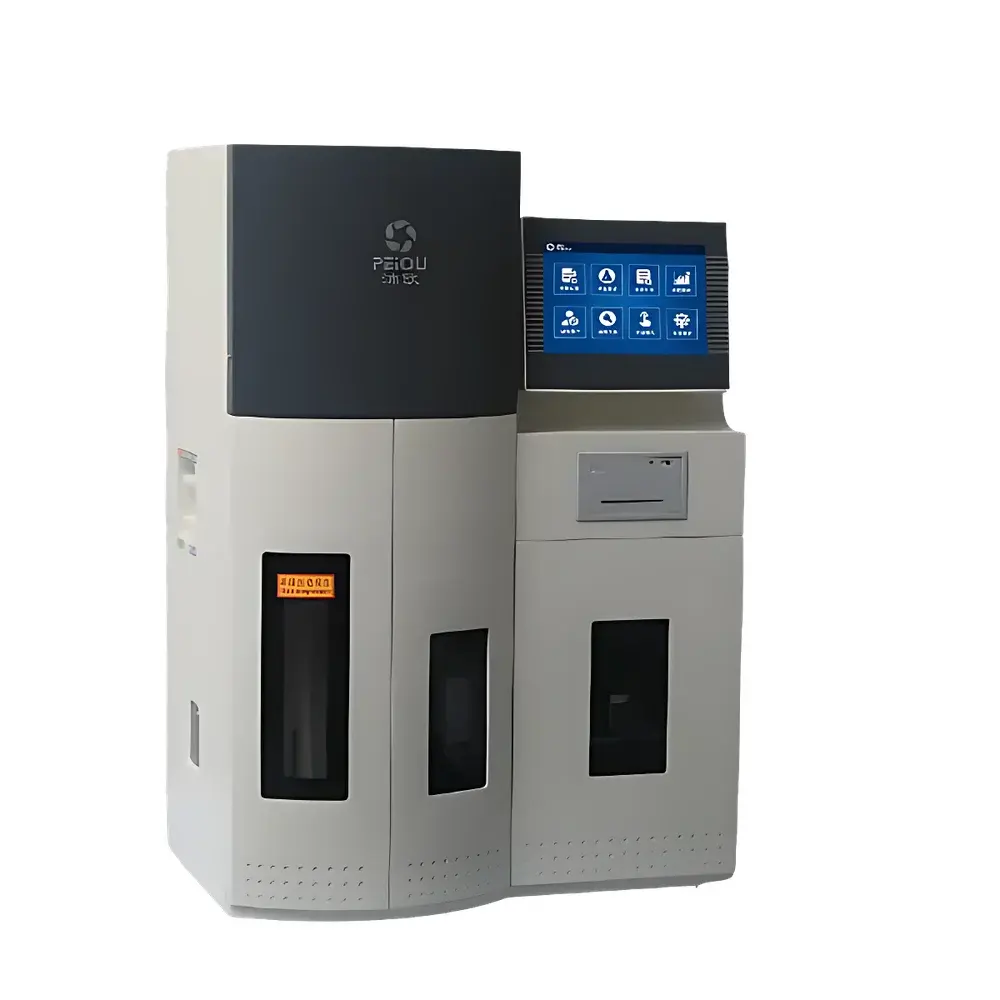
Peiou SKD-2000 Fully Automated Kjeldahl Nitrogen Determinator
| Brand | Peiou |
|---|---|
| Origin | Shanghai, China |
| Model | SKD-2000 |
| Automation Level | Fully Automated |
| Nitrogen Determination Range | 0.1–240 mg N |
| Distillation Time per Sample (incl. titration) | 3–8 min |
| Repeatability | RSD < 0.5% |
| Sample Weight Capacity | ≤6 g (solid), ≤16 mL (liquid) |
| Nitrogen Recovery Rate | >99.5% |
| Power Consumption | 750–1500 W |
| Dimensions (L×W×H) | 500 mm × 350 mm × 720 mm |
Overview
The Peiou SKD-2000 Fully Automated Kjeldahl Nitrogen Determinator is an integrated analytical system engineered for precise, traceable, and high-throughput quantification of total nitrogen—and by extension, protein content—based on the classical Kjeldahl digestion and distillation methodology. It operates through three rigorously controlled phases: acid digestion (typically performed off-instrument using a separate digester), alkaline distillation under controlled steam conditions, and potentiometric or photometric titration of liberated ammonia. The instrument implements ISO 8968-1, AOAC 981.10, and ASTM D1142-compliant protocols, ensuring regulatory alignment for food, feed, pharmaceutical, agricultural, and environmental laboratories operating under GLP or ISO/IEC 17025 frameworks. Its architecture eliminates manual intervention after sample loading: automated reagent dosing (H2SO4, NaOH, boric acid), steam generation with dynamic power modulation, real-time temperature monitoring of the distillation chamber, concurrent distillation-titration, and closed-loop endpoint detection via RGB colorimetric sensor technology.
Key Features
- True concurrent distillation and titration: Ammonia is neutralized immediately upon condensation, minimizing volatilization loss and reducing cycle time to as low as 3 minutes per sample.
- Triple-color (RGB) photometric endpoint detection: Real-time spectral monitoring of the bromocresol green–methyl red indicator system enables robust, interference-resistant endpoint identification—even in turbid or colored digestates.
- Dual-level liquid control in the distillation flask: Redundant float and pressure sensors prevent dry-heating events and ensure uninterrupted steam generation during extended runs.
- Intelligent titration engine: Step resolution down to 0.8 µL per increment, with adaptive volume adjustment based on standardized HCl concentration; driven by a precision ceramic piston pump rated for >100,000 cycles.
- Comprehensive safety interlocks: Real-time monitoring of cooling water flow rate and pressure, digestion vessel door status, reagent reservoir levels, and distillation block temperature—with audible/visual alerts and automatic process suspension on fault detection.
- Modular reagent delivery: All liquids (acid, base, diluent, boric acid) dispensed volumetrically via calibrated peristaltic or syringe pumps (0–150 mL range, 1 mL resolution), eliminating gravimetric variability.
- Steam continuity assurance: Integrated water reservoir with auto-refill logic maintains constant steam output without interruption—even during refill cycles—ensuring quantitative ammonia transfer.
- Externally mounted reaction cell: Isolated from ambient light sources to eliminate photometric drift; constructed from corrosion-resistant PTFE-coated stainless steel and high-grade ABS housing with IP20-rated electrical insulation.
Sample Compatibility & Compliance
The SKD-2000 accommodates heterogeneous matrices without modification: solid samples up to 6 g (e.g., cereal flour, meat powder, soil) and liquid samples up to 16 mL (e.g., milk, fermentation broth, wastewater). Its design conforms to critical regulatory expectations: full audit trail logging (user ID, timestamp, method ID, raw titration curve, reagent lot numbers), electronic signature support compliant with FDA 21 CFR Part 11 (when paired with validated LIMS integration), and traceability of all calibration and maintenance events. It meets the performance criteria outlined in USP <467> for residual solvent analysis where nitrogen-bearing impurities are monitored, and supports AOAC Official Method 992.15 for crude protein in animal feed. Optional RS232/USB/WiFi interfaces enable seamless data export to ELN or ERP systems with configurable metadata tagging.
Software & Data Management
The embedded Linux-based control system features a 7-inch capacitive color touchscreen with intuitive Chinese/English bilingual UI (configurable at boot). All methods—including digestion parameters (if linked to compatible digesters), distillation ramp profiles, titration algorithms, and report templates—are stored locally with SHA-256 hash verification. Each analysis generates a timestamped .CSV and PDF report containing raw absorbance curves, derivative plots, equivalence point coordinates, %N, %protein (using standard conversion factors), RSD per batch, and instrument health diagnostics. Data retention exceeds 100,000 records; optional cloud backup or network share synchronization is supported. Firmware updates are delivered via signed .bin files with cryptographic validation to maintain integrity across GxP environments.
Applications
- Food & Beverage: Crude protein quantification in dairy, cereals, legumes, and plant-based alternatives per Codex Alimentarius standards.
- Animal Feed & Agriculture: Total nitrogen and non-protein nitrogen (NPN) assessment in silage, compound feed, and fertilizer formulations.
- Pharmaceuticals: Nitrogen content verification in excipients, active pharmaceutical ingredients (APIs), and stability-indicating assays.
- Environmental Testing: Total Kjeldahl nitrogen (TKN) in wastewater, sludge, and soil per EPA Method 351.2 and ISO 11261.
- Chemical & Petrochemical: Nitrogen impurity profiling in solvents, lubricants, and polymer precursors where nitrogen affects catalytic activity or thermal stability.
FAQ
Does the SKD-2000 require external digestion equipment?
Yes—the SKD-2000 performs only distillation and titration. Sample digestion must be completed separately using a certified block or microwave digester prior to loading into the distillation unit.
Can the instrument handle nitrate-rich samples such as fertilizers or leafy vegetables?
Yes—via programmable delay timing (0–1800 s) before alkalinization, enabling pre-reduction steps (e.g., salicylic acid addition) to convert NO3− to NH4+ prior to distillation.
Is method validation documentation provided?
Peiou supplies IQ/OQ documentation templates aligned with ISO/IEC 17025, including linearity (0.1–240 mg N), accuracy (recovery ≥99.5% across five certified reference materials), and intermediate precision (RSD <0.5% over 3 days, 3 operators, 3 instruments).
What maintenance intervals are recommended for long-term compliance?
Daily: Cleaning of condenser tubing and titration cell; weekly: calibration of reagent pumps and RGB sensor using NIST-traceable dye standards; annually: full thermocouple and pressure transducer verification by authorized service engineer.
How is data integrity ensured during power interruption?
The system employs non-volatile FRAM memory for all active method states and result buffers; upon restart, it resumes from last stable checkpoint without data loss or corruption.





