
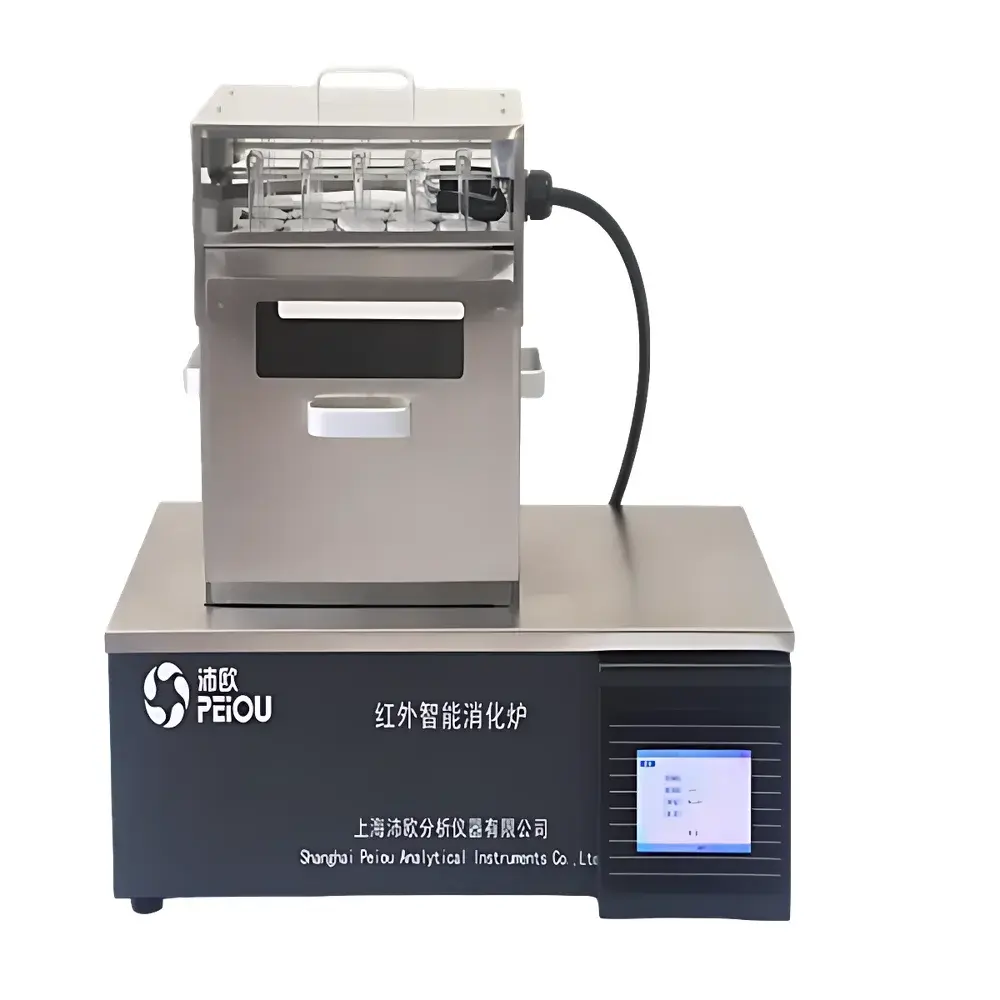
Peiou SKD-20S3 Infrared Quartz Digestion Furnace
| Brand | Peiou |
|---|---|
| Origin | Shanghai, China |
| Model | SKD-20S3 |
| Heating Method | Far-infrared quartz radiation |
| Number of Digestion Ports | 20 |
| Temperature Range | Ambient to 550 °C |
| Temperature Stability | ±1 °C |
| Programmable Control | LCD-based, multi-step ramping (timer + n-segment program) |
| Power Supply | AC 220 V |
| Rated Power | 1950 W |
| Thermal Insulation | Dual-layer (ceramic fiber + air gap) |
| Safety Features | Over-current protection, earth-leakage circuit breaker, integrated explosion-proof vent, corrosion-resistant stainless steel fume hood with lift mechanism and acid-resistant tray |
| Compliance | CE-marked |
Overview
The Peiou SKD-20S3 Infrared Quartz Digestion Furnace is a precision-controlled, high-efficiency sample digestion system engineered for complete mineralization of organic matrices under strong acid conditions. It operates on the principle of far-infrared (FIR) radiation transfer, utilizing specially formulated opal-white quartz tubes as the primary heating element. Unlike conventional metal-sheathed or ceramic heaters, this design converts >97% of input electrical energy into targeted far-infrared wavelengths (peak emission ~3–6 µm), which are strongly absorbed by common digestion reagents (e.g., H₂SO₄, HNO₃, HClO₄) and sample matrices. This resonant absorption minimizes thermal inertia, enables rapid and uniform heat penetration, and eliminates visible/near-IR transmission—reducing surface overheating, splashing, and wall deposition (“wall hang-up”) during prolonged reflux. The furnace is purpose-built for Kjeldahl nitrogen analysis, total phosphorus determination, heavy metal extraction (e.g., Pb, Cd, As in soils and biological tissues), and routine wet digestion prior to ICP-OES, ICP-MS, or AAS quantification.
Key Features
- Far-infrared quartz heating modules with opal-white quartz tubing: chemically inert, resistant to concentrated sulfuric, nitric, and perchloric acids; no coating degradation or outgassing over extended service life.
- 20-position digestion block with optimized port geometry: ensures uniform thermal coupling across all digestion tubes (standard 100–500 mL Kjeldahl or EPA-compliant borosilicate/Quartz tubes); inter-port temperature deviation < ±1.5 °C at 400 °C.
- Multi-stage programmable temperature control: LCD interface supports up to 8 independent ramp/soak segments per run; real-time graphical display of setpoint vs. actual temperature curve; PID algorithm ensures stable regulation within ±1 °C.
- Dual thermal insulation architecture: inner layer of high-purity ceramic fiber (density ≥128 kg/m³, service temp up to 1260 °C) plus an outer air-gap barrier—reducing external surface temperature to <50 °C during operation and improving energy efficiency by ~22% versus single-layer designs.
- Integrated safety subsystems: factory-calibrated explosion relief valve; corrosion-resistant stainless steel fume extraction hood with vertical lift mechanism; PTFE-coated acid-resistant drip tray; dedicated exhaust port compatible with laboratory ducted or recirculating fume hoods.
- Comprehensive electrical protection: Type B residual current device (RCD) rated at 30 mA, thermal cut-off switch, and over-current relay compliant with IEC 61000-4-5 surge immunity standards.
Sample Compatibility & Compliance
The SKD-20S3 accommodates standard digestion vessels used in AOAC, EPA Method 3050B/3051A, ISO 11466, and GB/T 5009 series protocols—including 100–500 mL Kjeldahl flasks, EPA-approved quartz or borosilicate digestion tubes, and custom cylindrical reactors up to 60 mm diameter. Its chemical resistance and absence of metallic contamination sources make it suitable for trace-metal analysis workflows requiring adherence to CLP, GLP, and ISO/IEC 17025 quality management frameworks. The CE marking confirms conformity with EU Machinery Directive 2006/42/EC and Low Voltage Directive 2014/35/EU. While not FDA 21 CFR Part 11–certified out-of-box, its digital log export function (via optional RS-232/USB interface) supports audit-trail generation when integrated into validated LIMS environments.
Software & Data Management
The embedded microcontroller firmware stores up to 100 user-defined digestion programs, each with timestamped start/stop records and max-temperature history. Temperature profiles can be exported in CSV format via serial interface for post-run validation against SOP-defined ramp rates (e.g., 5 °C/min to 150 °C, hold 30 min; then 10 °C/min to 400 °C). Optional PC software (Windows-compatible) provides graphing, comparative run analysis, and PDF report generation—including operator ID, batch number, and calibration verification status. All parameter changes are logged with date/time stamps, satisfying basic ALCOA+ data integrity requirements for non-GMP research labs.
Applications
- Agricultural & environmental testing: Total N, P, K, Ca, Mg, Fe, Zn, Cu, Mn, and heavy metals in plant tissue, soil, sludge, and water sediments.
- Food & feed analysis: Crude protein (Kjeldahl), ash content, selenium, iodine, and mycotoxin residue pre-digestion per AOAC 984.27 and ISO 8586.
- Geochemical laboratories: Silicate rock dissolution, ore assay preparation, and rare-earth element leaching prior to ICP-MS measurement.
- Pharmaceutical R&D: Excipient and API digestion for elemental impurities screening per ICH Q3D guidelines.
- Academic research: Method development for microwave-assisted digestion validation, kinetic studies of acid decomposition pathways, and inter-laboratory proficiency testing.
FAQ
What types of digestion acids are compatible with the SKD-20S3?
Concentrated H₂SO₄ (up to 98%), HNO₃ (65%), HCl (37%), and HClO₄ (70%)—including mixed acid systems such as H₂SO₄/H₂O₂ and HNO₃/HF (with appropriate HF-resistant vessel selection)—are fully supported. Avoid hydrofluoric acid contact with quartz components unless using externally lined digestion tubes.
Can the SKD-20S3 be integrated into automated sample prep lines?
Yes—via optional dry-contact relay outputs and Modbus RTU over RS-485, enabling synchronization with robotic arm handlers, autosamplers, or centralized lab automation platforms.
Is calibration traceable to national standards?
The unit includes a built-in Class II platinum resistance thermometer (Pt100) calibrated at three points (100 °C, 300 °C, 500 °C) against NIST-traceable reference probes; full calibration certificate available upon request.
What maintenance is required for long-term reliability?
Quarterly visual inspection of quartz tubes for microfractures; annual verification of thermocouple accuracy and safety interlock response time; replacement of ceramic fiber insulation only if physically damaged or compressed beyond 20% original thickness.
Does the furnace support overnight unattended operation?
Yes—programmable end-of-run cooling sequence, auto-shutdown, and continuous RCD monitoring allow secure overnight runs when paired with certified fume extraction and fire-rated lab infrastructure.



