
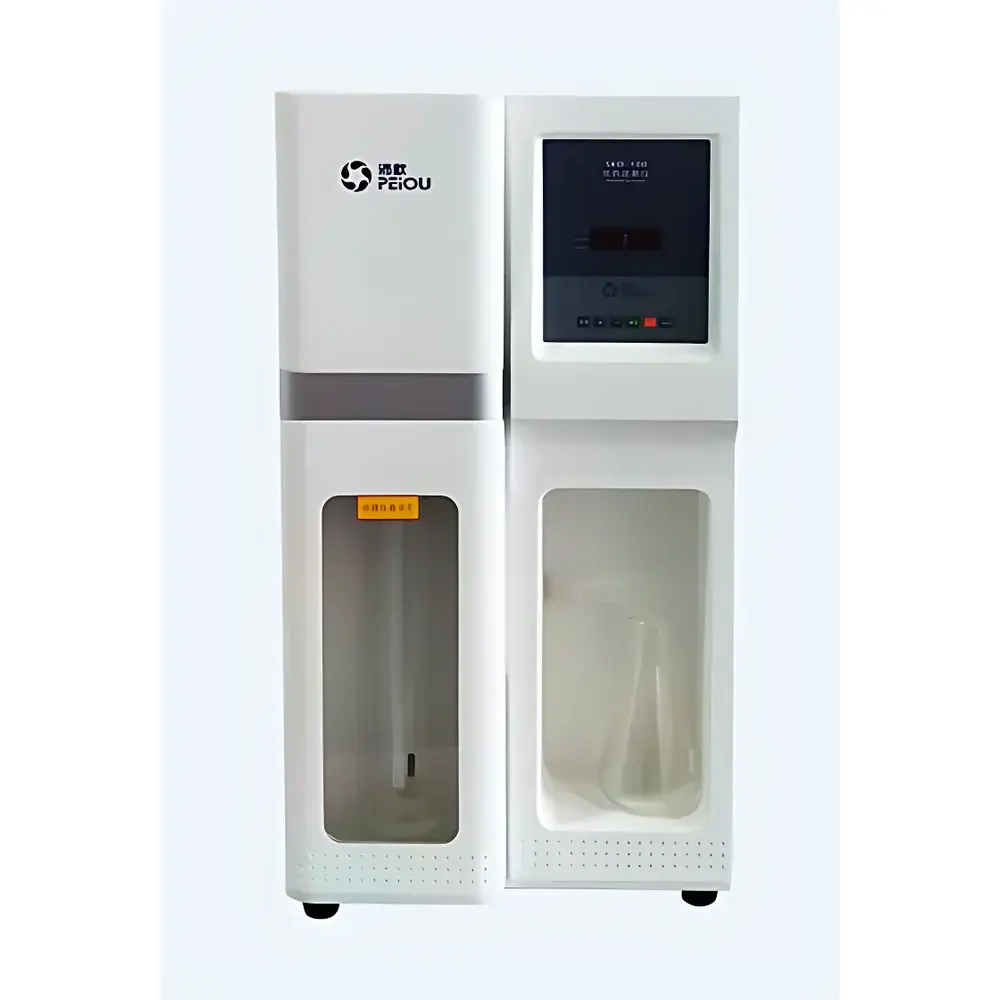
Peiou SKD-300 Cation Exchange Capacity (CEC) Analyzer for Soil
| Brand | Peiou |
|---|---|
| Origin | Shanghai, China |
| Model | SKD-300 |
| Instrument Type | Multi-Function Soil Analyzer |
| Measurement Range | 0.07–140 mmol/L |
| Recovery Rate | >99.5% |
| Repeatability (RSD) | ≤0.5% |
| Distillation Time Setting | 0–99 min |
| Distillation Speed | 3–8 min/sample |
| Sample Weight | Variable (determined by analyte concentration) |
| Boric Acid Delivery | Constant-Pressure Controlled |
| Programmable Methods | 10 stored acid addition & distillation protocols |
| Display | LED digital |
| Dimensions (W×D×H) | 370 × 300 × 680 mm |
| Heating Power | Adjustable up to 1500 W |
| Safety Features | Auto dry-run protection, emergency stop button, low-water cutoff, corrosion-resistant fluid path |
| Material | ABS engineering plastic housing |
Overview
The Peiou SKD-300 Cation Exchange Capacity (CEC) Analyzer is a dedicated benchtop instrument engineered for precise, automated determination of cation exchange capacity in soil and related environmental matrices. CEC is a fundamental soil fertility parameter reflecting the total negative charge on clay colloids and organic matter—primarily arising from isomorphic substitution in phyllosilicate lattices and deprotonation of functional groups in humic substances. This charge governs the soil’s capacity to retain and supply essential plant nutrients (e.g., K⁺, Ca²⁺, Mg²⁺, NH₄⁺) and influences buffering against pH change, heavy metal mobility, and contaminant retention. The SKD-300 implements a standardized ammonium acetate–distillation methodology (aligned with ISO 11260, ASTM D4373, and USDA-NRCS Method 12A), wherein exchangeable cations are displaced by NH₄⁺ under controlled pH and ionic strength, followed by quantitative steam distillation of liberated NH₃ into boric acid solution and subsequent titration or photometric detection.
Key Features
- Corrosion-resistant architecture: Housing fabricated from molded ABS engineering plastic rated for continuous exposure to concentrated HCl, NaOH, and (NH₄)₂OAc solutions—ensuring long-term structural integrity and electrical insulation.
- Chemically inert fluid handling: All internal tubing and seals are selected for thermal stability (up to 120 °C) and resistance to strong acids/bases; validated for ≥3 years of routine operation without replacement.
- Precision reagent delivery: Patented constant-pressure boric acid dosing system eliminates volumetric drift across runs, directly contributing to ≤0.5% RSD in replicate analyses.
- Microcontroller-based automation: Integrated single-chip system manages acid addition timing, steam distillation duration (0–99 min adjustable), power modulation (1500 W max, continuously variable), and post-run cleaning cycles.
- Robust safety framework: Real-time monitoring of water level in the steam generator, automatic shutdown on dry-heating detection, hardware-level emergency stop circuit, and fail-safe interlocks on all high-temperature zones.
- Method flexibility and traceability: Stores up to 10 user-defined protocols—including acid volume, exchange time, distillation ramp profile, and cooling delay—supporting method validation per GLP and ISO/IEC 17025 requirements.
Sample Compatibility & Compliance
The SKD-300 accommodates air-dried, sieved (<2 mm) soil samples across textural classes—from sandy loams to heavy clays—and has been verified for use with amended soils, biosolids, and sediment matrices where organic carbon content does not exceed 15%. It conforms to the procedural rigor of ISO 11260:1994 (Soil quality — Determination of cation exchange capacity — Ammonium acetate method at pH 7), ASTM D4373-22 (Standard Test Method for Cation Exchange Capacity of Soils), and USDA-NRCS National Soil Survey Laboratory Method No. 12A. Its design supports audit-ready documentation when paired with external LIMS or electronic lab notebooks, satisfying data integrity expectations under FDA 21 CFR Part 11 (when used in regulated environmental testing labs).
Software & Data Management
While the SKD-300 operates via embedded firmware without PC connectivity, its LED interface provides real-time status feedback (e.g., “ACID ADD”, “DISTILLING”, “COOLING”, “READY”) and displays elapsed time, set parameters, and fault codes. All operational settings—including distillation start time, acid volume, and method ID—are retained in non-volatile memory after power loss. For laboratories requiring full electronic records, the instrument’s timed outputs (e.g., relay closure at distillation completion) can interface with external data loggers or SCADA systems. Method storage enables consistent execution across shifts and operators—critical for multi-lab collaborative studies or regulatory submissions.
Applications
- Soil fertility assessment for agricultural land-use planning and precision nutrient management.
- Environmental site characterization: evaluating contaminant attenuation potential in brownfield remediation projects.
- Regulatory compliance testing under national soil quality standards (e.g., China’s GB 15618-2018, EU Soil Thematic Strategy reporting).
- Research on soil organic matter dynamics, clay mineral transformation, and long-term land-use impacts on exchange complex stability.
- Quality control in commercial soil amendment manufacturing (e.g., biochar, zeolite-based conditioners).
FAQ
What extraction method does the SKD-300 implement?
It follows the ammonium acetate (pH 7) displacement method, as specified in ISO 11260 and ASTM D4373.
Can the SKD-300 be used for exchangeable base cation analysis (Ca²⁺, Mg²⁺, K⁺, Na⁺)?
No—the SKD-300 quantifies total exchange capacity only. Separate ICP-OES or AAS analysis of the exchange extract is required for individual cation speciation.
Is calibration verification required before each batch?
Yes—daily verification using certified reference materials (e.g., NIST SRM 2710a) or spiked recovery checks is recommended to maintain ≤0.5% RSD performance.
What maintenance intervals are advised?
Routine inspection of tubing integrity and valve actuation every 200 runs; annual verification of heating element output and pressure regulator function.
Does the instrument support unattended overnight operation?
Yes—its auto-shutdown, dry-run protection, and stable thermal architecture allow safe extended runs, provided ambient ventilation meets Class II laboratory standards.







