
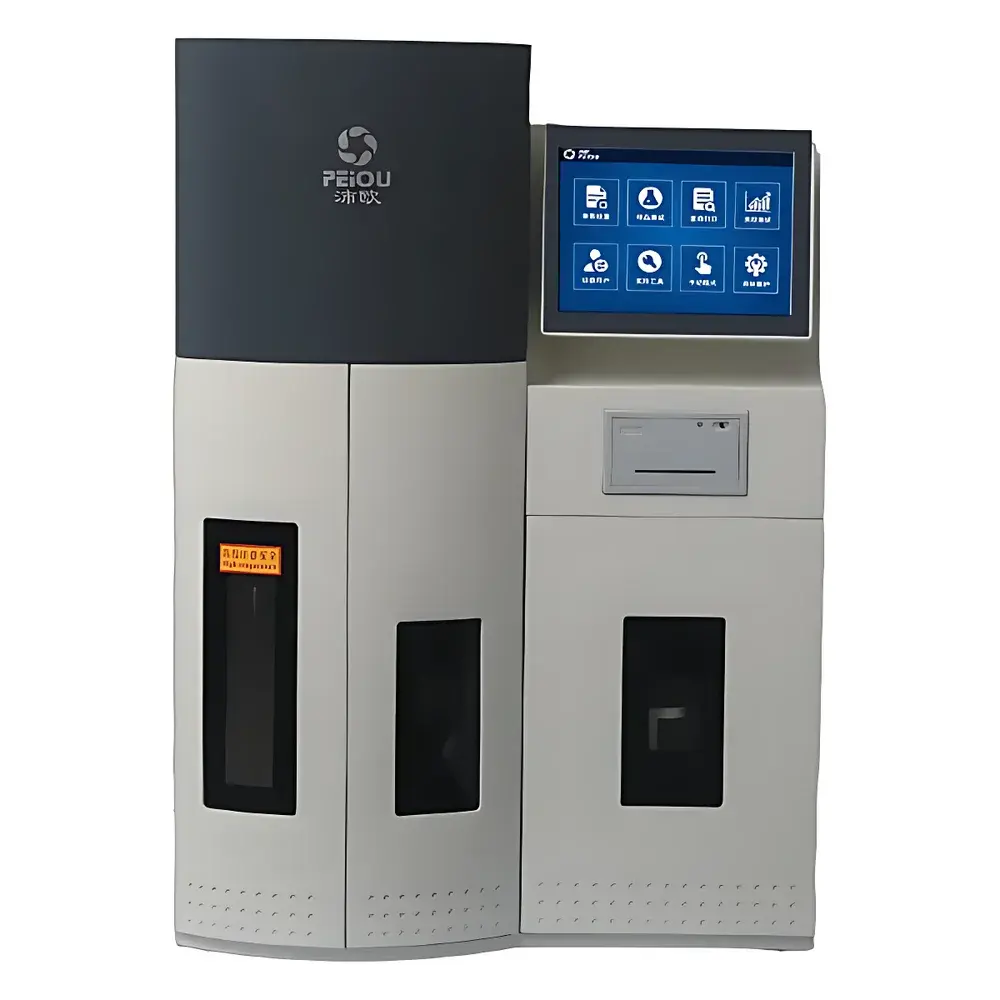
Peiou SKD-3600 Fully Automated Soil Cation Exchange Capacity (CEC) Analyzer
| Brand | Peiou |
|---|---|
| Origin | Shanghai, China |
| Manufacturer Type | Authorized Distributor |
| Country of Origin | China |
| Model | SKD-3600 |
| Pricing | Available Upon Request |
| Measurement Range | 0.07–140 cmol/kg |
| Titration Step Volume | 0.8 µL/step |
| Titration Precision | RSD < 0.002 µL/step |
| Repeatability | RSD < 0.5% |
| Recovery Rate | >99.5% |
| Distillation Time | 3–8 min/sample |
| Reagent Pump Capacity | 0–150 mL (1 mL increments) |
Overview
The Peiou SKD-3600 Fully Automated Soil Cation Exchange Capacity (CEC) Analyzer is an integrated, benchtop analytical system engineered for precise, high-throughput quantification of cation exchange capacity in diverse soil matrices. It operates on the principle of ammonium acetate–exchange followed by steam distillation and acid–base titration—methodologically aligned with standardized protocols including ISO 11260, ASTM D4373, and USDA–NRCS Soil Survey Laboratory Methods Manual. The instrument automates the complete workflow: sample conditioning, exchangeable cation displacement (using buffered CH₃COONH₄), removal of excess acetate via ethanol wash, NH₄⁺ conversion to NH₃ under alkaline distillation (NaOH addition), quantitative NH₃ capture in boric acid solution, and potentiometric or colorimetric endpoint titration with standardized H₂SO₄. This closed-loop, reagent-controlled process eliminates manual intervention errors while maintaining full traceability of analytical conditions.
Key Features
- Fully automated dual-stage operation: simultaneous distillation and titration per sample, reducing cycle time to 3–8 minutes
- High-resolution micro-piston pump delivering 0.8 µL/step precision with RSD < 0.002 µL/step—enabling sub-milligram-level reagent dosing accuracy
- Real-time optical endpoint detection using RGB chromatic analysis (red/green/blue channel monitoring) for robust colorimetric titration without ambient light interference
- Intelligent dry-run prevention: dual-level liquid sensing in distillation vessel combined with thermal modeling to detect incipient dry-burn conditions and halt heating automatically
- Comprehensive fluidic integrity monitoring: real-time detection of coolant flow interruption, low water pressure, and reagent depletion (NaOH, H₃BO₃, diluent, deionized water)
- ABS engineering polymer chassis resistant to concentrated sulfuric and sodium hydroxide solutions—ensuring long-term chemical compatibility and structural stability
- Active temperature regulation of distillation chamber with embedded Pt100 sensor and PID-controlled heating element
- Interlocked safety door with position feedback—system halts all active processes if opened during operation
- Automated post-analysis cleaning sequence for titration cup, delivery tubing, and distillation head using programmable rinse cycles
Sample Compatibility & Compliance
The SKD-3600 accommodates air-dried, sieved (<2 mm) soil samples across textural classes—from sandy loams to heavy clays—and handles organic-rich substrates (e.g., peat, compost-amended soils) with validated recovery (>99.5%) and repeatability (RSD < 0.5%). It supports both routine screening and regulatory-grade analysis, meeting data integrity requirements under GLP and GMP frameworks. All method parameters—including reagent volumes, distillation duration, base concentration, and titrant strength—are digitally logged with timestamped metadata. Optional integration with analytical balances enables automatic mass import (ASTM E29, ISO/IEC 17025-compliant), while wireless data transmission supports centralized LIMS deployment. Instrument validation documentation includes IQ/OQ/PQ templates aligned with FDA 21 CFR Part 11 expectations for electronic records and signatures.
Software & Data Management
The embedded control software provides real-time graphical visualization of distillation progress, titration curve evolution, and endpoint determination logic. Each analysis generates a tamper-evident digital report containing raw sensor outputs (pH, temperature, volume dispensed), calculated CEC value (cmolc/kg), intermediate metrics (NH₃ recovery %, blank correction), and operator-defined metadata (sample ID, analyst, date/time). Audit trails record all parameter modifications, user logins, and calibration events. Export formats include CSV, PDF, and XML for interoperability with laboratory information management systems (LIMS). Optional cloud-based remote diagnostics allow authorized service engineers to assess system health without onsite visits.
Applications
- Soil fertility assessment for agronomic planning and fertilizer recommendation systems
- Land reclamation and remediation site characterization (e.g., post-mining, industrial brownfield sites)
- Environmental impact assessments requiring baseline CEC profiling prior to construction or waste disposal
- Research into clay mineralogy–CEC correlations and humic substance interactions
- Quality control in commercial soil amendment manufacturing (e.g., biochar, zeolite blends)
- Regulatory compliance testing under national soil quality standards (e.g., China’s GB 15618, EU Soil Thematic Strategy reporting)
FAQ
What standard methods does the SKD-3600 support?
It implements ammonium acetate–based extraction per ISO 11260 and ASTM D4373, with optional configuration for barium chloride–triethanolamine (BaCl₂–TEA) methodology.
Can the instrument handle high-organic-content soils?
Yes—its optimized distillation kinetics and adaptive alkaline dosing ensure consistent NH₃ liberation from humic- and fulvic-rich matrices without charring or incomplete volatilization.
Is method validation documentation provided?
Yes—factory-supplied IQ/OQ/PQ protocols, performance verification reports, and uncertainty budget templates are included with each unit.
How is data integrity maintained during network transmission?
Wireless data export uses TLS 1.2–encrypted MQTT or HTTPS channels; locally stored records comply with ALCOA+ principles (Attributable, Legible, Contemporaneous, Original, Accurate, Complete, Consistent, Enduring, Available).
What maintenance intervals are recommended?
Daily: visual inspection of fluid lines and waste container; weekly: pump calibration verification and titration electrode conditioning; annually: full metrological recalibration by certified service engineer.







