
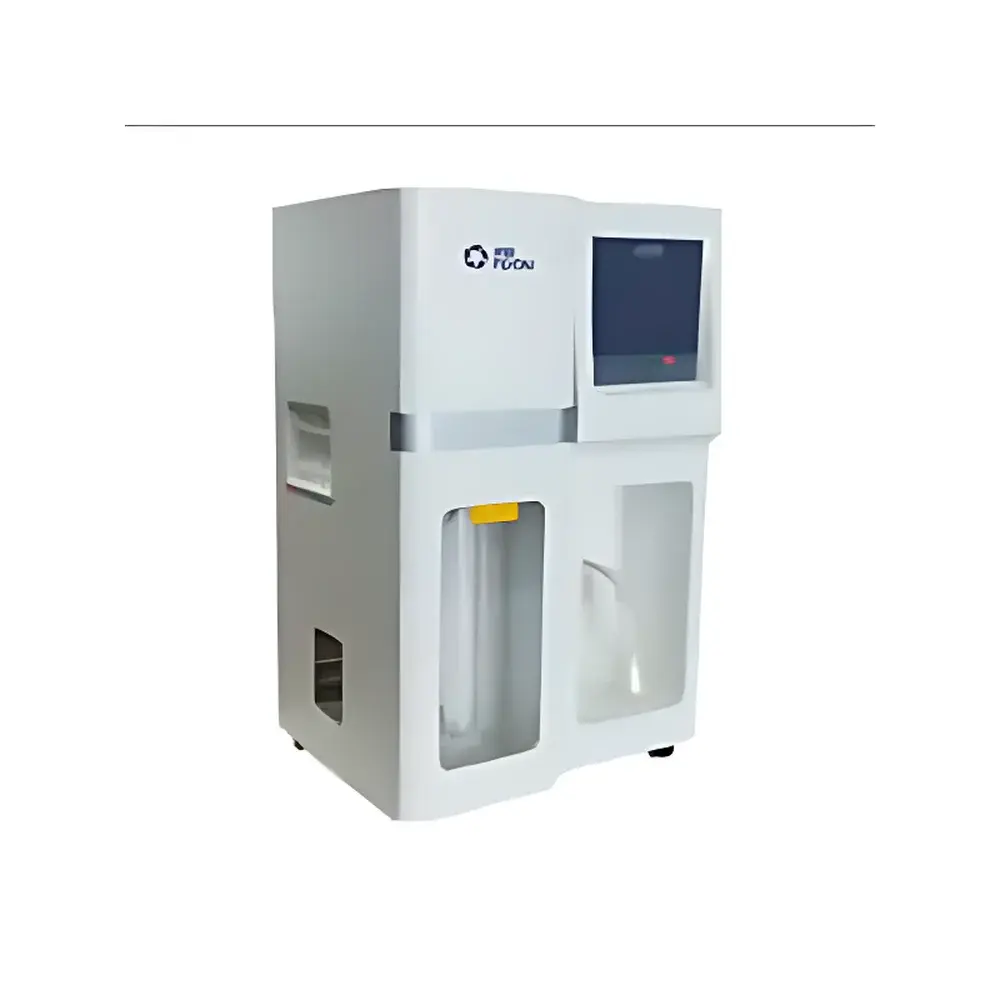
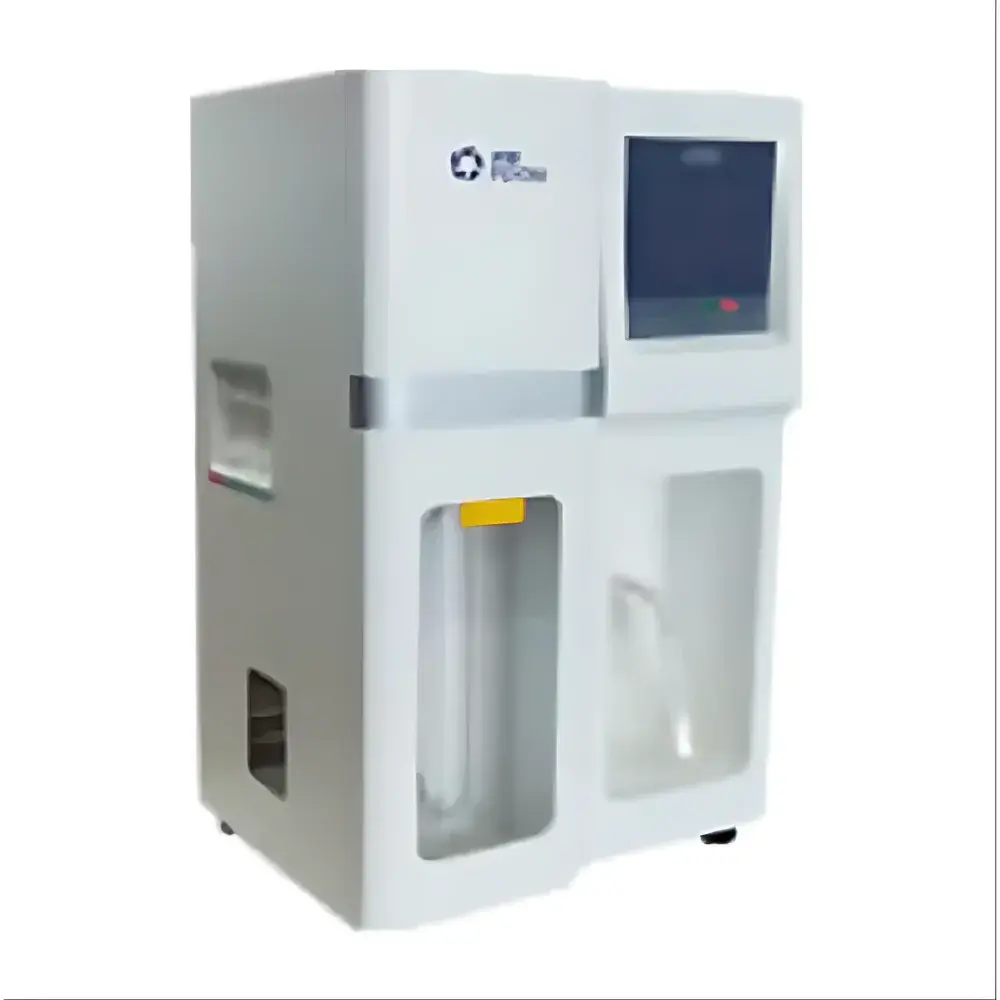
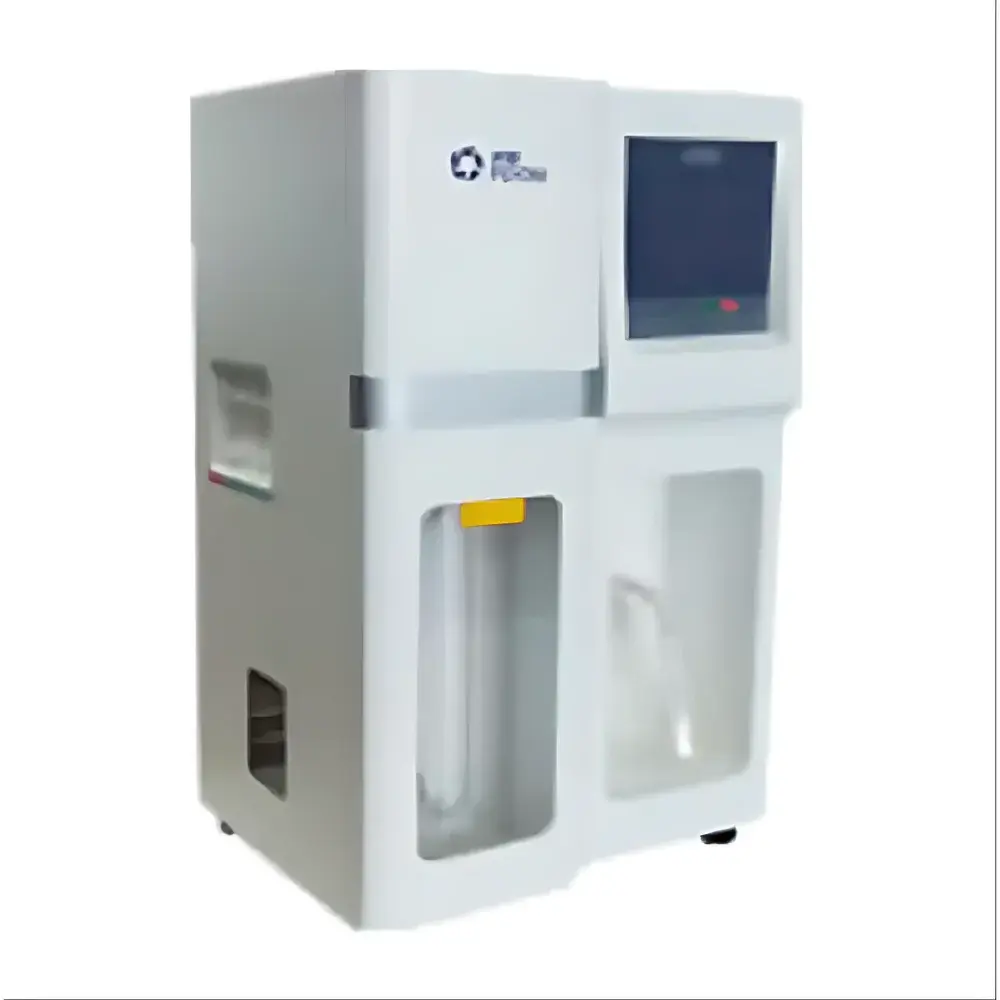
Peiou SKD-800 Automated Kjeldahl Nitrogen Analyzer
| Brand | Peiou |
|---|---|
| Origin | Shanghai, China |
| Model | SKD-800 |
| Sample Capacity | ≤5 g (solid) / ≤15 mL (liquid) |
| Nitrogen Range | 0.08–200 mg N |
| Recovery Rate | >99.5% |
| Precision (RSD) | ≤0.5% |
| Distillation Time | 1–99 min |
| Distillation Rate | 14–28 mL/min (adjustable) |
| Power Adjustment | 750–1500 W |
| Cooling Water Requirement | ≥1.5 L/min at ≤20 °C, min. pressure 0.15 MPa |
| Data Storage | ≥100 distillation programs, ≥1000 sample records |
| Safety Features | Dual-level digestion flask level sensing, real-time cooling water flow/pressure monitoring, reagent level detection (H₂SO₄, NaOH, boric acid, diluent), digestion chamber temperature monitoring, condensate temperature cutoff, interlocked safety door sensor, intermittent alkali addition control |
| Construction | Monolithic ABS engineering plastic chassis |
| Dimensions | 370 × 300 × 680 mm |
| Electrical | 220 V AC, 50 Hz, 3.5–7 A |
Overview
The Peiou SKD-800 Automated Kjeldahl Nitrogen Analyzer is a fully integrated, microprocessor-controlled system engineered for precise and reproducible total nitrogen determination in accordance with AOAC, ISO 8968, ISO 1871, and ASTM D1122 methodologies. Based on classical Kjeldahl digestion–distillation–titration principles, the SKD-800 automates the critical distillation stage following acid digestion, enabling accurate quantification of organic and ammoniacal nitrogen in food, feed, environmental, pharmaceutical, and agricultural samples. Its architecture separates fluidic, electrical, and pneumatic pathways—reagents are housed externally in dedicated reservoirs, while internal tubing is constructed from chemically inert, high-temperature-resistant fluoropolymers and silicone elastomers to ensure long-term integrity under aggressive acidic and alkaline conditions. The unit employs dual independent liquid-level sensors in the distillation flask to prevent dry-heating events, and integrates real-time thermal monitoring of both the distillation chamber and receiving flask to halt operation if condensate temperature exceeds safe thresholds—thereby preserving analytical integrity and preventing analyte loss.
Key Features
- Automated reagent delivery system with independent, motor-driven peristaltic pumps for sulfuric acid, sodium hydroxide, boric acid, and diluent—each equipped with optical liquid-level sensors to trigger audible/visual alarms and suspend operation upon depletion.
- Intelligent distillation power modulation (750–1500 W) enables optimized steam generation for low-concentration (100 mg N) samples, ensuring consistent recovery across dynamic ranges.
- Real-time cooling water supervision: flow rate and pressure are continuously monitored; interruption triggers immediate pause, state retention, and automatic resumption with compensatory time extension once flow resumes.
- Intermittent alkali dosing algorithm prevents violent exothermic reactions and sample splashing during neutralization—critical for volatile or foaming matrices such as dairy powders or fermented products.
- Monolithic ABS engineering plastic enclosure provides full resistance to sulfuric acid mist, electrical insulation, and structural immunity to corrosion—eliminating rust, warping, or conductivity risks over extended service life.
- Front-panel 5.7-inch LCD display with intuitive icon-based navigation supports real-time tracking of all operational phases: preheating, digestion carryover, reagent addition, distillation progress, and cleaning cycles.
Sample Compatibility & Compliance
The SKD-800 accommodates solid samples up to 5 g and liquid samples up to 15 mL, compatible with standard Kjeldahl digestion tubes (e.g., 100–300 mL capacity). It complies with GLP documentation requirements through timestamped event logging—including reagent consumption, thermal anomalies, door status, and manual interventions. While not inherently 21 CFR Part 11 compliant, its audit-trail-capable firmware supports traceable data export (CSV) for integration into validated LIMS environments. All fluid-contact materials meet USP Class VI biocompatibility standards, and the system’s sealed design minimizes exposure to corrosive vapors during routine operation—supporting ISO/IEC 17025-accredited laboratories requiring documented instrument qualification (IQ/OQ/PQ).
Software & Data Management
The embedded control firmware stores ≥100 customizable distillation protocols—each defining alkali volume, diluent ratio, steam power profile, distillation duration, and post-run rinse parameters. Sample metadata (ID, operator, date/time, method ID) is logged automatically for ≥1000 analyses and exportable via USB interface. No proprietary software installation is required; raw CSV files contain complete parameter sets and endpoint titration equivalents (mg N, % protein). System diagnostics—including pump cycle counts, sensor calibration flags, and thermal history—are accessible via service menu for preventive maintenance planning.
Applications
The SKD-800 is routinely deployed in QC laboratories for protein content verification in cereals, soy products, meat analogs, and infant formula per AOAC 981.10 and ISO 20483. Environmental labs utilize it for total Kjeldahl nitrogen (TKN) analysis in wastewater sludge and soil extracts (EPA Method 351.2). Feed manufacturers apply it to validate crude protein claims in compound feeds and premixes under FAMI-QS and GMP+ standards. Its robustness in high-salt, high-fat, or viscous matrices—enabled by adaptive steam control and anti-foam alkali dosing—makes it suitable for challenging samples including algae biomass, fish meal, and spent grain.
FAQ
Does the SKD-800 support direct titration integration?
No—the SKD-800 performs automated distillation only; titration must be conducted separately using manual burettes or standalone autotitrators.
Can the instrument operate without continuous cooling water supply?
No—cooling water flow is a mandatory safety interlock; operation halts immediately upon detection of flow interruption or insufficient pressure (<0.15 MPa).
Is remote monitoring or Ethernet connectivity available?
The SKD-800 lacks network interfaces; data retrieval is limited to USB mass storage export of CSV logs.
What maintenance intervals are recommended for internal tubing?
Manufacturer specifies ≥36 months service life for all fluoropolymer and silicone fluid paths under normal use with certified reagents; no scheduled replacement is required within this period.
How is method validation supported?
The system logs all critical process variables (temperature, power, timing, reagent volumes) per run, enabling full reconstruction of analytical conditions for IQ/OQ/PQ documentation and regulatory audits.



