
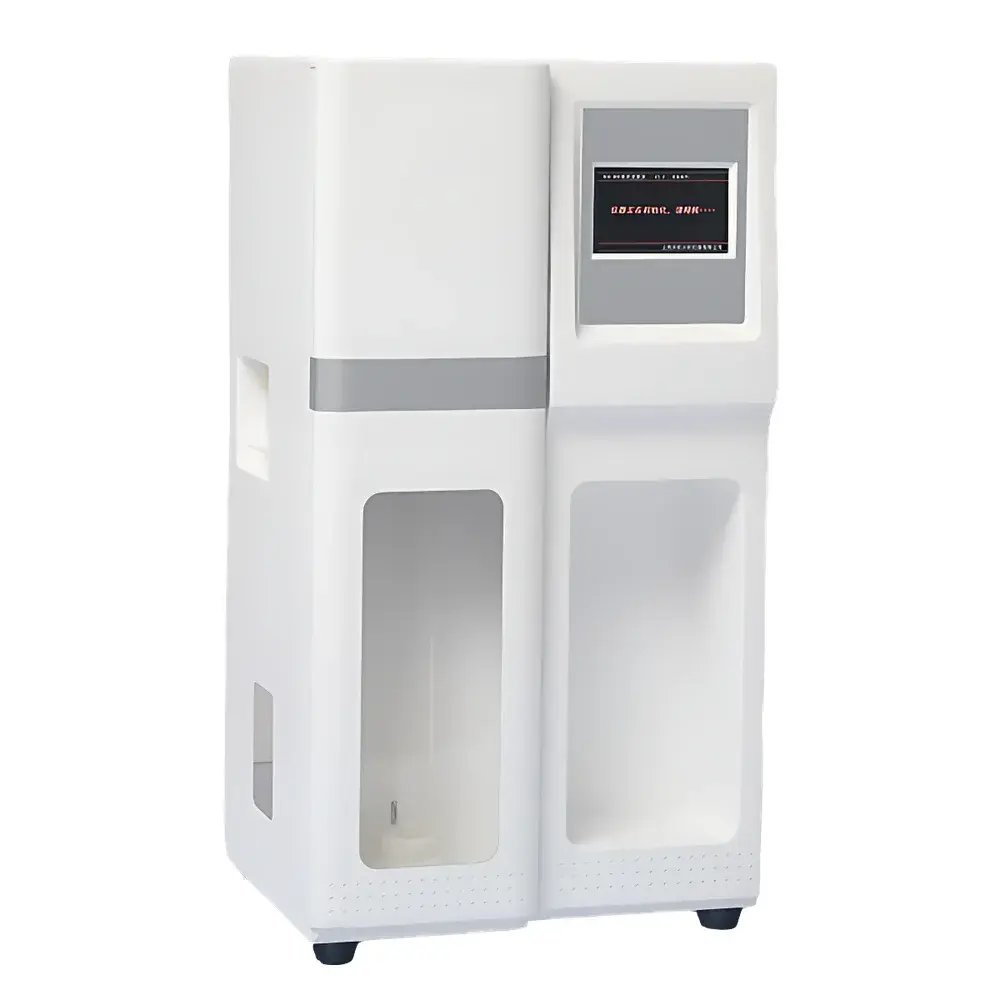
Peiou SKD200 Automated Kjeldahl Nitrogen Determinator
| Brand | Peiou |
|---|---|
| Origin | Shanghai, China |
| Model | SKD200 |
| Instrument Type | Kjeldahl Nitrogen Determinator |
| Automation Level | Semi-Automatic |
| Nitrogen Determination Range | 0.1–240 mg N |
| Distillation Time | 3–8 min |
| Repeatability | RSD < 0.5% |
| Sample Weight Capacity | ≤6 g (solid) / ≤16 mL (liquid) |
| Nitrogen Recovery Rate | 99.5% |
| Adjustable Distillation Power | 1500 W |
| Dimensions (L×W×H) | 370 × 300 × 680 mm |
Overview
The Peiou SKD200 Automated Kjeldahl Nitrogen Determinator is a semi-automated benchtop instrument engineered for precise, reproducible quantification of total nitrogen content in diverse sample matrices via classical Kjeldahl digestion and steam distillation methodology. Based on ISO 8968-1, AOAC 981.10, and ASTM D1142 standards, the system performs acid digestion (performed off-instrument), followed by automated alkalization, steam distillation, ammonia trapping in boric acid, and subsequent titrimetric or colorimetric quantification. Designed for routine QC/QA laboratories in food & feed, agricultural research, pharmaceutical development, environmental testing, and chemical manufacturing, the SKD200 delivers robust performance with minimal operator intervention while maintaining full method traceability and process control.
Key Features
- Intelligent semi-automated workflow: fully programmable sequence for reagent addition (H2SO4, NaOH, diluent), steam generation, distillation, and post-run rinsing — all initiated via intuitive 7-inch color LCD touchscreen interface with Chinese/English bilingual menu support.
- High-fidelity nitrogen recovery: optimized intermittent alkali dosing prevents violent exothermic reactions and sample splashing; constant-pressure steam generator eliminates back-siphoning of condensate into the distillation chamber.
- Dual-level liquid safety monitoring: redundant float-switch system ensures immediate power cutoff upon low-water condition, preventing dry-heating of the boiler element.
- Adjustable thermal output: 1500 W heating power is continuously variable to accommodate low-concentration samples (e.g., water extracts, biological fluids) and high-boiling-point matrices (e.g., fertilizers, polymer additives), ensuring consistent distillation efficiency across the full 0.1–240 mg N range.
- Modular reagent handling: external, removable reagent reservoirs allow real-time manual supplementation during operation without interrupting active runs — critical for extended batch analysis or method optimization.
- Durability-focused construction: one-piece molded ABS engineering plastic chassis provides corrosion resistance against concentrated sulfuric and sodium hydroxide solutions; internal fluid pathways utilize chemically inert, high-temperature-resistant tubing rated for ≥3 years of continuous service under GLP-compliant usage conditions.
Sample Compatibility & Compliance
The SKD200 accommodates solid samples up to 6 g (e.g., cereal grains, meat powders, soil composites) and liquid samples up to 16 mL (e.g., milk, fermentation broths, digest filtrates). Its design supports compliance with internationally recognized protocols including ISO 5983-1 (animal feeding stuffs), ISO 20483 (cereals and milled cereal products), USP (residual solvents), and EPA Method 350.1 (wastewater nitrogen). The instrument’s fixed distillation volume control (15–30 mL/min), programmable delay timing (0–1800 s), and adjustable distillation duration (1–99 min) enable method adaptation for complex matrices such as slow-releasing nitrogen compounds in fertilizers or heat-labile protein digests. All operational parameters are logged with timestamps, supporting audit readiness for GLP and GMP environments.
Software & Data Management
The embedded microprocessor stores up to 999 customizable distillation programs and retains over 1000 individual run records with full metadata: date/time stamp, sample ID, reagent volumes, distillation time, power setting, and user-defined notes. Data export is supported via USB interface for integration into LIMS or statistical analysis platforms. While the base configuration does not include FDA 21 CFR Part 11-compliant electronic signatures or audit trail functionality, the system architecture allows for future firmware upgrades enabling secure user authentication, change logging, and electronic record integrity verification — essential for regulated pharmaceutical and clinical laboratory applications.
Applications
- Food & Dairy: Crude protein estimation in milk powder, soy isolates, infant formula, and plant-based alternatives using nitrogen-to-protein conversion factors (e.g., 6.38 for dairy, 5.70 for cereals).
- Agriculture & Feed: Total Kjeldahl nitrogen (TKN) analysis in compound feeds, silage, manure, and fertilizer formulations per AOAC 984.13 and ISO 11261.
- Environmental Testing: TKN quantification in wastewater influent/effluent, sludge, and sediment per EPA 350.1 and ISO 14253-1.
- Pharmaceutical & Biotech: Nitrogen content verification in excipients, amino acid formulations, and biopolymer raw materials per USP general chapters.
- Chemical Industry: Quality control of nitrogen-containing intermediates (e.g., urea derivatives, melamine, nitrocellulose) and catalyst supports.
FAQ
What digestion apparatus is compatible with the SKD200?
The SKD200 is designed exclusively for post-digestion distillation; it requires pre-digested samples (typically in 100–250 mL Kjeldahl flasks) and does not integrate digestion heating or reflux modules.
Can the SKD200 be connected to an automatic titrator?
Yes — the distillate outlet is standardized (12 mm OD), enabling direct coupling to third-party autotitrators (e.g., Metrohm 809, Hanna HI84532) via silicone tubing; titration endpoint detection is performed externally.
Is cooling water recirculation supported?
The unit requires continuous-flow cooling water at ≥1.5 L/min and ≤20 °C inlet temperature; recirculating chillers with sufficient capacity (≥1500 W heat removal) may be used provided flow rate and temperature stability meet specification.
How is method validation documented?
Each run logs key process variables; users must maintain separate laboratory notebooks or electronic records documenting spike recovery tests, blank determinations, and calibration verification using certified reference materials (e.g., NIST SRM 84g wheat gluten).
What maintenance intervals are recommended?
Daily: rinse steam trap and condenser; weekly: inspect reagent lines and clean alkali nozzle; annually: replace boiler gasket and verify pressure sensor calibration — all procedures detailed in the bilingual technical manual.



