
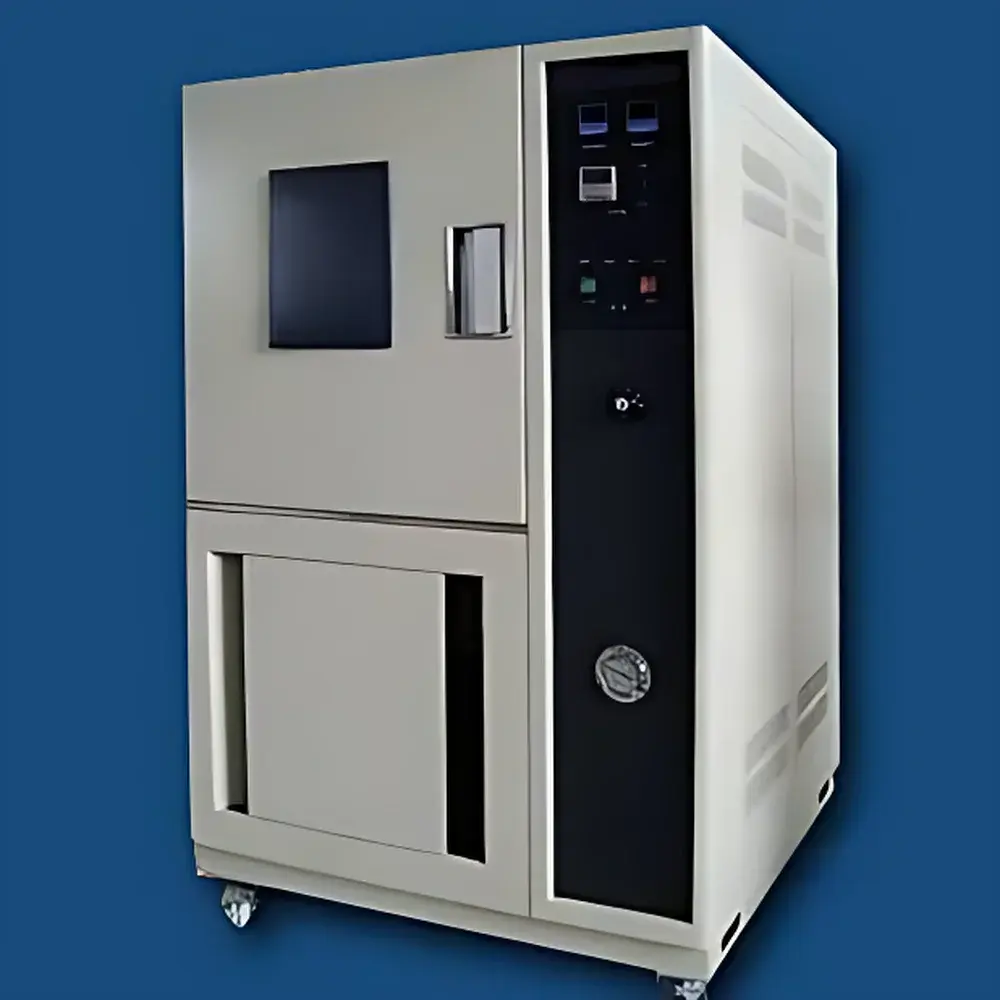
Peiyi KS-GDCJ50 Thermal Shock Test Chamber
| Brand | Peiyi |
|---|---|
| Model | KS-GDCJ50 |
| Temperature Range | −40 °C to +150 °C |
| Internal Chamber Dimensions (W×D×H) | 400 mm × 350 mm × 400 mm |
| External Dimensions (W×D×H) | 820 mm × 700 mm × 1380 mm |
| Temperature Uniformity | ≤2 °C |
| Temperature Stability | ≤±0.5 °C |
| Heating Rate | ≥2–3 °C/min |
| Cooling Rate | ≤1 °C/min |
| Control System | Imported Digital PID Temperature Controller |
| Refrigeration System | Single- or Dual-Stage Cascade Refrigeration (Air- or Water-Cooled) |
| Compressor | Original French Tecumseh (Taylor) Unit |
| Insulation | Ultra-Fine Glass Fiber |
| Safety Protections | Leakage Protection, Compressor High-Pressure & Overheat Protection, Fan Overheat Protection, Overcurrent & Fuse Protection, Acoustic Alarm |
| Power Supply | AC 380 V or 220 V ±10%, 50 Hz |
| Compliance | GB/T 5170.5–1996 |
Overview
The Peiyi KS-GDCJ50 Thermal Shock Test Chamber is an engineered environmental stress screening system designed for rapid temperature transition testing of electronic components, automotive parts, aerospace materials, and industrial assemblies. It operates on the principle of two-zone (hot/cold) or single-chamber thermal shock methodology—enabling programmable transitions between extreme low and high temperatures to accelerate failure mechanisms associated with thermal expansion mismatch, interfacial delamination, solder joint fatigue, and material embrittlement. The chamber meets the metrological and operational requirements specified in GB/T 5170.5–1996, the Chinese national standard for verification of environmental test equipment parameters, and serves as a foundational tool for reliability validation under IEC 60068-2-14, MIL-STD-810H Method 503.5, and JEDEC JESD22-A104. Its dual-stage cascade refrigeration architecture—featuring an original Tecumseh (Taylor) compressor and fully imported refrigeration components—ensures stable sub-zero performance down to −40 °C while maintaining precise control up to +150 °C.
Key Features
- High-fidelity digital PID temperature controller with real-time numeric display and intuitive interface for ramp/soak profiling
- Stainless steel interior chamber and electrostatically coated cold-rolled steel exterior for corrosion resistance and structural integrity
- Ultra-fine glass fiber insulation layer minimizing thermal leakage and enhancing energy efficiency
- Low-noise centrifugal air circulation system ensuring uniform airflow distribution and consistent thermal exposure across test volume
- Comprehensive safety suite including compressor high-pressure cutoff, overtemperature protection for heating elements and fans, leakage current interruption, fuse-based overcurrent protection, and audible alarm activation
- Standard configuration includes double-layer insulated observation window, two 50-mm diameter cable access ports, moisture-resistant interior lighting, and adjustable stainless steel sample racks
Sample Compatibility & Compliance
The KS-GDCJ50 accommodates specimens up to 400 mm (W) × 350 mm (D) × 400 mm (H), supporting PCB assemblies, molded connectors, battery modules, LED packages, and small mechanical subassemblies. Its thermal uniformity (≤2 °C) and stability (±0.5 °C) are verified per GB/T 5170.5–1996 calibration procedures using traceable NIST-equivalent PT100 sensors. The unit is routinely deployed in GLP-compliant laboratories—including UL’s Shanghai facility, TÜV Rheinland’s regional testing centers, and China’s CIQ and AQSIQ accredited labs—for qualification testing aligned with ISO/IEC 17025 documentation requirements. While not intrinsically certified to UL 1995 or EN 60068-3-5, its design facilitates integration into broader test protocols requiring audit-ready environmental conditioning data.
Software & Data Management
The chamber supports optional RS485/Modbus RTU communication for integration into centralized lab management systems. When paired with third-party SCADA or LIMS platforms, it enables time-stamped logging of chamber setpoints, actual chamber temperatures, compressor status, and alarm events. All recorded thermal profiles comply with basic ALCOA+ principles (Attributable, Legible, Contemporaneous, Original, Accurate, Complete, Consistent, Enduring, Available) when exported in CSV format. For regulated environments, optional 21 CFR Part 11-compliant software modules provide electronic signature capability, user role-based access control, and immutable audit trails—supporting GMP and ISO 9001 quality system requirements.
Applications
- Thermal cycling qualification of automotive ECUs prior to AEC-Q200 certification
- Failure mode analysis of polymer encapsulants in optoelectronic devices under repeated thermal stress
- Validation of adhesive bond integrity in multi-material battery enclosures
- Screening of solder paste reliability in high-density HDI PCBs
- Pre-conditioning of sensors and MEMS devices before functional electrical testing
- Supporting accelerated life testing (ALT) programs in accordance with ASTM E3037 guidance
FAQ
What is the recommended ambient operating environment for this chamber?
The unit must be installed in a conditioned space maintained between +5 °C and +35 °C, with relative humidity below 85% RH non-condensing and adequate ventilation for heat dissipation—particularly when configured with water-cooled condensers.
Can the KS-GDCJ50 perform programmable thermal shock profiles with dwell times?
Yes—the digital controller supports multi-step ramp/soak sequences; however, full profile programming (e.g., 100-cycle automated cycles) requires optional PC-based software or external PLC integration.
Is the chamber suitable for testing samples with active power input during thermal shock?
Standard configuration includes two 50-mm-diameter feedthrough ports rated for low-voltage signal lines; high-power or high-frequency feedthroughs require custom gland kits and are subject to thermal derating verification.
Does Peiyi provide calibration certificates traceable to national standards?
Factory calibration reports (per GB/T 5170.5) are included; ISO/IEC 17025-accredited calibration services are available through authorized third-party providers upon request.
What maintenance intervals are recommended for the refrigeration system?
Compressor oil and filter replacement every 24 months under continuous operation; annual inspection of refrigerant charge, condenser coil cleanliness, and fan motor bearings is advised.



