
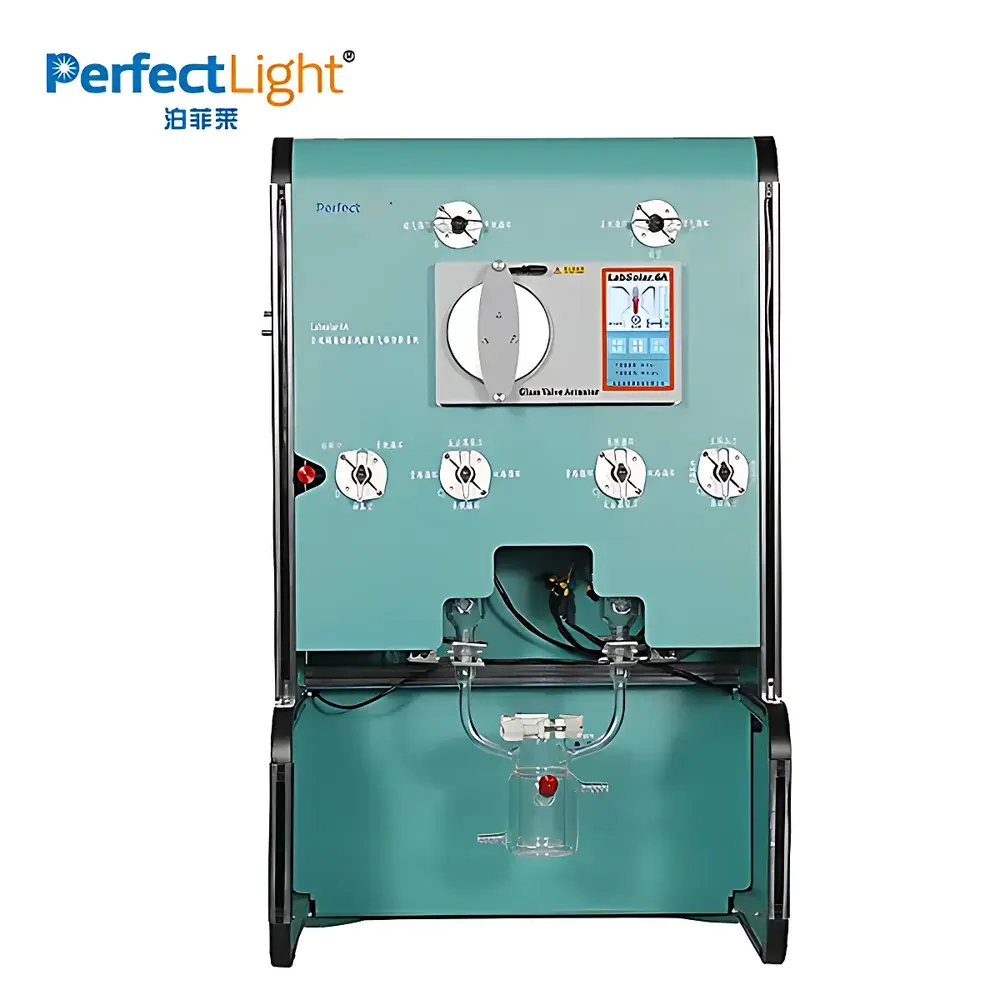
PerfectLight Labsolar-6A All-Glass Automated Online Trace Gas Analysis System for Liquid-Phase CO₂ Reduction
| Brand | PerfectLight |
|---|---|
| Origin | Beijing, China |
| Manufacturer Type | Authorized Distributor |
| Product Origin | Domestic (China) |
| Model | 6A Liquid-Phase |
| Pricing | Upon Request |
Overview
The PerfectLight Labsolar-6A All-Glass Automated Online Trace Gas Analysis System is a purpose-engineered platform for quantitative kinetic evaluation of liquid-phase photocatalytic CO₂ reduction reactions. It operates on a closed-loop, fully integrated gas circulation principle—combining sample conditioning, reaction containment, high-fidelity gas recirculation, and automated GC-compatible sampling within a single all-glass architecture. Unlike vacuum-driven water-splitting systems, CO₂ reduction typically proceeds under ambient or slightly sub-atmospheric pressure with high-concentration feed gases (e.g., CO₂, H₂O vapor, sacrificial agents), where molecular diffusion alone is insufficient for homogeneous gas distribution. The Labsolar-6A addresses this through forced unidirectional circulation driven by a non-magnetic, hermetically sealed piston pump—eliminating concentration gradients across the reactor headspace and ensuring representative sampling of transient gaseous products including H₂, O₂, CO, CH₄, C₂H₄, and trace C₁–C₂ hydrocarbons. Its borosilicate glass construction provides near-zero surface adsorption, chemical inertness toward acidic/basic electrolytes and organic co-solvents (e.g., acetonitrile, triethanolamine), and optical transparency for uniform irradiation—enabling accurate measurement of intrinsic catalyst turnover frequencies (TOFs) without matrix-induced bias.
Key Features
- Ultra-low adsorption all-glass flow path: High-purity borosilicate glass tubing and valves minimize analyte retention; validated linearity R² > 0.9995 for H₂ (100 µL–10 mL) and repeatability RSD < 3% (n = 4) across full dynamic range.
- High-integrity gas sealing: Multi-stage ground-glass valve assembly lubricated with Dow Corning® high-vacuum grease achieves ≤ 0.1 µmol O₂ leakage per hour over 8 h—critical for stoichiometric O₂ quantification in H₂O-mediated CO₂ reduction.
- Automated sampling & injection: Programmable multi-port glass sampling valve with selectable 0.6 mL or 2 mL quantitative loops; actuated via software-controlled mechanical arm—enabling unattended operation for extended time-series experiments (≥ 72 h).
- Reaction vessel flexibility: Standard 370 mL borosilicate reactor with quartz optical window (chain-clamped for uniform stress distribution); customizable volume (50–150 mL recommended) and geometry for photoelectrochemical or photothermal configurations.
- Condensation management: Integrated coiled condenser and optional cryogenic trap suppress low-boiling interferents (H₂O, CH₃CN, TEA) from entering GC columns or vacuum pumps—extending instrument lifetime and improving baseline stability.
- Integrated thermal control: 10-segment programmable heating of circulation lines and sampling manifold (up to 200 °C ± 0.1 °C); prevents condensate formation and maintains consistent gas-phase composition during variable-temperature studies.
Sample Compatibility & Compliance
The Labsolar-6A supports aqueous, organic-aqueous, and pure organic reaction media used in CO₂ reduction (e.g., Na₂SO₄/TEOA, KHCO₃/CH₃CN, or ionic liquid systems). Its all-glass wetted path complies with ISO 8573-1 Class 1 purity requirements for trace gas analysis and meets ASTM E260 and ISO 6142 standards for calibration gas handling. The system’s ≤1.5 kPa absolute vacuum capability and 0–101.3 kPa operating pressure range accommodate both batch and semi-continuous protocols. For GLP/GMP-aligned labs, audit trails—including valve position logs, pressure/temperature timestamps, and method execution records—are retained in the embedded 32-bit controller. While not FDA 21 CFR Part 11 certified out-of-box, its secure firmware architecture supports integration with validated LIMS environments requiring electronic signature and data integrity controls.
Software & Data Management
Control is executed via a 4.5-inch TFT color touchscreen running deterministic real-time firmware. The interface displays live reactor pressure, ambient temperature, valve status, and pump cycle counters. Preloaded instrument methods govern sequence timing for valve actuation, GC trigger signals, and vacuum pump duty cycling. A dual-layer security model includes user-level access (operator vs. administrator) and encrypted debug mode for advanced configuration. Sensor-driven maintenance alerts notify users when vacuum grease replacement or quantitative loop recalibration is due. Raw chromatographic data export follows standard .csv and .txt formats compatible with Agilent ChemStation, Thermo Xcalibur, and OpenChrom platforms. Time-stamped metadata (e.g., “GasLoop_Cycle_#27_T=25.3°C_P=98.7kPa”) is embedded in every exported dataset to ensure traceability.
Applications
This system is routinely deployed in academic and industrial catalysis laboratories for:
- Kinetic profiling of heterogeneous photocatalysts (e.g., TiO₂, g-C₃N₄, MOF-derived Cu sites) under simulated solar illumination;
- Isotopic labeling studies using ¹³CO₂ to distinguish surface-bound vs. solution-phase intermediates;
- Stability assessment of molecular catalysts (e.g., Ru(bpy)₃²⁺ derivatives) via long-term O₂/H₂ co-evolution monitoring;
- Reaction mechanism elucidation through coupled GC–IC analysis (e.g., simultaneous quantification of gaseous CO/CH₄ and liquid-phase HCOOH);
- Photoreactor benchmarking per IUPAC-recommended protocols for quantum yield determination.
FAQ
What gas species can be quantified with this system?
H₂, O₂, CO, CH₄, C₂H₄, and other permanent gases compatible with thermal conductivity (TCD) or flame ionization (FID) detection. Methanol and formic acid require off-line IC/HPLC coupling.
Is the system compatible with external light sources?
Yes—it integrates seamlessly with Microsolar-300 xenon lamps, LED arrays (365–780 nm), and laser systems via standardized optical ports and synchronized shutter control.
Can the reaction volume be scaled beyond 370 mL?
Custom reactors up to 1 L are available upon request; engineering validation for pressure rating and optical path uniformity is required for volumes >500 mL.
How is calibration performed?
Using certified standard gas mixtures injected via the dedicated calibration port; built-in linear regression tools generate R²-weighted calibration curves with automatic outlier rejection.
Does the system support remote monitoring?
Local Ethernet connectivity enables read-only dashboard access via browser; full remote control requires optional industrial IoT gateway integration (not included).



