
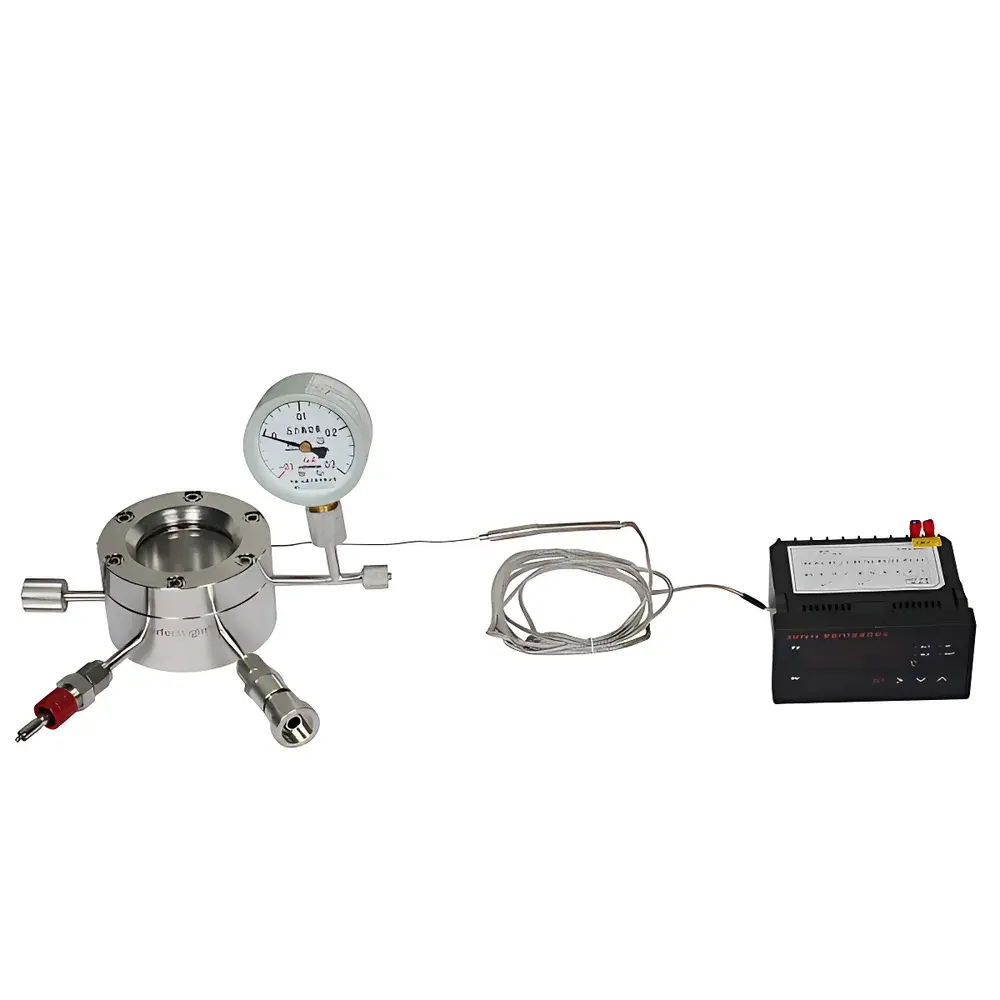
PerfectLight PLR-GPTR Gas–Solid Phase Photo-Thermal Reactor
| Brand | PerfectLight |
|---|---|
| Origin | Beijing, China |
| Model | PLR-GPTR Reactor |
| Reactor Volume | 25–200 mL (selectable) |
| Construction Material | Stainless Steel (316L) |
| Maximum Operating Pressure | 0.3 MPa |
| Operating Temperature Range | Ambient to 300 °C (PLR-GPTRT variant with internal heating) |
| Heating Control | 10-segment programmable PID temperature control |
| Temperature Accuracy | ±0.5 °C |
| Catalyst Bed Geometry | Flat, planar powder bed configuration |
| Gas Inlet/Outlet | Standard 6 mm OD stainless steel tubing with high-pressure quick-connect fittings |
| Pressure Monitoring | Integrated digital pressure transducer |
| Temperature Sensing | In-situ thermocouple embedded in catalyst bed |
| Vacuum Capability | Not rated for vacuum operation |
| Compliance | Designed for laboratory-scale gas–solid photo-thermal catalysis under ambient and low-pressure conditions |
Overview
The PerfectLight PLR-GPTR Gas–Solid Phase Photo-Thermal Reactor is an engineered platform for controlled investigation of heterogeneous photocatalytic and photothermal catalytic processes under combined light irradiation and thermal activation. Unlike conventional batch reactors, the PLR-GPTR series adopts a flattened cylindrical geometry optimized to maximize photon penetration depth and ensure uniform illumination across the catalyst layer while maintaining intimate gas–solid contact. Its core design principle follows the Couette–type flow distribution within a fixed-bed configuration, where gaseous reactants diffuse radially through a thin, uniformly packed catalyst film—minimizing mass transfer limitations and enabling accurate kinetic interpretation. The reactor operates under low-pressure conditions (up to 0.3 MPa gauge), making it suitable for stoichiometric or excess-gas-flow experiments involving CO₂ reduction, NH₃ synthesis, VOC oxidation, H₂ production, and sulfur/nitrogen fixation. Crucially, the system supports mechanistic discrimination between purely thermal, purely photochemical, and synergistic photo-thermal pathways via paired experimental protocols under identical temperature profiles—with and without illumination.
Key Features
- In-situ catalyst bed temperature monitoring via embedded K-type thermocouple, reporting bulk-phase catalyst temperature—not jacket or ambient temperature—to eliminate thermal lag artifacts.
- Integrated digital pressure sensor with real-time data logging, calibrated for continuous monitoring during dynamic gas consumption or evolution events.
- Modular thermal architecture: PLR-GPTRT variants incorporate resistive heating elements directly beneath the catalyst support plate, enabling localized heating independent of external bath or furnace—critical for isolating photothermal contributions.
- 10-segment programmable PID temperature controller with ramp-hold capability, supporting reproducible thermal profiles across multiple experimental cycles (±0.5 °C stability at setpoint).
- High-integrity fluidic interface using stainless steel VCR-style quick-connect fittings rated for repeated cycling up to 0.3 MPa; compatible with both static batch and continuous-flow gas delivery configurations.
- Standardized 6 mm OD stainless tubing connections facilitate seamless integration with GC, MS, FTIR, or online gas analyzers without adapter-induced dead volume.
Sample Compatibility & Compliance
The PLR-GPTR accommodates powdered, pelletized, or monolithic heterogeneous catalysts loaded as flat beds (typically 0.5–2 mm thickness) on perforated stainless steel support plates. Its geometry ensures uniform incident photon flux (when coupled with collimated LED or Xe lamp systems) and minimizes shadowing effects common in tubular or packed-bed reactors. All wetted components are constructed from electropolished 316L stainless steel, compliant with ASTM A276 and ISO 8502-3 surface cleanliness standards for catalytic testing. While not certified for ASME Section VIII or PED compliance, the reactor meets general laboratory safety requirements per ANSI Z9.5 and ISO 15195 for low-pressure chemical apparatus. It is routinely deployed in GLP-aligned research environments where traceability of temperature, pressure, and illumination parameters is maintained through external DAQ systems.
Software & Data Management
The PLR-GPTR does not include proprietary firmware or embedded software. Instead, it interfaces with third-party data acquisition platforms (e.g., LabVIEW, MATLAB, or Python-based DAQ scripts) via analog 0–5 V outputs for pressure and temperature signals. Optional RS485 Modbus RTU communication modules enable integration into centralized process control networks. All temperature and pressure logs are timestamped and exportable in CSV or HDF5 format—supporting audit-ready documentation for method validation under FDA 21 CFR Part 11–aligned workflows when paired with appropriate electronic lab notebook (ELN) systems.
Applications
- Quantitative evaluation of apparent quantum yield (AQY) and turnover frequency (TOF) in CO₂ hydrogenation under simultaneous UV–vis irradiation and controlled thermal input.
- Kinetic deconvolution of light-driven vs. thermally activated surface reaction steps in selective ammonia synthesis from N₂ and H₂.
- Stability assessment of plasmonic catalysts (e.g., Au/TiO₂, Cu/CeO₂) under prolonged photo-thermal stress at 200–300 °C.
- Time-resolved product analysis during photocatalytic VOC degradation (e.g., formaldehyde, toluene) using online GC–MS coupling.
- Screening of metal–organic frameworks (MOFs) and covalent organic frameworks (COFs) for solar-driven sulfur capture and conversion.
FAQ
Does the PLR-GPTR support vacuum operation?
No—the reactor is not designed or rated for vacuum service. Its sealing system and pressure rating are optimized for positive-pressure gas-phase reactions up to 0.3 MPa.
Can I use the PLR-GPTR with corrosive gases such as H₂S or Cl₂?
Compatibility depends on exposure duration and concentration. For short-term, low-concentration studies, 316L stainless steel provides adequate resistance; extended exposure requires optional Hastelloy C-276 lining or quartz-lined variants (custom order).
Is optical access integrated into the reactor body?
Optical access is provided externally via standardized flange-mounted quartz windows (diameter ≥25 mm, thickness ≥5 mm, UV-grade fused silica); window mounting hardware and O-rings are supplied separately per application wavelength range.
What is the maximum recommended catalyst loading mass for the 100 mL model?
For optimal photon penetration and gas diffusion, catalyst mass should be limited to 0.3–0.8 g depending on specific surface area and particle density—ensuring bed height remains ≤1.5 mm.
Are calibration certificates provided for the pressure and temperature sensors?
Factory calibration reports are included with each unit; NIST-traceable recalibration services are available upon request through authorized PerfectLight service centers in North America and Europe.



