
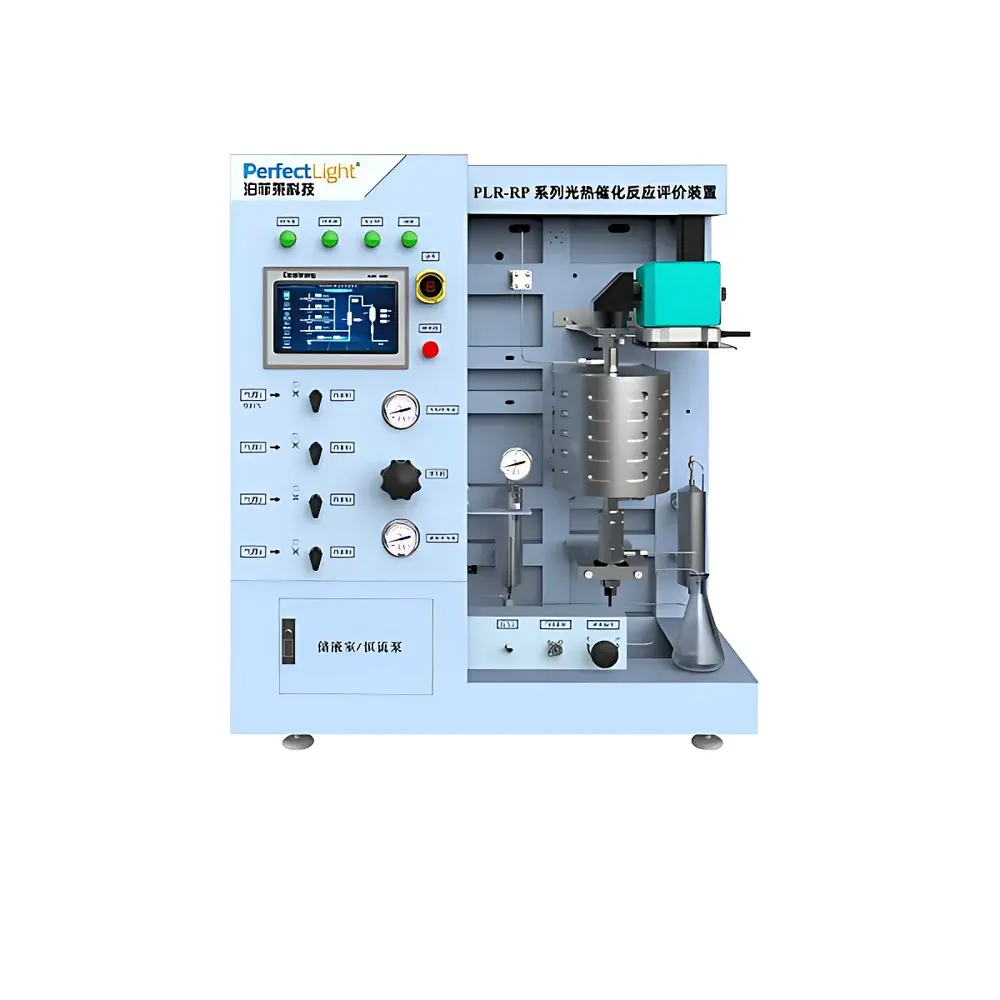
PerfectLight PLR-RP Series Photothermal Catalytic Reaction Evaluation System
| [Brand | PerfectLight |
|---|---|
| Origin | Beijing, China |
| Model | PLR-RP Series |
| Configuration Options | Vertical/Horizonal Furnace |
| Max. Temp. | 650–1050 °C (configurable) |
| Max. Pressure | 3–10 MPa (gauge, configurable) |
| Light Delivery | Quartz Column–Based Axial Illumination & Annular Illumination Reactors |
| Catalyst Loading Capacity | Up to 9 mL (annular mode) |
| Temperature Control | 16-Stage Programmable Ramp/Soak |
| Compliance | Designed for ASTM E2934, ISO 18750, and GLP-aligned experimental traceability] |
Overview
The PerfectLight PLR-RP Series Photothermal Catalytic Reaction Evaluation System is an engineered platform for quantitative investigation of heterogeneous gas–solid phase reactions under simultaneous light irradiation and thermal activation. Unlike conventional thermal catalysis—where reaction kinetics are governed solely by Arrhenius-type energy barriers—or standalone photocatalysis—reliant on photon-induced charge carrier generation—the PLR-RP system enables precise decoupling and synergistic control of photonic and thermal inputs. Its core architecture integrates a quartz-column light delivery path with a thermally isolated, multi-zone furnace assembly, allowing independent yet synchronized modulation of spectral irradiance (UV–Vis–NIR), catalyst bed temperature (650–1050 °C), and system pressure (up to 10 MPa). This dual-input capability supports mechanistic studies of photothermal synergy, including localized lattice excitation, hot-carrier transfer across metal–support interfaces, and non-equilibrium surface adsorption/desorption dynamics—critical for advancing solar-to-chemical energy conversion pathways.
Key Features
- Optimized Photon Delivery Architecture: Dual illumination modes—axial planar illumination via fused-silica light column and annular illumination using coaxially arranged high-power LED or Xe lamp arrays—maximize effective catalyst irradiance area from ≤0.3 cm² (planar) to ≈20 cm² (annular), while maintaining uniform photon flux distribution across the catalyst bed.
- Four-Tier Thermal Management System: Comprising (1) preheating chamber with integrated vaporizer for liquid feedstock, (2) heated transfer lines with PID-controlled伴热带 (≤200 °C), (3) main reaction zone with 16-segment programmable temperature profiling, and (4) post-reaction quench & condensate separation unit—enabling full thermal trajectory control from feed introduction to product recovery.
- Modular Reactor Configurations: Interchangeable vertical and horizontal furnace options; reactor geometries include fixed-bed tubular, annular packed-bed, and custom-designed microchannel variants—all compatible with standard quartz or high-temperature alloy liners (Inconel 625, Hastelloy C-276).
- Dual-Stage Safety Interlock: Hardware-level overtemperature cutoff (two-tier threshold: alarm at T₁, auto-shutdown at T₂) and overpressure response (audible/visual alert + feed shutoff at Pₘₐₓ) conform to IEC 61508 SIL-2 functional safety principles.
- Integrated Analytical Interface: Dedicated gas sampling ports (with Swagelok VCR fittings), in-line pressure regulation (back-pressure regulator with ±0.01 MPa resolution), and standardized GC/MS and QMS coupling interfaces support real-time product speciation and kinetic modeling.
Sample Compatibility & Compliance
The PLR-RP system accommodates powdered, pelletized, or monolithic catalysts (particle size: 20–500 µm; loading volume: 0.9–9 mL). It supports continuous-flow and batch-mode operation with gaseous feeds (H₂, CO₂, CH₄, C₂H₆, NOₓ, SO₂, VOC mixtures) and volatile liquid precursors (e.g., methanol, ethanol, formic acid) delivered via syringe pump–vaporizer–heated line cascade. All wetted components comply with ASTM A269 TP316L stainless steel specifications. Software data logging meets FDA 21 CFR Part 11 requirements for electronic records and signatures, including user authentication, audit trail generation, and immutable timestamping. System design aligns with ISO 18750 (photocatalytic activity testing) and ASTM E2934 (standard guide for photothermal catalysis experiments).
Software & Data Management
The proprietary PerfectLight Control Suite (v4.2+) provides synchronized control of illumination intensity (0–100% dimming, ±0.5% stability), furnace zones (±1 °C accuracy), mass flow controllers (±0.5% FS), and back-pressure regulation. Real-time data acquisition at 10 Hz includes temperature gradients (6-channel K-type thermocouples), pressure transients (0–15 MPa range), light irradiance (calibrated Si photodiode, 250–2500 nm), and optional gas chromatographic retention time alignment. Export formats include CSV, HDF5, and MATLAB .mat for kinetic fitting (e.g., Langmuir–Hinshelwood, Mars–van Krevelen models). Audit logs record all parameter changes, user logins, and system events—fully traceable for GLP/GMP validation.
Applications
- CO₂ hydrogenation to CH₄, CO, or C₂₊ hydrocarbons under solar-simulated irradiation
- CH₄ dry reforming (CO₂ + CH₄ → 2CO + 2H₂) with plasmonic Ni–CeO₂ catalysts
- Photothermally driven NOₓ abatement in simulated flue gas streams
- VOC oxidation (toluene, formaldehyde) over TiO₂–WO₃ heterojunctions
- Fe-based Fischer–Tropsch synthesis under NIR-enhanced thermal activation
- In situ DRIFTS–GC–MS coupled operando studies of surface intermediates
- Catalyst thermal sintering behavior under combined UV irradiation and elevated temperature
FAQ
What light sources are compatible with the PLR-RP system?
Standard configurations support 300–2000 nm output via 300 W Xe arc lamps, 100 W LED arrays (365/405/450/520/850 nm), or tunable monochromator-coupled systems. Custom integration with pulsed lasers (ns–ps duration) is available upon request.
Can the system operate under vacuum or inert atmosphere?
Yes. Base pressure <10⁻³ mbar achievable with turbomolecular pumping; standard operation supports N₂, Ar, He, and synthetic air purging with O₂ content control down to 10 ppm.
Is catalyst characterization data exportable for publication?
All raw sensor outputs—including time-stamped temperature/pressure/light intensity traces and calibrated GC peak areas—are exportable in machine-readable formats compliant with FAIR (Findable, Accessible, Interoperable, Reusable) data principles.
How is temperature uniformity verified across the catalyst bed?
Each furnace variant undergoes factory calibration using embedded thermocouple mapping (±0.5 mm spatial resolution) and infrared thermography under representative load conditions; certificate of uniformity (±2 °C over 50 mm axial length) is supplied with each unit.
Does the system support long-duration stability testing (e.g., >100 h)?
Yes. Continuous operation up to 500 h has been validated with redundant thermal fuses, active cooling of optical components, and automated leak-check routines executed every 24 h.




