
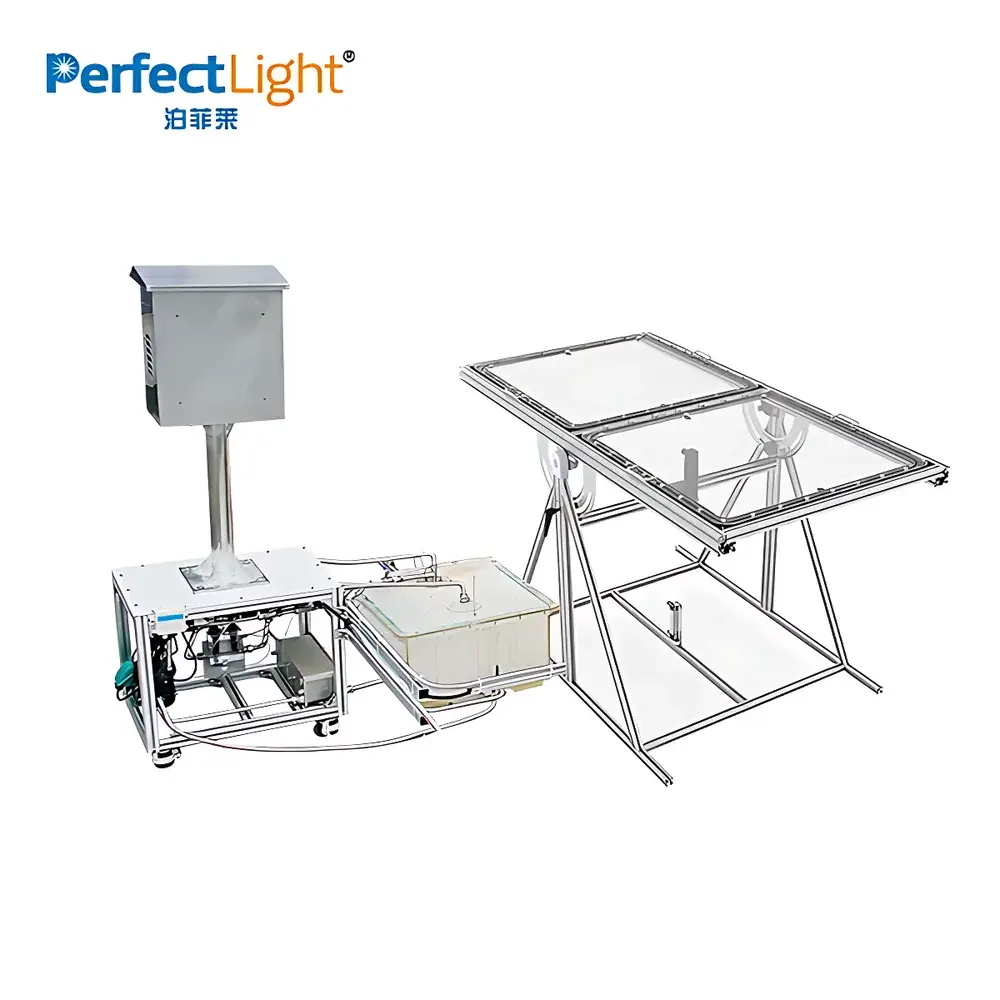
PerfectLight PLR-SPRF Pilot-Scale Flat-Plate Photocatalytic Reactor
| Brand | PerfectLight |
|---|---|
| Origin | Beijing, China |
| Manufacturer Type | Authorized Distributor |
| Product Category | Domestic |
| Model | PLR-SPRF |
| Instrument Classification | Photocatalytic Reactor |
| Usable Volume | Medium-Scale |
| Maximum Illuminated Area | 0.5 m² (80 × 70 cm) |
| Optional Areas | 0.1 m² (40 × 40 cm), 0.25 m² (60 × 60 cm), 1.0 m² (modular assembly) |
| Liquid Layer Thickness | 1–5 mm |
| Substrate Compatibility | Non-woven fabric, carbon paper, carbon cloth, high-borosilicate glass, PMMA |
| Tilt Adjustment Range | 0–90° |
| Continuous Flow Liquid Flow Rate | 0–200 mL/min |
| Carrier Gas Flow Rate | 4–100 mL/min |
| Operating Temperature | Ambient to 60 °C |
| Operating Pressure | Atmospheric (≤50 kPa for sealed mode) |
| Gas Recirculation Pump Flow | 1.5–10 L/min |
| Wetted Materials | PA66, PMMA, PP, Fluoroelastomer |
| Control System | Integrated PLC with HMI touchscreen |
| Measured Parameters | Flow rate, pressure, pH, ORP, temperature |
Overview
The PerfectLight PLR-SPRF Pilot-Scale Flat-Plate Photocatalytic Reactor is an engineered platform designed to bridge the critical gap between laboratory-scale photocatalytic discovery and industrially viable process implementation. Unlike conventional batch photoreactors used in mechanistic studies, the PLR-SPRF operates on the principle of continuous-flow, immobilized-catalyst photochemistry—where incident photons drive redox reactions at solid–liquid interfaces under controlled hydrodynamic and irradiation conditions. Its flat-plate geometry enables uniform photon flux distribution across large active areas (up to 1.0 m² via modular coupling), while maintaining laminar flow regimes that ensure reproducible mass transfer coefficients and predictable light penetration depth. This architecture directly addresses scale-up challenges inherent in photocatalysis: non-uniform irradiation, thermal gradient formation, catalyst leaching, and gas–liquid phase separation inefficiency. The system is specifically validated for solar-driven water splitting applications but is equally applicable to CO₂ reduction, organic pollutant degradation, and selective photo-oxidation processes requiring spatially resolved reaction engineering.
Key Features
- Modular flat-plate reactor design supporting customizable illuminated areas: standard configurations include 0.1 m² (40 × 40 cm), 0.25 m² (60 × 60 cm), and 0.5 m² (80 × 70 cm); scalable to 1.0 m² via standardized flanged interconnections.
- Multi-substrate mounting system with interchangeable support blocks—compatible with conductive (carbon paper, carbon cloth), insulating (high-borosilicate glass, PMMA), and flexible (non-woven polymer) catalyst supports—enabling systematic evaluation of substrate–catalyst interfacial charge transfer.
- Integrated liquid circulation loop with precision peristaltic or diaphragm pump (0–200 mL/min), ensuring consistent catalyst wetting, minimized concentration polarization, and passive removal of gaseous products from the reaction boundary layer.
- Dedicated gas–liquid separation module featuring coalescing filters and adjustable headspace volume, allowing quantitative collection and real-time sampling of H₂, O₂, or CO via GC-compatible manual injection valve or gas-tight Tedlar® bags.
- PLC-based control architecture with 7-inch resistive touchscreen HMI; supports closed-loop monitoring and setpoint regulation of liquid flow rate, system pressure, solution pH, oxidation–reduction potential (ORP), and temperature (ambient to 60 °C).
- Full mechanical adjustability: reactor tilt angle (0–90°) optimized for gravitational drainage, bubble release dynamics, and incident irradiance alignment—critical for outdoor solar testing or artificial lamp array integration.
Sample Compatibility & Compliance
The PLR-SPRF accommodates heterogeneous photocatalysts immobilized on thermally and chemically stable substrates, including metal oxides (e.g., TiO₂, BiVO₄), nitrides (g-C₃N₄), and emerging single-atom catalysts. All wetted components—PA66 structural frames, PMMA optical windows, PP fluid manifolds, and fluorocarbon elastomer seals—are selected for UV resistance, low extractables, and compatibility with aqueous electrolytes (pH 2–12) and mild organic cosolvents. The system meets ISO 17025-relevant design principles for test equipment traceability and supports GLP-compliant operation when paired with audit-trail-enabled data logging software. While not certified to IEC 61000-6-3 or UL 61010-1 out-of-the-box, its electrical architecture conforms to CE marking prerequisites for laboratory instrumentation intended for non-hazardous environments.
Software & Data Management
Data acquisition is performed via embedded Modbus TCP communication between the PLC controller and optional PC-based SCADA software (provided as Windows-compatible executable). Raw sensor outputs—including analog 4–20 mA pH/ORP signals, pulse-output flow meters, and digital pressure transducers—are time-stamped at 1 Hz resolution and stored in CSV format. The interface supports user-defined alarm thresholds (e.g., pH drift > ±0.3 units, flow deviation > ±5%), automatic event logging, and export of calibrated parameter histories for post-run kinetic analysis. For regulatory environments, optional 21 CFR Part 11 compliance packages are available—including electronic signatures, role-based access control, and immutable audit trails—enabling use in GMP-aligned photocatalyst qualification workflows.
Applications
- Solar hydrogen production process validation using earth-abundant photocatalysts under simulated AM 1.5G or natural sunlight exposure.
- Quantitative structure–activity relationship (QSAR) studies correlating catalyst morphology, support conductivity, and quantum yield across reactor scales.
- Long-term stability testing (>500 h) of immobilized catalyst systems under continuous illumination and flow, with periodic ex situ XRD/XPS characterization.
- Reaction engineering analysis of mass transfer limitations (e.g., H₂ desorption kinetics, O₂ bubble detachment frequency) via synchronized pressure transient and gas chromatography measurements.
- Evaluation of membrane-integrated variants for selective product extraction or in situ pH control during multi-step photoelectrosynthetic cascades.
FAQ
Can the PLR-SPRF operate under vacuum or elevated pressure?
The standard configuration is rated for atmospheric operation and sealed-mode pressures up to 50 kPa(g). Custom pressure-rated viewports and reinforced gasketing are available for ≤100 kPa(g) applications upon request.
Is UV-C irradiation supported?
Yes—high-borosilicate glass plates transmit down to ~300 nm; fused silica or CaF₂ optical windows can be substituted for full UV-C (200–280 nm) compatibility.
How is catalyst loading quantified and reproduced across modules?
Each substrate mounting frame includes engraved fiducial marks and standardized clamping torque specifications; users are advised to employ gravimetric loading protocols verified by SEM-EDS mapping prior to cross-module comparison.
Does the system support automated catalyst screening?
While not a multi-well parallel reactor, the modular interface allows sequential substitution of pre-loaded substrate cassettes—enabling semi-automated throughput improvement when combined with programmable autosamplers and GC/MS.
What maintenance intervals are recommended for continuous operation?
Peristaltic tubing should be replaced every 500 operational hours; pH/ORP electrodes require calibration before each test campaign and replacement every 6 months under continuous use; optical surfaces demand weekly cleaning with IPA and lint-free wipes to maintain >92% transmittance.



