
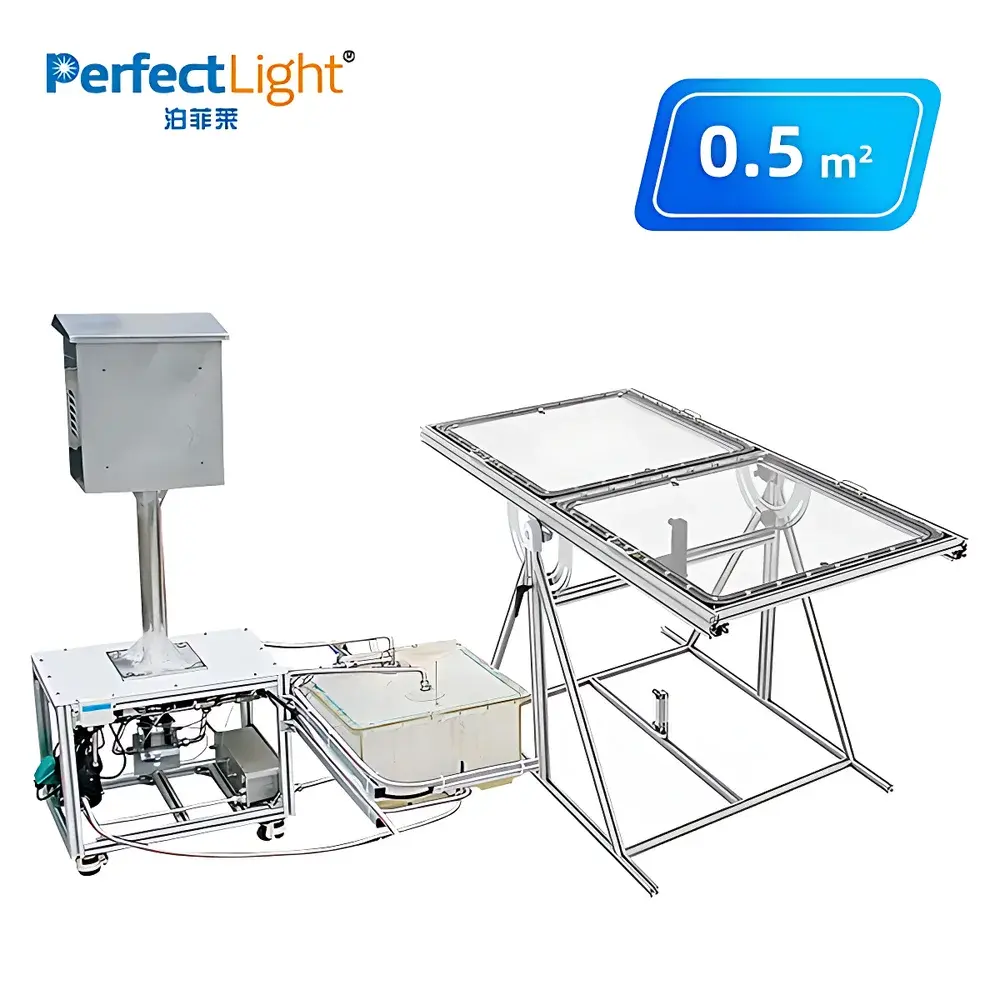
PerfectLight PLR-SPRF Pilot-Scale Flat-Plate Photocatalytic Reactor System
| Brand | PerfectLight |
|---|---|
| Origin | Beijing, China |
| Model | PLR-SPRF |
| Reactor Type | Flat-plate continuous-flow photocatalytic reactor |
| Maximum Illuminated Area | 1.0 m² (configurable via modular panels) |
| Active Illumination Area Options | 0.1 m² (40×40 cm), 0.25 m² (60×60 cm), 0.5 m² (80×70 cm) |
| Liquid Layer Thickness | 1–5 mm |
| Flow Rate Range (Liquid) | 0–200 mL/min |
| Carrier Gas Flow Rate | 4–100 mL/min |
| Operating Temperature | Ambient to 60 °C |
| Operating Pressure | Atmospheric or up to 50 kPa (gauge) |
| Reactor Tilt Adjustment | 0–90° continuous |
| Compatible Substrate Materials | Non-woven fabric, carbon paper, carbon cloth, high-borosilicate glass, PMMA, PA66, PP, fluororubber |
| Fluid Contact Materials | PA66, PMMA, PP, FKM |
| Control System | Integrated PLC with HMI touchscreen interface |
| Onboard Sensors | Flow rate, pressure, pH, ORP, temperature |
| Gas Sampling Interface | Manual injection valve for direct GC coupling or gas bag collection |
| Gas–Liquid Separation | Integrated membrane-based separator with calibrated gas outlet |
| Compliance | Designed for GLP-aligned pilot-scale process development per ISO 15190 and ASTM E2500-23 guidelines |
Overview
The PerfectLight PLR-SPRF Pilot-Scale Flat-Plate Photocatalytic Reactor System is an engineered platform for translational photoreactor development—from laboratory discovery to pre-commercial process validation. Unlike benchtop batch reactors optimized for mechanistic studies, the PLR-SPRF implements a continuous-flow, flat-plate architecture grounded in fundamental principles of photon flux distribution, mass transfer enhancement, and interfacial catalysis kinetics. Its design addresses critical scale-up challenges inherent in heterogeneous photocatalysis: non-uniform light penetration, thermal gradient formation, catalyst-substrate adhesion variability, and gas–liquid phase separation efficiency. By decoupling optical geometry from fluidic dynamics—via independently adjustable illumination angle (0–90°), precisely controlled liquid film thickness (1–5 mm), and segmented flow management—the system enables quantitative correlation between lab-scale quantum yield measurements and pilot-level volumetric productivity. It serves as a bridge between kinetic modeling (e.g., Langmuir–Hinshelwood rate expressions) and engineering parameters required for techno-economic analysis (TEA) and life-cycle assessment (LCA) of solar fuel production processes.
Key Features
- Modular Illuminated Area Scaling: Standard configurations support 0.1 m² (40×40 cm), 0.25 m² (60×60 cm), and 0.5 m² (80×70 cm) active irradiation zones; multiple units integrate via standardized flanged interfaces to achieve ≥1.0 m² total illuminated surface—validated in field deployments at Tsinghua University and Beifang University of Nationalities.
- Substrate-Agnostic Catalyst Mounting: Interchangeable support blocks accommodate diverse photocatalyst carriers—including conductive carbon substrates (paper, cloth), optically transparent dielectrics (high-borosilicate glass, PMMA), and polymeric matrices (PA66, PP)—enabling systematic evaluation of charge-transfer resistance and mechanical stability under hydrodynamic shear.
- In-Line Gas–Liquid Phase Management: Continuous laminar flow ensures uniform catalyst wetting while entraining evolved gaseous products (e.g., H₂, O₂, CO) into a dedicated separation chamber; integrated hydrophobic membrane barriers prevent liquid carryover, enabling gravimetric or volumetric quantification of gas yields with ±2% repeatability (n = 12).
- Real-Time Process Monitoring & Control: PLC-driven HMI interface monitors and regulates liquid flow (0–200 mL/min), carrier gas flow (4–100 mL/min), tilt angle, temperature (ambient–60 °C), pressure (≤50 kPa), pH, and oxidation-reduction potential (ORP); all parameters logged with timestamped audit trails compliant with FDA 21 CFR Part 11 requirements.
- Direct Analytical Integration: Built-in manual sampling valve allows seamless connection to gas chromatography (GC-TCD/FID) without system depressurization; optional integration with online FTIR or mass spectrometry for transient product speciation.
Sample Compatibility & Compliance
The PLR-SPRF accommodates heterogeneous photocatalysts immobilized on rigid or flexible supports, including TiO₂-, g-C₃N₄-, and perovskite-based formulations deposited via dip-coating, spray pyrolysis, or electrodeposition. All wetted components—fluid paths, seals, and reactor plates—are constructed from chemically resistant polymers (PA66, PMMA, PP) and fluorinated elastomers (FKM), ensuring compatibility with aqueous electrolytes, organic solvents (e.g., methanol/water mixtures), and corrosive redox mediators. The system adheres to ISO 15190:2020 (medical laboratories — requirements for safety) for general equipment risk assessment and aligns with ASTM E2500-23 (“Standard Guide for Specification, Design, and Verification of Pharmaceutical and Biopharmaceutical Manufacturing Systems”) for documented design qualification (DQ) and installation qualification (IQ) protocols. It supports GLP-compliant data integrity through electronic signatures, user access levels, and immutable parameter history logs.
Software & Data Management
Control firmware runs on a real-time Linux-based PLC with deterministic I/O scanning (<50 ms cycle time). The HMI software provides dual-mode operation: guided wizard mode for routine experiments and expert mode for custom PID loop tuning (e.g., cascade control of flow + temperature). All sensor data are exported in CSV/Excel format with embedded metadata (UTC timestamps, operator ID, experiment tag). Optional cloud synchronization (via TLS 1.3-encrypted MQTT) enables remote monitoring and centralized database aggregation across multi-site pilot facilities. Audit trail functionality satisfies ALCOA+ principles (Attributable, Legible, Contemporaneous, Original, Accurate, Complete, Consistent, Enduring, Available) per PIC/S PI 041-2 guidelines.
Applications
- Solar-driven water splitting for green hydrogen and oxygen co-production
- Photocatalytic CO₂ reduction to C₁–C₂ hydrocarbons and oxygenates
- Advanced oxidation processes (AOPs) for trace contaminant mineralization in wastewater
- Photoelectrochemical (PEC) device prototyping with integrated counter-electrode compartments
- Kinetic mapping of photon-flux–dependent reaction orders under AM1.5G or customized spectral irradiance
- Thermal–photonic synergy studies in hybrid solar-thermal photocatalysis
FAQ
What is the maximum allowable operating pressure for sealed-mode operation?
The system is rated for continuous operation at ≤50 kPa (gauge) with standard fluororubber seals; higher-pressure variants (up to 200 kPa) are available with FFKM gasketing and reinforced viewport assemblies.
Can the PLR-SPRF be used with slurry-based catalysts?
No—it is specifically designed for immobilized catalyst configurations; slurry systems require alternative reactor geometries (e.g., annular or microchannel designs) to avoid clogging and ensure uniform irradiation.
Is UV–Vis spectral irradiance calibration supported?
Yes—optional NIST-traceable radiometric calibration kits (250–800 nm) are available, including cosine-corrected silicon photodiode sensors and spectral irradiance meters compatible with IEC 60904-9 standards.
How is temperature uniformity maintained across the illuminated area?
Active backside cooling channels integrated into the reactor plate substrate enable ΔT < ±1.2 °C across 0.5 m² at 60 °C setpoint, verified by IR thermography per ASTM E1933-19.
Does the system support automated catalyst loading/unloading cycles?
Not natively—but programmable tilt actuation (0–90°) combined with gravity-assisted drainage permits semi-automated catalyst replacement protocols; full automation requires integration with third-party robotic handling modules.



