
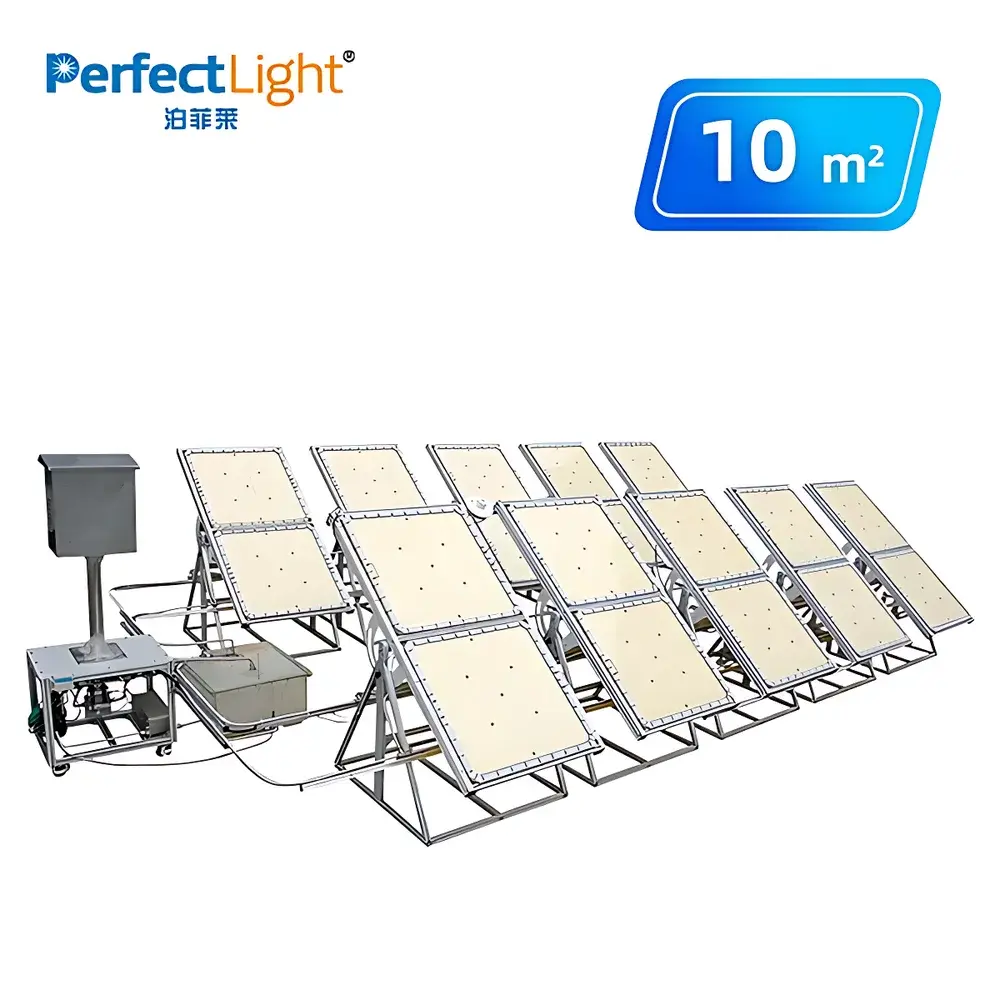
PerfectLight PLR-SPRG Industrial-Scale Flat-Plate Photoreactor System
| Brand | PerfectLight |
|---|---|
| Origin | Beijing, China |
| Model | PLR-SPRG |
| Effective Illuminated Area per Unit | 0.5 m² |
| Modular Scalability | Up to 100 m² (installed max: 10 m²) |
| Liquid Layer Thickness | 1–5 mm |
| Flow Rate Range (Liquid) | 0–200 mL/min |
| Carrier Gas Flow Rate | 4–100 mL/min |
| Operating Temperature | Ambient to 60 °C |
| Maximum Operating Pressure | ≤50 kPa |
| Reactor Tilt Angle Adjustment | 0–90° continuous |
| Wetted Materials | PA66, PMMA, PP, Fluoroelastomer |
| Control System | Integrated PLC with HMI touchscreen interface |
| In-situ Monitoring | Flow rate, pressure, pH, ORP, total/individual unit flow, gas circulation rate (10–50 L/min) |
Overview
The PerfectLight PLR-SPRG Industrial-Scale Flat-Plate Photoreactor System is an engineered platform for translational photochemical process development—from laboratory validation through pilot-scale demonstration to pre-commercial production. Unlike conventional batch photoreactors, the PLR-SPRG employs a modular, flat-plate architecture based on standardized 0.5 m² illuminated reaction units. Each unit operates under controlled laminar or transitional liquid flow across a catalyst-coated surface, enabling uniform photon flux distribution and predictable mass transfer kinetics. This design directly addresses the “scale-up effect” inherent in photocatalytic systems—where deviations in light penetration depth, interfacial residence time, gas bubble dynamics, and thermal gradients cause non-linear performance shifts between lab and plant scales. By maintaining geometric and hydrodynamic similarity across unit modules, the PLR-SPRG supports systematic scalability while preserving reaction selectivity, quantum yield reproducibility, and catalyst stability metrics essential for technology transfer.
Key Features
- Modular illumination architecture: Standardized 0.5 m² flat-plate reaction units with precision-machined optical interfaces; scalable via series/parallel configuration to 5 m², 10 m², or up to 100 m² (under construction).
- Multi-substrate compatibility: Interchangeable support blocks accommodate catalyst immobilization on non-woven fabrics, carbon paper, carbon cloth, borosilicate glass, or PMMA substrates—enabling optimization of light absorption, charge carrier transport, and mechanical durability.
- Integrated fluidic management: Peristaltic or diaphragm-driven liquid delivery ensures stable flow rates from 0 to 200 mL/min per unit; adjustable tilt (0–90°) enables gravity-assisted flow control and optimized liquid film thickness (1–5 mm).
- Dedicated gas–liquid separation: A passive phase-separation chamber captures evolved gaseous products (e.g., H₂, O₂, CO, CH₄) from the recirculating liquid stream; separated gas is routed to calibrated mass flow meters or sampling ports for offline GC/FID/TCD analysis.
- Real-time electrochemical monitoring: On-line sensors measure solution pH and oxidation–reduction potential (ORP) within the reaction loop, supporting mechanistic studies of redox-active photocatalytic cycles.
- PLC-based HMI control: Touchscreen interface provides simultaneous visualization and setpoint adjustment for liquid flow, gas flow (4–100 mL/min), pressure (≤50 kPa), temperature (ambient to 60 °C), and gas recirculation rate (10–50 L/min).
Sample Compatibility & Compliance
The PLR-SPRG accommodates heterogeneous photocatalysts—including TiO₂, g-C₃N₄, MOFs, and plasmonic nanoparticles—immobilized on thermally and chemically stable supports. All wetted components comply with ISO 10993-5 cytotoxicity screening standards for polymer selection (PA66, PMMA, PP) and fluorocarbon elastomer seals. The system supports GLP-aligned operation through audit-trail-capable data logging (timestamped sensor outputs, actuator commands, alarm events) and optional 21 CFR Part 11-compliant user authentication and electronic signature modules. It meets ASTM E2678-20 requirements for photoreactor calibration methodology and is compatible with ISO 11469-compliant material traceability documentation upon request.
Software & Data Management
The embedded PLC controller logs all process variables at configurable intervals (1 s to 5 min resolution) to internal SD storage or external NAS via Ethernet. Export formats include CSV and HDF5 for direct import into MATLAB, Python (Pandas), or Aspen Custom Modeler. Optional OPC UA server integration enables real-time data federation with enterprise MES or DCS environments. Historical datasets support statistical process control (SPC) charting, multivariate correlation analysis (e.g., photon flux vs. H₂ evolution rate), and kinetic model parameter estimation using nonlinear regression tools.
Applications
- Solar fuel synthesis: Water splitting, CO₂ reduction, and N₂ fixation under simulated AM1.5G or monochromatic LED illumination.
- Environmental remediation: Continuous-flow degradation of micropollutants (pharmaceuticals, pesticides) in aqueous matrices.
- Photocatalytic fine chemical synthesis: Selective C–H activation, asymmetric epoxidation, and nitroarene reduction under mild conditions.
- Materials screening: High-throughput evaluation of photocatalyst coatings under industrially relevant irradiance (≥1000 W/m²) and residence time distributions.
- Technology readiness level (TRL) advancement: Bridging TRL 4 (component validation in lab environment) to TRL 6 (system prototype demonstration in relevant environment), as defined by NASA and EU Horizon frameworks.
FAQ
What is the maximum total illuminated area currently deployed in operational installations?
The largest commissioned array is 10 m² (China National Petroleum Corporation Research Institute). A 100 m² system is under engineering commissioning.
Can the system operate under vacuum or elevated pressure?
It is rated for operation up to 50 kPa(g) positive pressure; vacuum operation is not supported due to structural design constraints of the flat-plate manifold.
Is catalyst leaching quantifiable during long-term operation?
Yes—integrated ICP-MS or AAS-compatible liquid sampling ports allow periodic effluent analysis; combined with mass balance calculations from gas chromatography, leaching rates can be determined over >500 h continuous runs.
Does the system support wavelength-resolved action spectrum measurement?
When coupled with tunable LED arrays or monochromator-integrated light sources, spectral responsivity mapping is achievable via synchronized irradiance calibration and product yield tracking.
Are spare parts and technical documentation available internationally?
Yes—full OEM schematics, maintenance manuals, and certified replacement modules (reaction plates, seal kits, sensor assemblies) are distributed globally through authorized technical partners with local service certification.



