
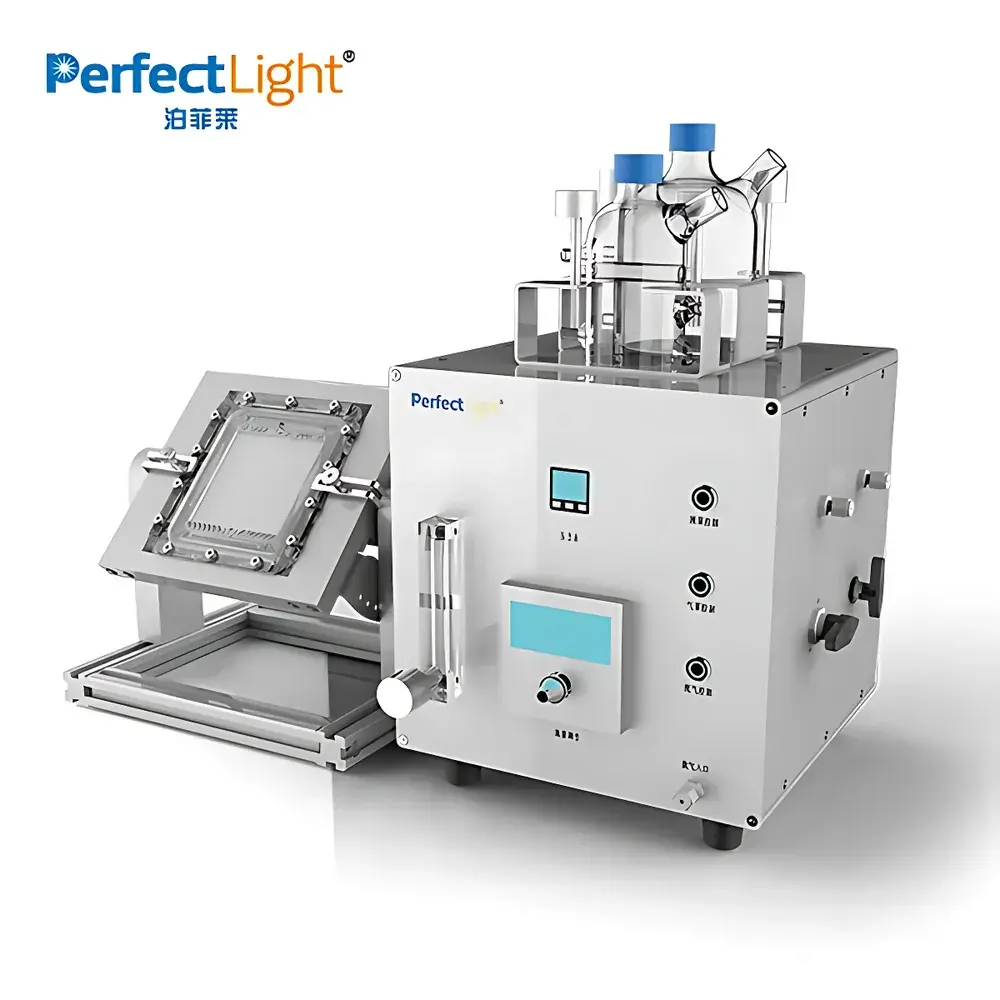
PerfectLight PLR-SPRL Benchtop Flat-Plate Photoreactor
| Brand | PerfectLight |
|---|---|
| Origin | Beijing, China |
| Model | PLR-SPRL |
| Reactor Type | Flat-plate photoreactor |
| Effective Illuminated Area | 10×10 cm² (configurable: 5×5, 15×15, 20×20, 25×25 cm²) |
| Liquid Layer Thickness | 1–5 mm (customizable) |
| Contact Materials | PA66, PMMA, PP, Fluoroelastomer |
| Tilt Angle Adjustment | 0–90° continuous |
| Continuous Flow Liquid Rate | 0–1 L/min |
| Carrier Gas Flow | 4–100 mL/min |
| Operating Temperature | Ambient to 60 °C |
| Operating Pressure | Atmospheric (sealed mode ≤50 kPa) |
| Sealed-Mode Gas Recirculation Flow | 1–1.5 L/min |
| Cooling | External water bath with circulating coolant |
Overview
The PerfectLight PLR-SPRL is a benchtop flat-plate photoreactor engineered for controlled, scalable photochemical reaction studies under laboratory conditions. Unlike conventional stirred-tank or batch-type photoreactors—where light penetration, mass transfer, and photon flux distribution are highly heterogeneous—the PLR-SPRL employs a planar geometry that enables uniform irradiation across the catalyst surface, precise control of optical path length, and systematic decoupling of radiative, thermal, and hydrodynamic variables. Its design adheres to fundamental principles of photocatalytic reactor engineering: photon absorption efficiency is maximized through optimized incident angle (0–90° adjustable), while interfacial mass transfer kinetics are quantified via tunable liquid film thickness (1–5 mm) and laminar flow regimes. This architecture supports first-principles investigation of heterogeneous photocatalysis—including TiO₂, g-C₃N₄, MOFs, and perovskite-based systems—under reproducible, instrumented conditions aligned with ASTM E2623-20 (Standard Guide for Photocatalytic Reactor Characterization) and ISO 22197-1 (Photocatalytic Air Purification Materials).
Key Features
- Modular flat-plate configuration with interchangeable reactor plates (5×5 to 25×25 cm²), enabling stepwise scale-up studies while preserving geometric similarity and dimensionless group consistency (e.g., Reynolds, Damköhler, and optical depth numbers).
- Multi-substrate compatibility: accommodates rigid and flexible supports—including carbon paper, carbon cloth, nonwoven textiles, borosilicate glass, and PMMA—secured via customizable support blocks for catalyst immobilization without adhesive interference.
- Integrated thermostatic control via external water bath circulation, maintaining isothermal operation (ambient to 60 °C) with ±0.5 °C stability—critical for kinetic studies where Arrhenius parameters must be resolved independently from thermal runaway artifacts.
- Dual operational modes: sealed-batch (with internal gas recirculation pump, 1–1.5 L/min) for initial catalyst screening and low-turnover experiments; and continuous-flow mode (liquid 0–1 L/min, carrier gas 4–100 mL/min) for steady-state activity assessment, residence time distribution analysis, and long-term stability testing.
- Direct GC coupling interface: built-in manual sampling valve (Swagelok SS-4UTK) permits offline or semi-online product quantification without system depressurization or catalyst disturbance—supporting compliance with GLP traceability requirements.
Sample Compatibility & Compliance
The PLR-SPRL is compatible with aqueous, organic, and biphasic reaction media. Wetted components (PA66, PMMA, PP, fluoroelastomer seals) ensure chemical resistance to common solvents (e.g., methanol, acetonitrile, water, dilute acids/bases) and photocatalytic byproducts (e.g., H₂O₂, •OH radicals). All materials meet USP Class VI biocompatibility standards for non-leaching performance. The reactor’s open architecture facilitates visual inspection, in situ UV-Vis spectroscopy probe integration, and post-reaction catalyst recovery. It conforms to IEC 61000-6-3 (EMC emissions) and IEC 61010-1 (safety requirements for laboratory equipment). While not certified for hazardous area use, its atmospheric/low-pressure design aligns with OSHA 1910.119 process safety thresholds for non-reactive photochemistry.
Software & Data Management
The PLR-SPRL operates as a hardware platform requiring external instrumentation for data acquisition. Temperature, flow rates, and pressure are monitored via third-party calibrated sensors (e.g., Omega PX409, Bronkhorst EL-FLOW Select), with outputs routed to LabVIEW, MATLAB, or Python-based DAQ systems. Experimental metadata—including illumination intensity (measured separately with calibrated Si photodiode or spectroradiometer), incident photon flux (μmol·m⁻²·s⁻¹), and cumulative photon dose—is manually logged or imported into structured CSV/Excel templates compliant with FAIR data principles. Audit trails, user access logs, and electronic signatures are implemented at the host software level to satisfy FDA 21 CFR Part 11 readiness when deployed in regulated R&D environments.
Applications
- Kinetic modeling of photocatalytic degradation (e.g., phenol, rhodamine B) under controlled photon flux and mass transfer constraints.
- Quantitative structure–activity relationship (QSAR) development for supported photocatalysts using variable substrate geometries and flow regimes.
- Thermal management validation for exothermic photo-redox reactions (e.g., CO₂ reduction, H₂ evolution) where localized heating compromises selectivity.
- Interfacial charge-transfer characterization via simultaneous electrochemical impedance spectroscopy (EIS) and optical monitoring.
- Process intensification studies bridging lab-scale discovery to pilot-scale flat-plate reactor design—particularly relevant for solar fuel generation and air/water remediation modules.
FAQ
Can the PLR-SPRL be used under vacuum or elevated pressure?
No—it is rated for atmospheric operation and sealed-mode use up to 50 kPa(g); pressure-rated variants require custom engineering and are not part of the standard configuration.
Is UV-C irradiation supported?
Yes, provided the selected window material (e.g., fused silica or high-transmission quartz) and light source emit within the desired spectral band; standard configurations include UV-A/visible compatibility.
How is light uniformity verified across the active area?
Users are advised to perform spatial irradiance mapping using a calibrated scanning photodiode or CCD-based imaging radiometer prior to kinetic experiments; PerfectLight provides recommended measurement protocols in the operator manual.
Does the system include a light source?
No—the PLR-SPRL is a reactor platform only; compatible light sources (Xe, LED, or Hg lamps with appropriate collimation and cooling) must be selected and integrated externally.
Can the tilt angle be motorized for dynamic angle control?
Not in the base model; angle adjustment is manual via precision-machined hinge and locking mechanism—motorized actuation is available as an OEM option upon request.



