
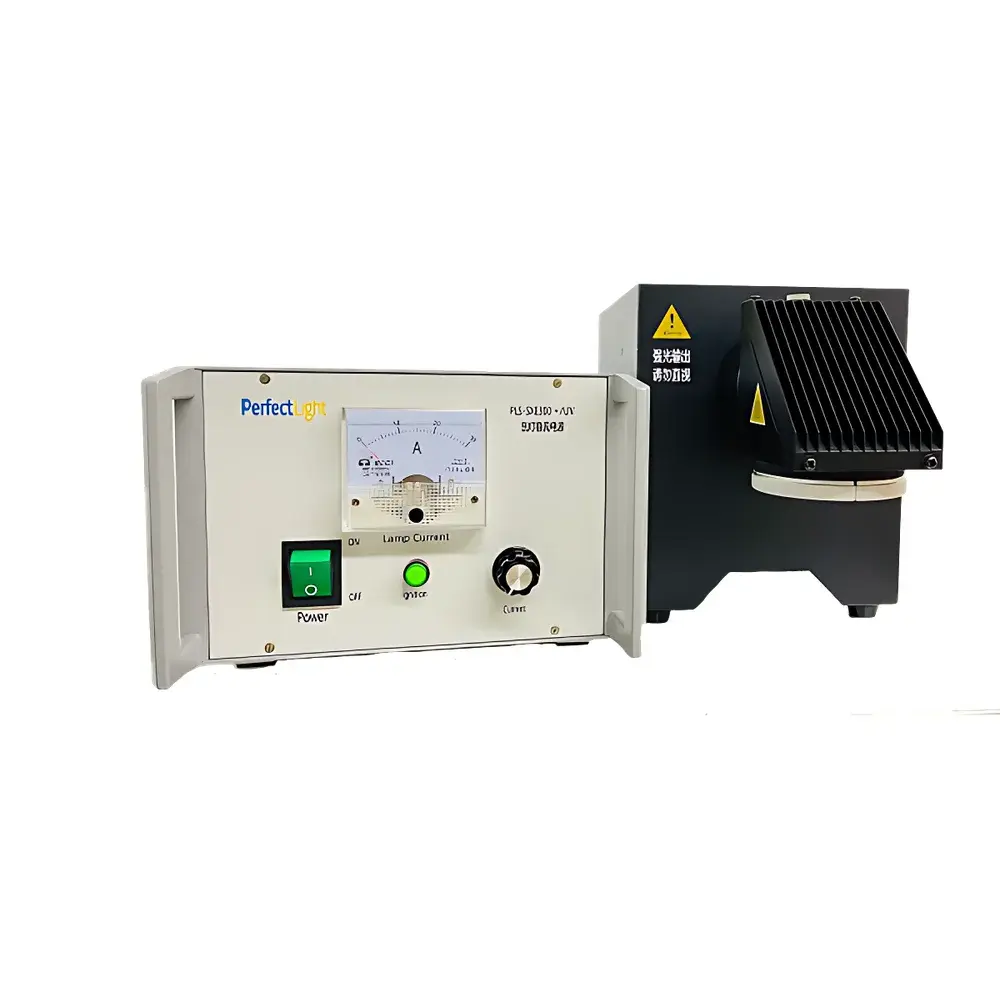
PerfectLight Solar Simulator with Xenon Lamp Source
| Brand | PerfectLight |
|---|---|
| Origin | Beijing, China |
| Manufacturer Type | Authorized Distributor |
| Product Origin | Domestic (China) |
| Model | Solar Simulator |
| Light Source Type | Xenon Arc Lamp |
| Illumination Mode | External Irradiation |
| Total Optical Power | 50 W |
| Spectral Range | 320–780 nm (extendable to 2500 nm) |
| Beam Divergence | Avg. 6° |
| Spot Diameter | 30–60 mm (distance-dependent) |
| Long-Term Irradiance Stability | ≤ ±3% |
| Lamp Power | 300 W |
| Power Adjustment Range | 150–300 W |
| Lamp Lifetime | >1000 h (under standard photocatalytic operating conditions) |
| Max Current Limit | 21 A |
| Trigger System | Integrated High-Voltage Ignition (dual-stage, no high-voltage cabling) |
| Cooling | Passive Aluminum Heat Sink Assembly |
| Electrical Interface | Low-Voltage DC Control Link (lamp box ↔ power supply) |
Overview
The PerfectLight Solar Simulator is a laboratory-grade xenon-arc-based optical source engineered for reproducible, spectrally broad irradiation in photochemical and photophysical research. It operates on the principle of thermal plasma emission from a stabilized DC-powered xenon short-arc lamp, delivering continuous-spectrum irradiance closely approximating AM1.5G solar spectral irradiance between 320 nm and 780 nm—fully compliant with ISO 9022-17 and ASTM E927-19 criteria for Class AAA spectral match when paired with appropriate bandpass or cut-on filters. The system is not a calibrated reference standard but is designed for comparative photocatalytic activity screening, kinetic studies, and process optimization under controlled illumination. Its external irradiation architecture enables flexible integration into custom reaction chambers, gas-phase flow reactors, and liquid-phase slurry photoreactors without optical coupling constraints.
Key Features
- High-stability xenon arc lamp with digitally regulated constant-current power supply, ensuring ≤ ±3% irradiance drift over 8-hour continuous operation.
- Passive thermal management via oversized aluminum heat sink assembly—enabling uninterrupted irradiation without forced-air or water cooling infrastructure.
- Integrated dual-stage ignition circuitry: high-voltage pulse generation occurs entirely within the lamp housing; zero high-voltage transmission through interconnect cables—enhancing operator safety and electromagnetic compatibility (EMC).
- Modular optical interface supporting interchangeable filter mounts for UV (254/365 nm), visible (400–700 nm), NIR (780–1400 nm), and narrowband (±5 nm FWHM) spectral selection.
- Microcontroller-based digital control unit enabling programmable ramp-up/down, duty-cycle modulation, and real-time current monitoring via RS-232 or USB-C interface.
- Metal-shielded lamp housing meeting IEC 61000-6-3 radiated emission limits and providing full RF shielding for sensitive electrochemical or spectroscopic measurements.
Sample Compatibility & Compliance
The simulator accommodates heterogeneous photocatalysts (e.g., TiO₂, g-C₃N₄, MOFs), thin-film photoelectrodes, suspension-based colloidal systems, and gas-phase catalytic beds. Its external illumination geometry supports standardized reactor configurations per ISO 22197-1 (NO removal), ISO 22197-2 (acetaldehyde degradation), and ASTM D6988 (photocatalytic self-cleaning surface testing). While not certified to IEC 61215 or IEC 60904-9 for PV device calibration, it meets functional requirements for academic and industrial R&D workflows where relative quantum yield comparison—not absolute spectral irradiance traceability—is the primary objective. All electrical subsystems conform to GB/T 18268.1 (equivalent to IEC 61326-1) for laboratory equipment EMC and safety.
Software & Data Management
The embedded firmware supports command-line protocol (ASCII over serial) compatible with LabVIEW, Python (pySerial), and MATLAB automation frameworks. Logged parameters—including lamp current, runtime, thermal sensor readings, and trigger status—are timestamped and exportable as CSV. Audit trails are retained onboard for ≥30 days. Optional PC software provides GUI-based scheduling, irradiance history visualization, and pass/fail threshold alerts aligned with GLP documentation requirements. No cloud connectivity or remote access capabilities are implemented—ensuring data sovereignty and compliance with institutional IT security policies.
Applications
- Photocatalytic Water Splitting: Quantitative H₂/O₂ evolution assays under simulated solar illumination; compatible with online GC-TCD and mass spectrometry coupling.
- CO₂ Photoreduction: Time-resolved product analysis (CH₄, CO, C₂H₄) using sealed batch reactors with in situ IR or GC-FID detection.
- Gas-Phase Pollutant Degradation: Kinetic modeling of VOC (formaldehyde, toluene), NOₓ, and SO₂ abatement on immobilized catalyst coatings.
- Aqueous-Phase Organic Degradation: Monitoring dye (methylene blue, rhodamine B) decolorization and aromatic ring cleavage via UV-Vis kinetics.
- Photoelectrochemical (PEC) Screening: Steady-state photocurrent mapping and Mott-Schottky analysis under chopped illumination.
- Photostability Testing: Accelerated aging of organic semiconductors, perovskites, and photochromic films under controlled irradiance load.
FAQ
Is this system NIST-traceable or calibrated to AM1.5G standards?
No. It is a research-grade simulation source optimized for repeatability and spectral coverage—not metrological-grade calibration. Users requiring absolute irradiance values must deploy a calibrated reference cell (e.g., KG5-filtered Si photodiode) prior to each experiment.
Can the spectral output be extended beyond 780 nm?
Yes. With optional CaF₂ or quartz-transmissive optics and NIR-pass filters, usable output extends to 2500 nm. Note: radiant flux above 1100 nm is significantly attenuated due to xenon plasma emission characteristics.
What maintenance is required for long-term operation?
Lamp replacement every 1000 hours (typical); periodic inspection of heat sink contact surfaces and cleaning of optical windows with spectroscopic-grade methanol. No routine alignment or recalibration is needed.
Does the system support pulsed or modulated illumination?
Yes. Firmware v2.3+ enables TTL-triggered on/off cycling at frequencies up to 10 Hz with rise/fall times <50 ms—suitable for transient absorption or time-resolved fluorescence studies.
Is ozone generation a concern during UV operation?
Minimal. The lamp envelope is doped fused silica (not quartz), suppressing UVC emission below 200 nm. Ozone production is negligible under standard operating conditions.




