
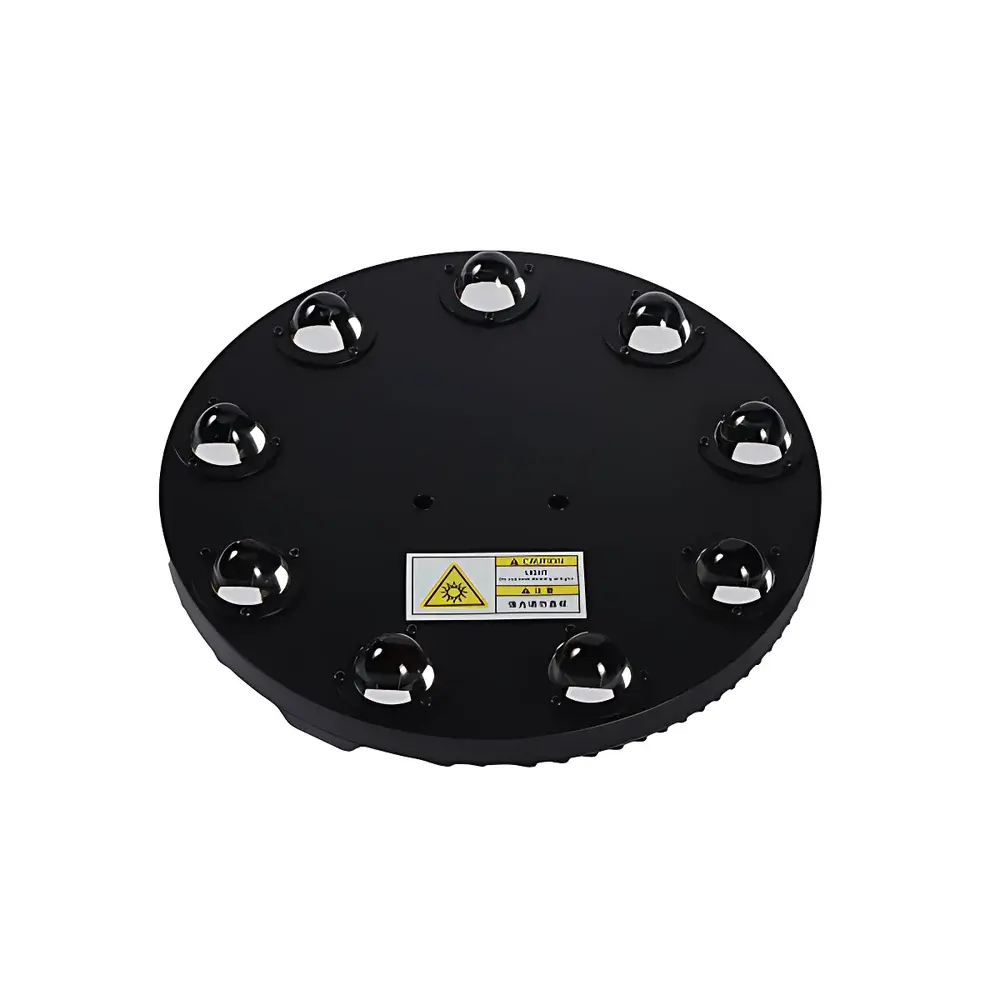
PerfectLight Vlight Multi-Channel Light Panel
| Brand | PerfectLight |
|---|---|
| Model | Vlight |
| Type | Multi-Channel Solar-Simulating Light Panel |
| Spectral Range | 380–760 nm |
| AM1.5G Spectral Match Accuracy | ±15% |
| Irradiance Output | 100–450 mW/cm² |
| Input Power | 10 W |
| Compatibility | PCX50B and PCX50C Multi-Channel Photocatalytic Reaction Systems |
| Origin | Beijing, China |
| Component Category | Optical Instrument Subassembly |
Overview
The PerfectLight Vlight Multi-Channel Light Panel is an engineered optical irradiation module designed for high-fidelity solar simulation in controlled laboratory environments. It operates on the principle of broadband spectral synthesis—utilizing calibrated LED arrays and precision optical filtering—to reproduce the ASTM G173-03 reference AM1.5G solar irradiance spectrum across the photosynthetically active and near-UV/visible range (380–760 nm). Unlike monochromatic or narrowband sources, the Vlight panel delivers spectrally stable, spatially uniform illumination optimized for quantitative photochemical and photocatalytic studies where spectral fidelity directly impacts quantum yield determination, reaction kinetics modeling, and material degradation assessment. Its fixed-spectrum architecture eliminates the need for real-time spectral recalibration during routine operation, supporting reproducible inter-laboratory comparisons under standardized test conditions.
Key Features
- AM1.5G spectral match within ±15% deviation across 380–760 nm, validated against NIST-traceable reference spectroradiometers;
- Adjustable irradiance output from 100 to 450 mW/cm²—enabling controlled dose-rate experiments without mechanical attenuation;
- Multi-channel modular design with independent thermal management per channel, minimizing cross-talk and ensuring long-term radiometric stability;
- Integrated thermal monitoring and over-temperature shutdown circuitry compliant with IEC 61000-6-3 electromagnetic compatibility standards;
- Fixed-focus collimated output geometry optimized for uniform irradiance distribution across standard 10 mm × 10 mm to 25 mm × 25 mm reactor footprints;
- Low-power consumption architecture (10 W nominal input) with >35% wall-plug-to-optical conversion efficiency in the target band.
Sample Compatibility & Compliance
The Vlight panel is mechanically and electrically interfaced with the PerfectLight PCX50B and PCX50C multi-channel photocatalytic reaction platforms, enabling synchronized irradiation across up to eight parallel reaction vessels. It supports quartz, borosilicate, and fused-silica cuvettes and custom reactor inserts with optical path lengths from 1 mm to 10 mm. All optical materials used in the light guide and diffuser assembly meet ISO 10110 surface quality specifications (scratch-dig 20–10). The device complies with CE marking requirements for laboratory equipment (2014/30/EU EMC Directive and 2014/35/EU LVD Directive) and conforms to ISO/IEC 17025-recommended practices for irradiance source characterization in accredited testing laboratories.
Software & Data Management
While the Vlight panel operates as a hardware-integrated subsystem within the PCX50 platform, its irradiance setpoints and operational status are accessible via the host system’s embedded control firmware (v3.2+). Real-time irradiance feedback is not provided at the panel level; however, factory calibration certificates include spectral power distribution (SPD) data in CSV format traceable to NIM (National Institute of Metrology, China) reference standards. For GLP-compliant workflows, users may log irradiance settings, timestamps, and system uptime in external LIMS-compatible spreadsheets. The panel does not implement FDA 21 CFR Part 11 electronic signature functionality, as it lacks user-accessible configuration storage or audit trail generation—consistent with its role as a passive optical subassembly rather than a standalone analytical instrument.
Applications
- Quantitative evaluation of photocatalytic hydrogen evolution rates under standardized solar-simulated illumination;
- Accelerated photostability testing of organic semiconductors, perovskite thin films, and dye-sensitized solar cell (DSSC) components;
- Comparative assessment of TiO₂, g-C₃N₄, and MOF-based photocatalysts under reproducible AM1.5G-equivalent conditions;
- Photoinduced radical generation kinetics studies using spin-trapping ESR coupled with time-resolved irradiance control;
- Calibration validation of reference photodiodes and spectroradiometers in metrology labs performing solar simulator classification per IEC 60904-9 Ed. 3.
FAQ
Is the Vlight panel certified to IEC 60904-9 for Class AAA solar simulator classification?
No. The Vlight panel meets spectral match (Class A) and spatial uniformity (Class B) criteria but does not satisfy temporal stability requirements (Class A) for full AAA classification due to its fixed-output architecture without active feedback regulation.
Can irradiance be measured in real time during operation?
No. The panel lacks integrated photodetectors. Users must employ external, NIST-calibrated reference sensors (e.g., Thorlabs S120VC or Gigahertz-Optik X1-1) placed at the sample plane for periodic verification.
What is the recommended recalibration interval?
PerfectLight recommends spectral recalibration every 2,000 operating hours or annually—whichever occurs first—using a calibrated spectroradiometer with <1 nm resolution and cosine-corrected input optics.
Does the Vlight support pulsed or modulated illumination modes?
No. It is designed exclusively for continuous-wave (CW) operation. Pulsed excitation requires external modulation of the DC power supply, which voids warranty and compromises spectral fidelity.
Is ozone generation observed during extended operation?
No measurable ozone is produced, as the spectral output is fully confined above 380 nm and contains no vacuum-UV (<200 nm) or deep-UV (<240 nm) emission components.



