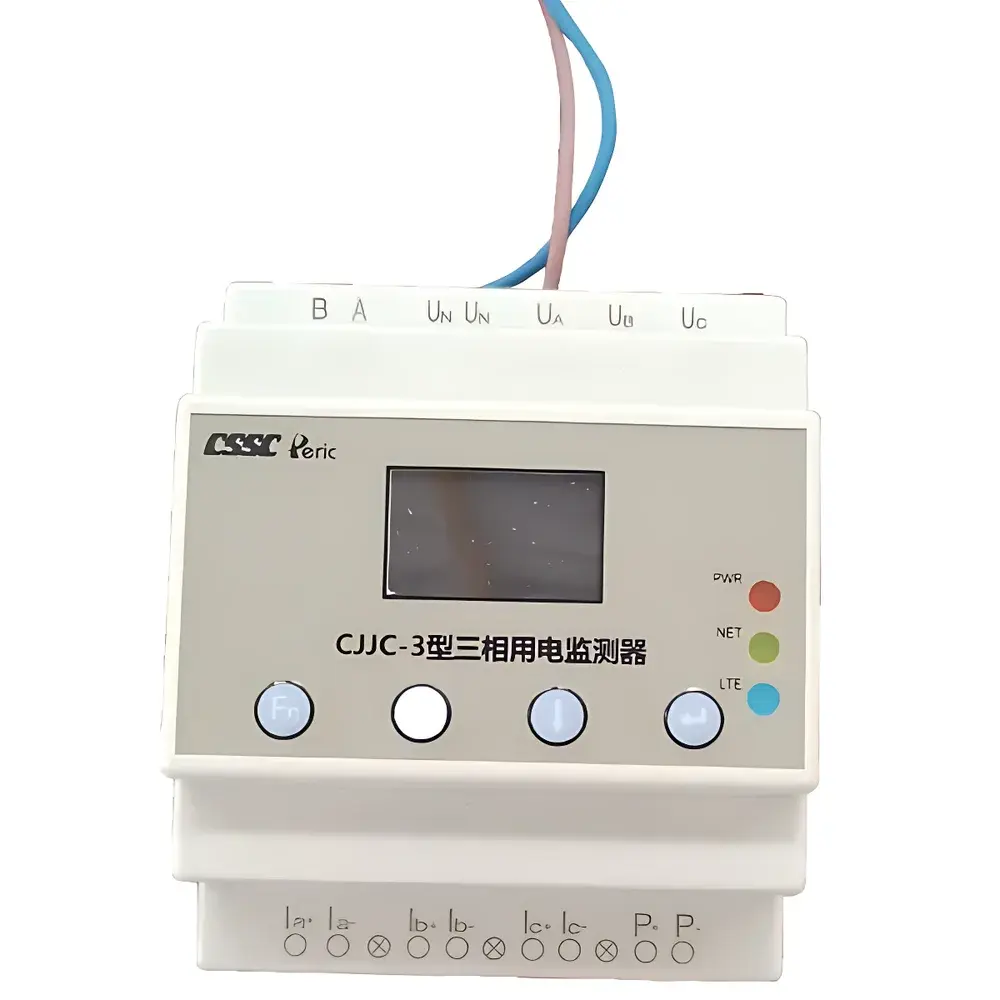
PERIC CJJC-3 Three-Phase Electrical Consumption Monitor
| Brand | PERIC |
|---|---|
| Origin | Hebei, China |
| Manufacturer Type | Manufacturer |
| Origin Category | Domestic |
| Model | CJJC-3 |
| Quotation | Upon Request |
| Communication | 4G (TCP/UDP/HTTP/MQTT) + RS485 |
| Power Supply | AC 85–265 V / DC 110–370 V |
| Operating Temperature | −30 to +70 °C |
| Electrical Parameters Measured | Phase & total voltage, current, active/reactive power, energy, grid frequency |
| Accuracy Class | Active Energy Class 1 |
| Voltage Input Range | AC 7–265 V (direct) |
| Current Input Range | 0–5 A (direct) |
| Mounting | DIN rail |
| Dimensions (L×W×H) | 92 × 76 × 59 mm |
| Data Upload Protocol | HJ 212 (customizable) |
| Special Functions | Power-on/off alarm, cover-open detection, internal temperature monitoring, built-in antenna & terminal block |
| Enclosure Design | Tamper-resistant, fully integrated wiring |
Overview
The PERIC CJJC-3 Three-Phase Electrical Consumption Monitor is an industrial-grade, DIN-rail-mounted telemetry device engineered for continuous, high-integrity monitoring of electrical parameters across three-phase AC distribution systems. It operates on the principle of real-time digital sampling of voltage and current waveforms at configurable intervals, computing derived quantities—including active and reactive power, cumulative energy (kWh/kvarh), phase imbalance, and grid frequency—using embedded DSP algorithms compliant with IEC 61000-4-30 Class S requirements for basic power quality measurement. Designed specifically for environmental regulatory enforcement applications, the CJJC-3 serves as a foundational sensor node in “sub-metering for pollution control” (also known as “Facility-Level Electricity Monitoring for Environmental Compliance”) systems. Its architecture supports unattended, long-term deployment in harsh outdoor or semi-industrial environments—such as wastewater treatment plants, cement kiln facilities, and VOCs abatement units—where verification of continuous operation of pollution control equipment (e.g., scrubbers, RTOs, baghouse fans) is mandated under provincial and national emission supervision frameworks.
Key Features
- Dual-mode communication stack: Integrated 4G LTE module supporting TCP, UDP, HTTP POST, and MQTT v3.1.1 protocols for secure, low-latency data transmission; supplemented by isolated RS485 interface (Modbus RTU) for local network integration or gateway redundancy.
- Regulatory-grade data integrity: Compliant with China’s HJ 212–2017 standard for environmental monitoring data transmission protocols—ensuring interoperability with provincial-level Eco-Monitoring Platforms (e.g., Hebei, Shandong, Henan provincial platforms) and enabling audit-ready timestamped records.
- Tamper-resilient mechanical design: Fully internalized terminal blocks and PCB-mounted 4G antenna eliminate external cabling points; polycarbonate housing with IP54-rated ingress protection; cover-open detection circuit triggers event logging and remote alerting via SMS or platform notification.
- Wide-range power autonomy: Dual-input power architecture accepts either AC 85–265 V or DC 110–370 V, enabling deployment across diverse site infrastructures—including solar-powered edge cabinets with battery backup.
- Embedded environmental awareness: Onboard thermistor continuously monitors internal operating temperature (−30 to +70 °C range), enabling thermal derating logic and early-warning alerts for abnormal ambient conditions affecting measurement stability.
Sample Compatibility & Compliance
The CJJC-3 is certified for direct connection to low-voltage three-phase distribution circuits (≤400 V AC system voltage). It accommodates direct current inputs up to 5 A per phase without external CTs, and voltage inputs from 7 V to 265 V line-to-neutral—making it suitable for both utility-side feeders and load-side branch circuits powering air pollution control equipment. All electrical safety design complies with GB/T 17215.211–2021 (equivalent to IEC 62052-11) for metering devices, and electromagnetic compatibility meets GB/T 17626 series (IEC 61000-4-x). The device supports GLP-aligned data logging: each recorded parameter carries microsecond-precision UTC timestamps, cryptographic checksums, and immutable sequence IDs—facilitating traceability during regulatory audits or non-compliance investigations.
Software & Data Management
Data acquisition and reporting are managed through PERIC’s open API-enabled cloud platform (accessible via HTTPS with TLS 1.2+ encryption). Raw measurements are buffered locally (≥30 days at 15-minute intervals) and transmitted using configurable retry logic with exponential backoff. Platform-side processing includes automated anomaly detection—such as unexpected zero-consumption windows (>15 min), sudden current drop coincident with cover-open events, or deviation from historical baseline consumption profiles (±15% over 24 h). Role-based access control (RBAC), audit trail logging (per ISO/IEC 27001 Annex A.9.4), and optional 21 CFR Part 11–compliant electronic signature modules are available for GMP-aligned environmental compliance programs.
Applications
- Environmental regulatory enforcement: Real-time verification of desulfurization/denitrification unit runtime, electrostatic precipitator fan operation, and activated carbon injection systems under heavy-pollution emergency response plans.
- Industrial energy management: Sub-metering of production lines vs. auxiliary systems to quantify energy intensity (kWh/ton) and identify inefficiencies aligned with ISO 50001 EnMS requirements.
- Smart grid edge analytics: Integration into municipal smart city infrastructure for demand-response coordination and distributed generation interconnection monitoring.
- Remote asset health monitoring: Correlation of motor current harmonics (derived from sampled waveforms) with predictive maintenance thresholds for critical blowers and pumps.
FAQ
Does the CJJC-3 support firmware updates over-the-air (FOTA)?
Yes—secure FOTA is supported via HTTPS-based package delivery with SHA-256 signature verification and rollback capability.
Can the device operate without cellular connectivity?
Yes—it continues local data logging and event detection autonomously; all buffered data transmits upon network recovery.
Is Modbus TCP supported in addition to Modbus RTU?
No—only Modbus RTU over RS485 is implemented; TCP/IP bridging requires an external protocol gateway.
What is the maximum sampling interval for energy accumulation registers?
Energy values are integrated continuously at ≥2 kHz sampling rate; cumulative kWh/kvarh registers are updated every second and reported at user-configurable intervals (1 min to 24 h).
How is time synchronization maintained?
The device synchronizes to NTP servers via 4G or falls back to internal RTC with ±2 s/month drift specification when offline.