
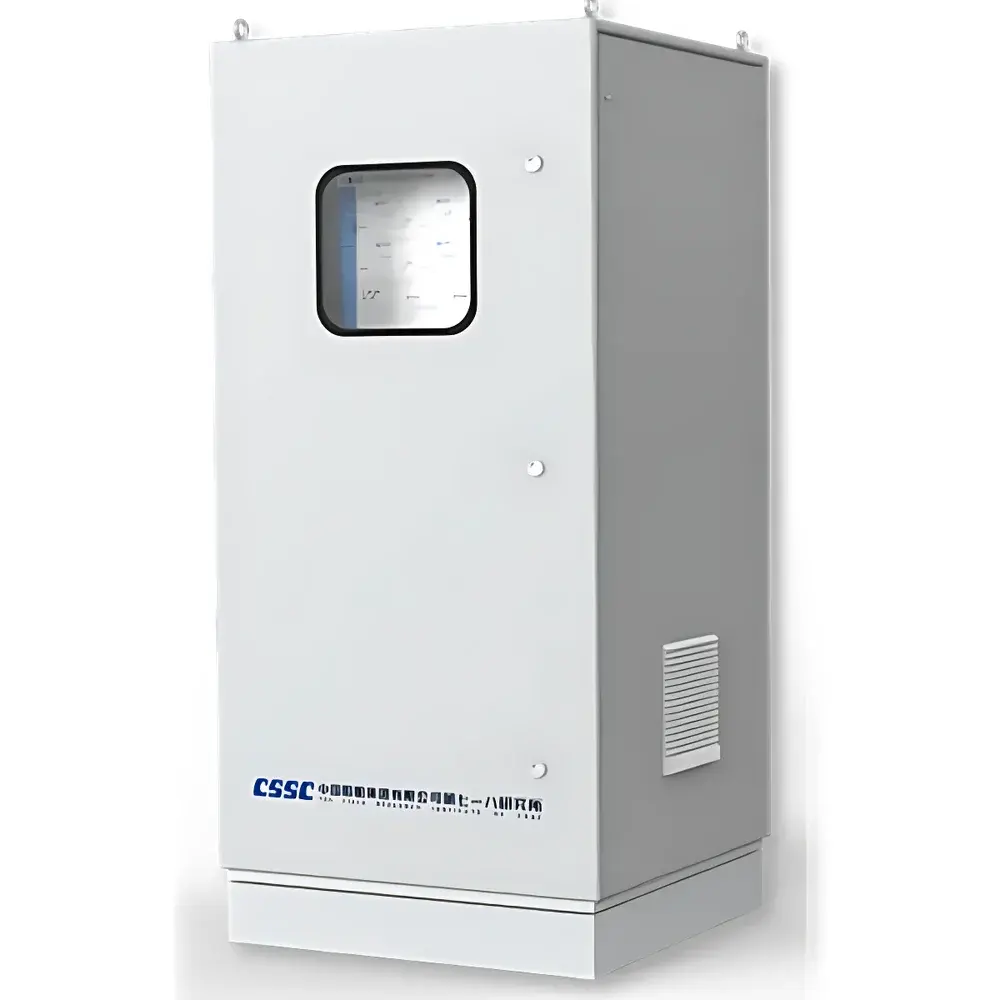
PERIC Custom Marine Engine Emission Test System
| Brand | PERIC |
|---|---|
| Origin | Hebei, China |
| Manufacturer Type | Manufacturer |
| Origin Category | Domestic |
| Model | Custom10 |
| Pricing | Upon Request |
| Gas Measurement Range | NH₃ (0–10,000 ppm), NO (0–3,000 ppm), NO₂ (0–3,000 ppm), N₂O (0–1,000 ppm), CH₃OH (0–2,000 ppm), CH₂O (0–1,000 ppm), CH₄ (0–30,000 ppm), O₂ (0–24% vol), CO (0–2,000 ppm), CO₂ (0–14% vol), SO₂ (0–1,000 ppm) |
| Accuracy | ≤ ±2% FS for all listed gases |
| Detection Technologies | NDIR, UV-DOAS, TDLAS |
| Application Scope | Dual-fuel diesel, LNG, methanol, and ammonia-fueled marine engines |
| Compliance Support | ASTM D6595, ISO 8178-4, IMO MARPOL Annex VI Tier III test protocols |
Overview
The PERIC Custom Marine Engine Emission Test System is an integrated, laboratory-grade emissions measurement platform engineered specifically for regulatory-compliant and R&D-grade testing of marine propulsion engines. It operates on a multi-physical principle architecture: non-dispersive infrared (NDIR) spectroscopy for CO, CO₂, CH₄, and CH₃OH; ultraviolet differential optical absorption spectroscopy (UV-DOAS) for NO, NO₂, SO₂, and NH₃; and tunable diode laser absorption spectroscopy (TDLAS) for high-sensitivity, real-time quantification of N₂O, CH₂O, and trace NH₃ in hot, humid, and particulate-laden exhaust streams. Designed to meet the dynamic operational envelope of marine engine test benches—including transient load cycles, variable exhaust temperatures (up to 200 °C), and pressure fluctuations—the system delivers continuous, synchronized multi-gas data acquisition at 1 Hz sampling rate with full traceability. Its modular architecture separates sampling, conditioning, and analysis functions into functionally isolated yet hydraulically and thermally coordinated subsystems, minimizing condensation artifacts, catalytic surface reactions, and adsorption/desorption hysteresis common in marine exhaust matrices.
Key Features
- Multi-technology gas detection core: Simultaneous deployment of NDIR, UV-DOAS, and TDLAS ensures orthogonal validation, cross-interference suppression, and extended dynamic range without manual range switching.
- Conditioned sampling train: Heated sample probe (190 °C), PTFE-lined heated transport line (180 °C), particle filtration (0.3 µm sintered metal), and permeation-based water removal preserve molecular integrity of polar analytes (e.g., NH₃, CH₂O) and prevent spectral masking.
- Factory-calibrated and field-verifiable: Each analyzer module ships with NIST-traceable calibration certificates and includes onboard zero/span verification capability using certified gas standards (ISO 6141).
- Modular scalability: Gas channel count and sensor configuration are fully customizable per IMO MARPOL Annex VI Appendix III or customer-specific test matrix—supporting up to 12 simultaneous target species.
- Ruggedized marine-grade hardware: IP65-rated enclosures, vibration-damped mounting, and EMC-compliant power supply ensure stable operation in shipyard and inland test facility environments.
Sample Compatibility & Compliance
The system is validated for use with exhaust streams from low-speed two-stroke and medium-speed four-stroke marine engines operating on conventional diesel, LNG, bio-LNG, green methanol, and carbon-neutral ammonia. It complies with critical international regulatory frameworks including IMO Resolution MEPC.322(75) (2021 Guidelines for Certification of Alternative Fuel Engines), ISO 8178-4:2022 (Reciprocating internal combustion engines — Exhaust emission measurement — Part 4: Test cycles for different engine applications), and ASTM D6595-22 (Standard Test Method for Determination of Gaseous Emissions from Spark-Ignition Engines). All data acquisition firmware supports audit-ready logging compliant with GLP principles, including electronic signatures, user access control, and immutable event timestamps.
Software & Data Management
PERIC EmissionSuite™ v4.2 provides unified control, real-time visualization, and post-processing of raw spectral data, concentration time-series, and engine parameter synchronization (via CAN bus or analog I/O). The software enables automated calculation of weighted emission factors (g/kWh) per IMO Tier II/III duty cycles (E2, E3, D2), supports batch reporting in XML and CSV formats compatible with EU MRV and IMO DCS databases, and includes built-in uncertainty propagation modeling per ISO/IEC 17025:2017 Annex A.3. Data security conforms to FDA 21 CFR Part 11 requirements, featuring role-based permissions, electronic audit trails, and encrypted local storage with optional cloud backup (AWS S3, GDPR-compliant).
Applications
- Development and type-approval testing of dual-fuel and mono-fuel marine engines under IMO Tier III and EU Stage V requirements.
- Verification of aftertreatment system efficiency (e.g., SCR, EGR, oxidation catalysts) across fuel-switching transients.
- Ammonia slip quantification and thermal decomposition pathway analysis in ammonia-fueled Otto-cycle test beds.
- Methanol combustion intermediates monitoring (formaldehyde, methyl hydroperoxide) to assess incomplete oxidation risks.
- Long-term durability studies tracking drift in NH₃ and N₂O emissions over 500+ hour endurance tests.
FAQ
Does the system support real-time ammonia slip measurement during SCR operation?
Yes—TDLAS-based NH₃ detection provides sub-second response time and <1 ppm detection limit at 190 °C exhaust temperature, enabling closed-loop SCR control validation.
Can it be integrated with existing engine test bed DAQ systems?
Yes—native support for CAN 2.0B, Modbus TCP, and analog voltage/current inputs allows seamless synchronization with AVL, Horiba, or DEWE-43 platforms.
Is factory recalibration required annually?
No—system design meets ISO 17025 intermediate verification intervals; annual performance verification using check gases is recommended, with full recalibration every 24 months.
What certifications accompany the system upon delivery?
Each unit ships with ISO/IEC 17025-accredited calibration reports, CE marking documentation, RoHS compliance statement, and IMO MARPOL Annex VI conformance declaration.
How is cross-sensitivity between NO₂ and Cl₂ addressed in exhaust containing halogenated additives?
UV-DOAS spectral deconvolution employs constrained least-squares fitting with reference spectra libraries that include Cl₂ interference bands, reducing NO₂ quantification error to <±0.8% FS under worst-case halogen loading.







