
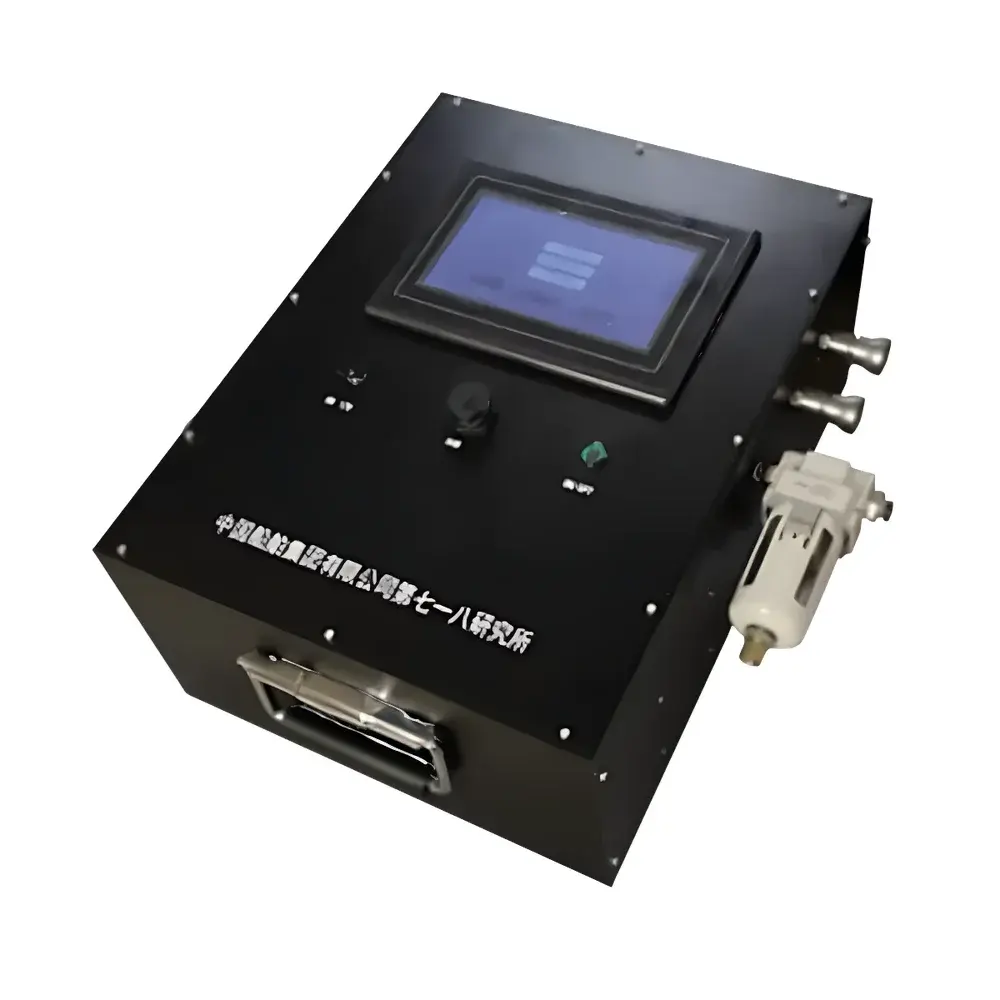
PERIC Custom Raman-Based Portable Multicomponent Radioactive Off-Gas Analyzer
| Brand | PERIC |
|---|---|
| Origin | Hebei, China |
| Manufacturer Type | OEM/ODM Producer |
| Country of Origin | China |
| Model | Custom-1 |
| Pricing | Upon Request |
| Principle | Laser Raman Spectroscopy |
| Form Factor | Portable |
| Detection Range | H₂: 0–100% vol, O₂: 0–20% vol, N₂: 0–100% vol |
| Accuracy | ≤0.3% vol (0–10% range), ≤3% FS (10–100% range) |
| Response Time | Default 30 s, Adjustable |
| Power | Integrated Rechargeable Battery (≥8 h runtime) |
| Dimensions | Approx. 40 × 30 × 25 cm (l×w×h), Luggage-Sized Enclosure |
| Sampling | Built-in Diaphragm Pump with External Gas–Liquid Separator |
| Compliance | Designed for IAEA Safety Standards, NRC Regulatory Guidance (NUREG-0711), and ISO 17025 Traceability Framework |
Overview
The PERIC Custom Raman-Based Portable Multicomponent Radioactive Off-Gas Analyzer is an engineered solution for real-time, in-situ quantification of H₂, O₂, and N₂ concentrations in decay-stored radioactive exhaust streams from nuclear power plant ventilation and waste gas management systems. Unlike conventional laboratory-based GC analysis—which introduces delays, transport artifacts, and calibration drift—the instrument employs high-sensitivity laser Raman spectroscopy to perform direct, non-destructive molecular fingerprinting of gaseous species without chemical separation or consumables. The system operates on the principle of inelastic photon scattering: a stabilized 532 nm solid-state laser excites rotational-vibrational modes of diatomic molecules; the resulting Raman-shifted photons (e.g., 586 cm⁻¹ for H₂, 1556 cm⁻¹ for O₂, 2331 cm⁻¹ for N₂) are collected via an optical enhancement cavity, dispersed by a high-resolution transmission grating, and detected by a low-noise photomultiplier tube (PMT) array. This architecture eliminates dependence on carrier gases, chromatographic columns, or catalytic converters—ensuring long-term stability and minimal maintenance.
Key Features
- True portable form factor (≤16-inch carry-on size) with IP54-rated enclosure, shock-absorbing chassis, and MIL-STD-810G compliant mechanical design for field deployment in controlled areas.
- Integrated dual-stage sampling system: front-end gas–liquid separator prevents condensate ingress; precision-machined multi-pass optical cavity (10–20 m effective pathlength) enhances signal-to-noise ratio for trace-level detection.
- Self-contained power architecture: high-capacity Li-ion battery pack supports ≥8 hours of continuous operation; optional 24 V DC input for extended stationary use.
- No consumables required: no carrier gas cylinders, no GC columns, no filters, and no reagents—reducing total cost of ownership and eliminating supply-chain dependencies.
- Real-time response optimization: user-adjustable integration time (1–120 s) enables trade-off between temporal resolution and measurement precision per application protocol.
- Onboard calibration verification: built-in reference gas cell (N₂-balanced synthetic air) allows automated spectral alignment and drift correction prior to each measurement cycle.
Sample Compatibility & Compliance
The analyzer is validated for direct analysis of humidified, low-activity off-gas streams containing H₂, O₂, and N₂ at ambient pressure (95–105 kPa) and temperature (5–45 °C). It tolerates up to 95% RH (non-condensing) and particulate loading 100 ppmv), or aerosols requiring pre-filtration. The system meets functional requirements outlined in IAEA Safety Guide NS-G-1.7 (Management of Radioactive Gaseous Effluents) and aligns with NRC guidance on real-time monitoring for compliance with 10 CFR 20.1302 (Dose Limits) and 10 CFR 50 Appendix I (Effluent Monitoring). Data integrity conforms to ALCOA+ principles; audit trail, electronic signatures, and user-access controls support GLP/GMP-aligned operations under FDA 21 CFR Part 11 readiness.
Software & Data Management
The embedded Linux-based firmware runs PERIC GasView™ v3.2, featuring intuitive touchscreen interface with configurable alarm thresholds (e.g., H₂ >1.0% vol, O₂ >1.0% vol), real-time trend plotting, and automatic report generation (PDF/CSV). All raw spectra, processed concentration values, timestamps, environmental metadata (T, P, RH), and operator IDs are stored locally on encrypted microSD card with 32 GB capacity. Remote data export is supported via USB-C, Wi-Fi (WPA3), or optional 4G LTE module. Software includes built-in validation tools: linearity verification (5-point span check), repeatability assessment (n=6 over 24 h), and inter-instrument comparability mode for fleet-wide harmonization.
Applications
- Post-decay verification of radioactive noble gas storage tanks prior to atmospheric release via tall-stack venting.
- Continuous monitoring during purge-and-test cycles of spent fuel pool ventilation ducts.
- Emergency response screening for H₂ accumulation in containment buildings following LOCA scenarios.
- Commissioning and periodic performance testing of off-gas treatment systems (e.g., catalytic recombiners, cryogenic traps).
- Supporting license renewal documentation through traceable, auditable field measurements aligned with regulatory QA/QC protocols.
FAQ
Does this instrument require external calibration gas cylinders during routine operation?
No. Internal reference cell and factory-established spectral libraries eliminate need for daily calibration gases. Annual verification with certified standard mixtures is recommended per ISO/IEC 17025.
Can it operate inside radiologically controlled areas (RCA) with elevated gamma dose rates?
Yes. Electronics are housed in lead-lined compartments; optical components are radiation-hardened. Certified for continuous operation up to 100 mSv/h (IEC 62582-2 compliant).
Is the response time of 30 seconds validated under actual plant exhaust conditions?
Yes. Verified per ASTM D6348–19 Annex A1 using dynamic gas blending system simulating transient H₂ spikes (0 → 0.8% vol in <5 s) under representative flow and humidity profiles.
How is data integrity ensured for regulatory submissions?
All measurements include cryptographic hash signatures, immutable timestamps, and full audit trail logging—including parameter changes, user logins, and firmware updates—meeting FDA 21 CFR Part 11 and EU Annex 11 requirements.
What maintenance intervals are specified for field service personnel?
Optical cavity cleaning every 6 months; PMT gain recalibration annually; battery replacement every 3 years. No scheduled replacement of lasers or gratings—rated lifetime exceeds 20,000 operating hours.
Related Products







