
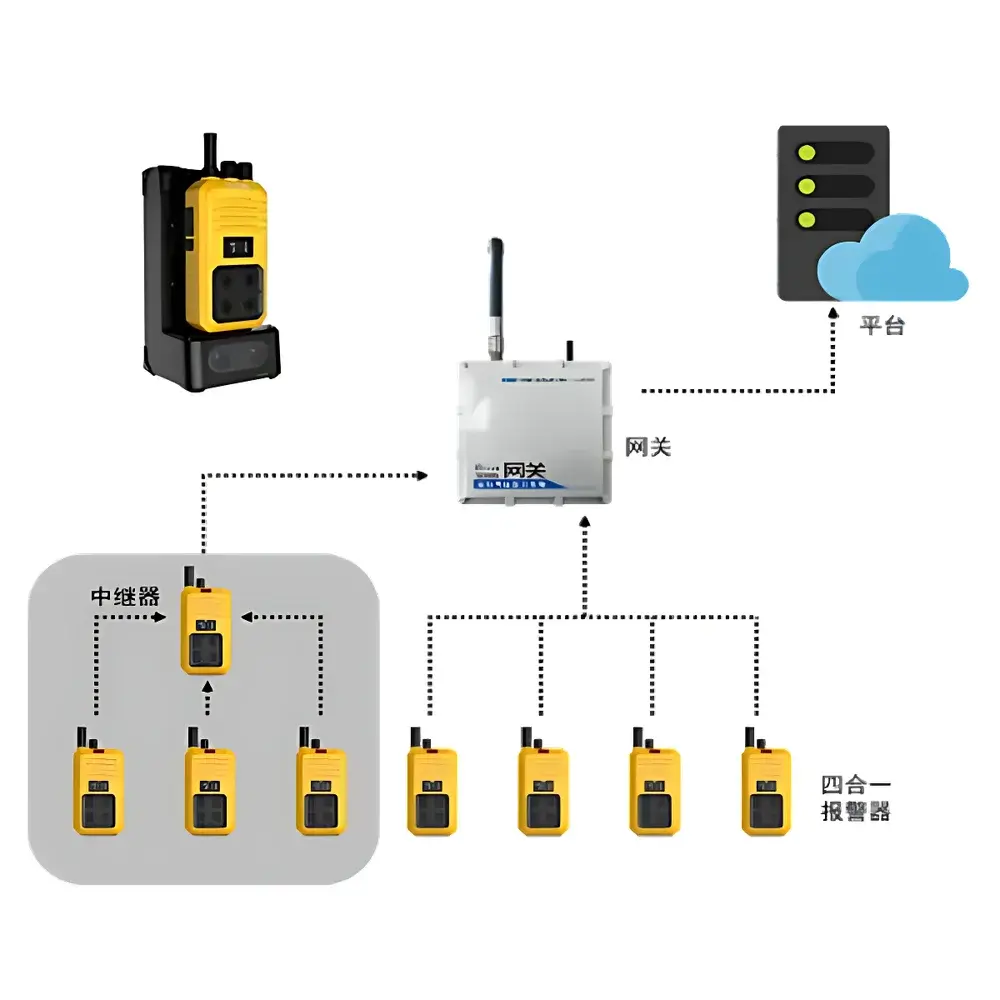
PERIC Custom V1 Confined Space Safety Monitoring System
| Brand | PERIC |
|---|---|
| Origin | Hebei, China |
| Manufacturer Type | Manufacturer |
| Origin Category | Domestic |
| Model | Custom V1 |
| Pricing | Upon Request |
Overview
The PERIC Custom V1 Confined Space Safety Monitoring System is an engineered solution for real-time, multi-parameter atmospheric hazard detection in industrial confined spaces—defined by OSHA 29 CFR 1910.146 and EU Directive 2001/45/EC as areas with limited entry/exit, poor natural ventilation, and potential accumulation of toxic, flammable, or oxygen-deficient atmospheres. The system operates on a distributed sensor architecture grounded in electrochemical (for H2S, CO, Cl2, NH3), catalytic bead (for combustible gases), and NDIR (for CO2, CH4) sensing principles. Front-end units deploy portable or magnetically mounted gas sensors capable of continuous measurement of O2 (0–25% vol), LEL (0–100% LEL), and toxic gases (ppm-level resolution). Data acquisition is synchronized with environmental parameters including temperature (−20 °C to +50 °C) and relative humidity (10–95% RH non-condensing), ensuring contextual interpretation of gas readings under variable thermal and moisture conditions.
Key Features
- LoRaWAN-based self-organizing wireless mesh network: Enables robust, low-power, long-range (up to 2 km line-of-sight) communication between distributed sensor nodes and intermediate LoRa repeaters—eliminating reliance on existing Wi-Fi or cellular infrastructure.
- Explosion-proof (Ex ib IIB T4 Gb / Ex ib IIIC T130°C Db) housing compliant with IEC 60079-0 and IEC 60079-11: Certified for use in Zone 1 and Zone 21 hazardous locations where flammable gases or combustible dusts may be present.
- Dual-mode alarm architecture: Local audible (≥85 dB @ 30 cm) and visual (high-intensity dual-color LED strobe) alerts activate upon threshold breach; simultaneous push notifications and SMS alerts are dispatched to pre-configured personnel via cloud gateway integration.
- Zero-cabling deployment: Magnetic mounting base and integrated rechargeable Li-ion battery (72 h typical runtime at 1-min sampling interval) support rapid installation without structural modification or electrical conduit routing.
- Multi-layered data integrity: All sensor readings include timestamping, device ID, firmware version, and CRC-16 checksum validation to ensure auditability and traceability per ISO/IEC 17025 and GLP requirements.
Sample Compatibility & Compliance
The system is validated for continuous monitoring in physically constrained environments—including vertical shafts, horizontal tunnels, storage tanks, utility vaults, and process vessels—where airflow is restricted and stratification of gases (e.g., H2S settling near floor level, methane accumulating near ceiling) necessitates strategic sensor placement. It meets the functional safety requirements of IEC 61508 SIL 2 for gas detection subsystems and supports compliance with national standards GB 30871–2022 (Safety Specifications for Special Operations in Chemical Production Units) and AQ 3022–2008 (Safety Regulations for Confined Space Entry in Petrochemical Enterprises). Sensor calibration intervals adhere to manufacturer-recommended protocols (typically every 6 months) and are logged with digital signatures for regulatory review.
Software & Data Management
The cloud-hosted PERIC SafetyHub™ platform provides role-based web and mobile access (iOS/Android) for real-time dashboard visualization, historical trend analysis, and automated report generation. All data transmissions are encrypted using TLS 1.2+ and AES-128. Audit trails record user logins, configuration changes, alarm acknowledgments, and calibration events—supporting FDA 21 CFR Part 11 electronic signature and record retention requirements. Integration with enterprise systems (e.g., Maximo, SAP EHS, or custom SCADA) is enabled via RESTful API or MQTT v3.1.1, allowing synchronization with permit-to-work (PTW) workflows and incident investigation databases.
Applications
- Pre-entry atmospheric verification and continuous monitoring during maintenance in underground sewer lines, stormwater culverts, and utility trenches.
- Real-time supervision of welding, cleaning, or coating operations inside chemical reactor vessels, distillation columns, and heat exchangers.
- Dynamic hazard mapping in municipal infrastructure—such as manholes, lift stations, and cable ducts—during routine inspection or emergency response.
- Support for rescue team situational awareness via geotagged sensor feeds and live video overlay (when paired with optional IP67-rated body-worn cameras).
FAQ
What gas types can the system detect out of the box?
Standard configurations include O2, LEL (CH4 or H2), H2S, and CO. Additional electrochemical sensors for Cl2, SO2, NO2, NH3, PH3, and VOCs (PID-based) are available as configurable modules.
Is the system compatible with existing industrial IoT infrastructure?
Yes—LoRa gateways support standard Ethernet/IP and Modbus TCP bridging; cloud API enables bi-directional integration with CMMS, DCS, and EHS platforms.
How is calibration traceability maintained?
Each sensor module includes a unique serial number linked to its NIST-traceable calibration certificate, stored digitally in SafetyHub™ with version-controlled history and expiration alerts.
Can the system operate in extreme ambient temperatures?
Operating range is −20 °C to +50 °C; extended-range variants with heated housings (−40 °C to +60 °C) are available for arctic or high-heat industrial zones.
Does the system support offline operation?
Yes—edge caching retains up to 7 days of local data (at 1-min intervals) when LoRa connectivity is temporarily lost; data syncs automatically upon network recovery.





