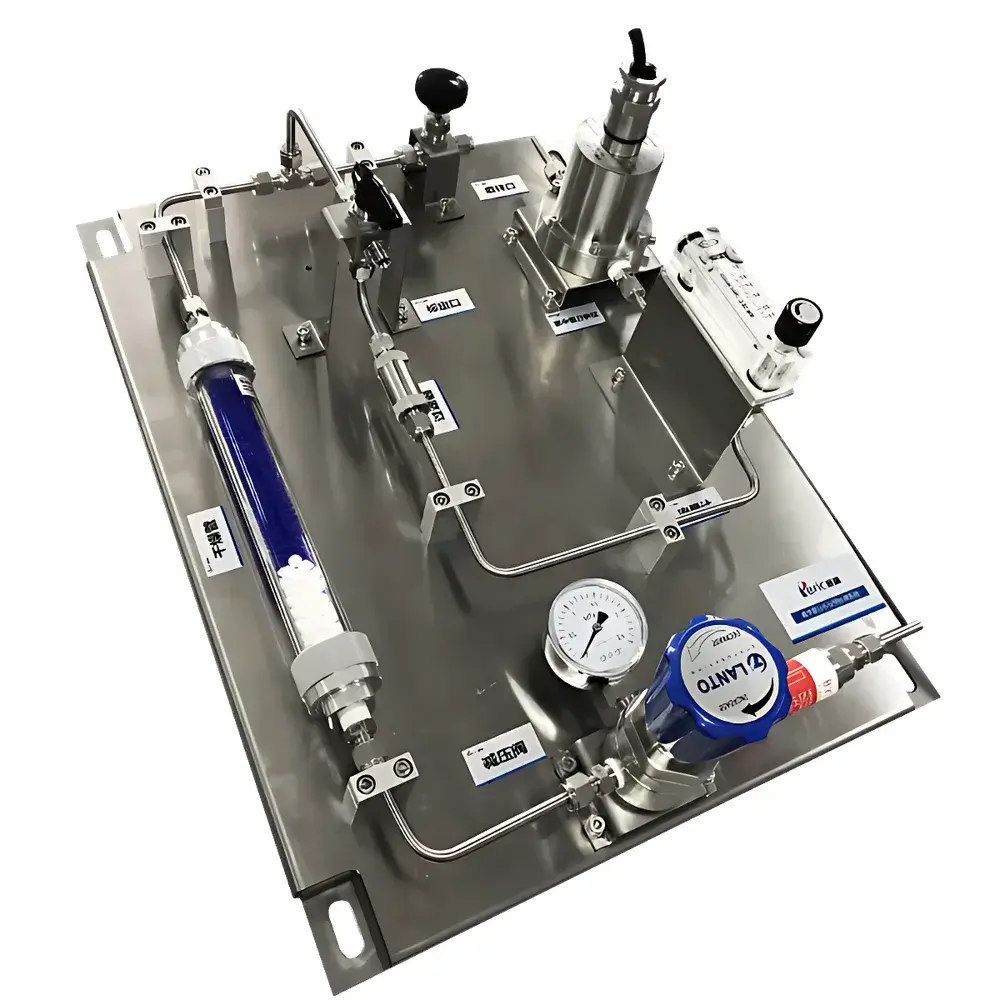
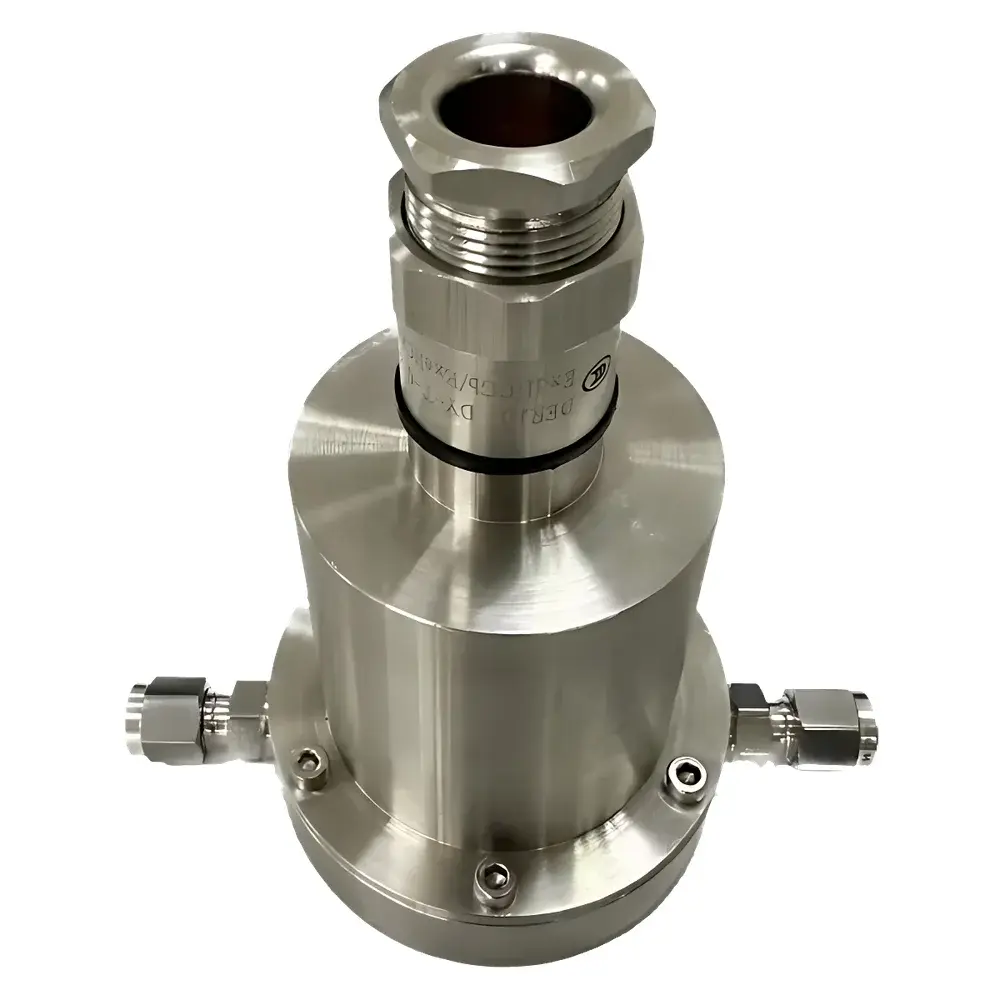
PERIC GNF-TR-H2 Intrinsically Safe Hydrogen Analyzer
| Brand | PERIC |
|---|---|
| Model | GNF-TR-H2 |
| Detection Principle | Thermal Conductivity (TCD) |
| Measurement Range | 0–5.00% H₂ (customizable) |
| Resolution | 0.01% H₂ |
| Accuracy | ≤±2% FS |
| Repeatability | ≤±1% FS |
| Zero Drift | ≤±2% FS/24h |
| Span Drift | ≤±2% FS/24h |
| Response Time (T90) | ≤30 s |
| Sample Pressure | ≤0.2 MPa |
| Sample Flow Rate | 500 ±10 mL/min |
| Sample Temperature | 0–50 °C |
| Ambient Operating Temperature | 0–50 °C |
| Storage Temperature | 0–50 °C |
| Relative Humidity | 20–80% RH (non-condensing) |
| Power Supply | DC 24 V |
| Power Consumption | <5 W |
| Output Signals | 4–20 mA DC (load ≤250 Ω) & RS485 Modbus RTU |
| Explosion Protection | Ex db IIC T6 Gb |
| Enclosure Rating | IP65 |
| Compensation | Integrated temperature & humidity compensation |
| Compliance | ATEX, IECEx, GB 3836.1/3836.4 compliant |
Overview
The PERIC GNF-TR-H2 Intrinsically Safe Hydrogen Analyzer is a field-deployable, explosion-proof process analyzer engineered for continuous, real-time quantification of hydrogen concentration in oxygen-rich or inert gas streams—particularly in electrolytic hydrogen/oxygen generation systems, chlor-alkali plants, ammonia synthesis loops, and hydrogen recovery units. It operates on the thermal conductivity detection principle: hydrogen’s thermal conductivity (~709 mW/m·K at 25 °C) is over seven times greater than that of oxygen (~91 mW/m·K) and nearly ten times higher than nitrogen (~26 mW/m·K). This large differential enables selective, drift-resistant measurement without consumables or catalytic reactions. The analyzer employs a dual-sensor, reference-compensated thermal conductivity cell with temperature-stabilized bridge circuitry to minimize ambient thermal influence. Its robust mechanical architecture—including stainless steel sensor housing, welded sample chamber, and flameproof enclosure—ensures long-term stability under industrial vibration, pressure fluctuation, and transient gas composition changes.
Key Features
- Explosion-proof certification to Ex db IIC T6 Gb per IEC 60079-1 and GB 3836.1/3836.4, enabling safe deployment in Zone 1 hazardous areas where hydrogen-air mixtures may be present.
- Dual-channel thermal conductivity cell with active temperature and humidity compensation algorithms, reducing environmental dependency and extending calibration intervals.
- Fast response dynamics: T90 ≤30 seconds ensures timely detection of hydrogen breakthrough events during electrolyzer startup, shutdown, or membrane failure scenarios.
- Configurable analog output (4–20 mA, HART-compatible load up to 250 Ω) and digital interface (RS485, Modbus RTU protocol) for seamless integration into DCS, PLC, or SCADA systems.
- Low-power design (<5 W @ 24 VDC) supports operation in remote or energy-constrained installations, including solar-powered monitoring stations.
- Sample conditioning agnostic: accepts raw, unfiltered gas streams within specified pressure (≤0.2 MPa), flow (500 ±10 mL/min), and temperature (0–50 °C) limits—eliminating need for external regulators or chillers in most applications.
Sample Compatibility & Compliance
The GNF-TR-H2 is validated for use with high-purity oxygen (>99.5%), nitrogen, argon, and synthetic air matrices containing trace-to-percent levels of H₂. It is not suitable for corrosive, condensable, or particulate-laden streams without upstream filtration and drying. All wetted materials—including sensor diaphragm, flow path, and sampling port—are constructed from 316L stainless steel and PTFE-sealed components to resist oxidation and embrittlement. The analyzer complies with international safety and electromagnetic compatibility standards: IEC 61326-1 (EMC for industrial environments), IEC 61000-4 series (surge, ESD, radiated immunity), and ISO 9001-certified manufacturing processes. Documentation includes full Declaration of Conformity, Ex certificate number, and traceable factory calibration report per ISO/IEC 17025 requirements.
Software & Data Management
Configuration, diagnostics, and calibration are performed via a Windows-based PC utility communicating over RS485. The software supports zero/span calibration with certified standard gases, user-defined alarm thresholds (high/low, rate-of-change), data logging (timestamped H₂ %, temperature, humidity, status flags), and firmware updates. Audit trails record all parameter changes, calibration events, and system resets—supporting GLP and GMP documentation requirements. Raw output signals meet IEC 61511 functional safety guidelines for SIL-1 capable applications when integrated with appropriate logic solvers.
Applications
- Real-time H₂ monitoring in PEM and alkaline electrolyzer off-gas to detect membrane crossover and ensure O₂ purity compliance (e.g., ISO 8573-1 Class 1 for medical oxygen).
- Hydrogen purity verification in purge gas streams prior to catalyst activation in petrochemical reformers.
- Leak detection and concentration trending in hydrogen storage and distribution infrastructure (e.g., tube trailers, buffer vessels).
- Process safety interlocks in hydrogenation reactors and fuel cell feed systems where H₂ accumulation poses flammability risk (LEL = 4% in air).
- Quality assurance in metallurgical annealing atmospheres where residual H₂ affects surface oxide formation.
FAQ
What gas matrices is the GNF-TR-H2 validated for?
It is calibrated and verified for use in O₂, N₂, Ar, and synthetic air. Performance in CO₂ or He requires revalidation due to differing thermal conductivities.
Does the analyzer require periodic zero gas or span gas calibration?
Yes—recommended every 3–6 months depending on operating conditions; zero calibration with certified N₂ or Ar, span calibration with certified H₂/N₂ mixture (e.g., 2.5% H₂).
Can it operate continuously in outdoor enclosures?
Yes, provided ambient temperature remains within 0–50 °C and relative humidity stays below 80% RH without condensation; IP65-rated housing resists dust and water ingress.
Is the 4–20 mA output intrinsically safe?
No—the analog output is non-energy-limited; intrinsic safety is achieved only via the Ex db IIC T6 Gb enclosure rating. Loop-powered configurations require associated apparatus per IEC 60079-11.
How is sensor contamination mitigated?
The thermal conductivity cell has no catalytic surfaces or electrolytes; however, heavy oil mist or silicones must be removed upstream using coalescing filters rated to 0.1 µm.
Related Products