
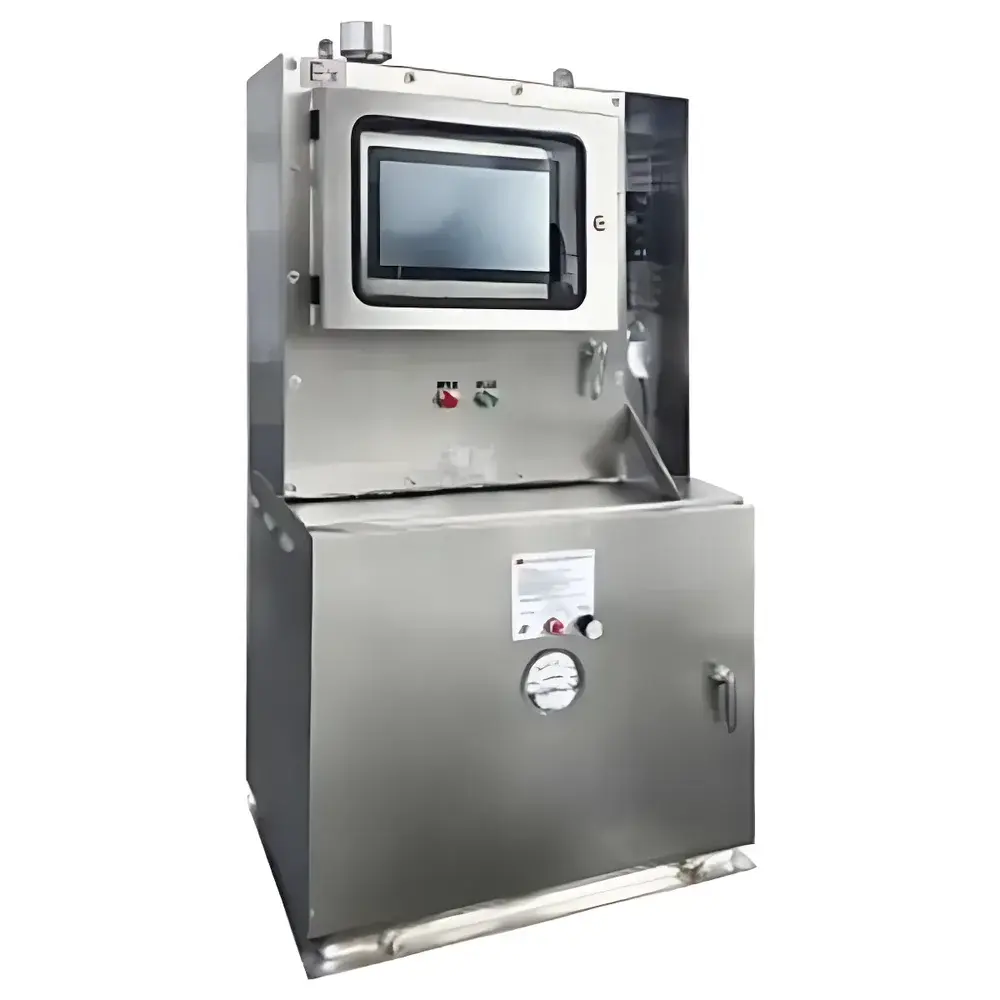
PERIC PR-GLRSA Positive-Pressure Explosion-Proof Laser Raman Spectrometer
| Brand | PERIC |
|---|---|
| Origin | Hebei, China |
| Manufacturer Type | Manufacturer |
| Origin Category | Domestic |
| Model | PR-GLRSA |
| Quotation | Upon Request |
| Detection Channels | 2 (simultaneous) |
| Target Gases | H₂, CO, C₃H₈, C₃H₆ |
| Concentration Ranges | H₂: 0–50% vol, CO: 0–10% vol, C₃H₈: 0–50% vol, C₃H₆: 0–80% vol |
| Accuracy | ≤ ±3% FS |
| Response Time | ≤ 30 s |
| Explosion Protection | Ex db ec ib pzc II C T3 Gc (Positive-Pressure Purged & Pressurized) |
| Operating Temperature | 5–40 °C |
| Power Supply | AC 220 V / 50 Hz, ≤ 800 W (host only) |
| Purge Gas | Clean, oil-free, dry, particle-free compressed air, 0.4–0.8 MPa |
Overview
The PERIC PR-GLRSA is a purpose-engineered, positive-pressure explosion-proof laser Raman spectrometer designed for real-time, in-situ quantitative analysis of multi-component process gases in hazardous environments—particularly hydrocarbon synthesis and catalytic carbonylation units. It operates on the physical principle of spontaneous Raman scattering: monochromatic laser light (typically 532 nm or 785 nm) interacts with molecular vibrational modes in the sample gas, generating frequency-shifted photons whose spectral positions and intensities are uniquely characteristic of chemical identity and concentration. Unlike absorption-based techniques, Raman spectroscopy requires no calibration gases for qualitative identification and enables simultaneous detection of multiple species—including H₂, CO, C₃H₆, and C₃H₈—within a single optical path. The instrument is deployed in butanol production facilities where precise monitoring of syngas (CO/H₂) and olefin feed (propylene) is critical to maintaining optimal rhodium-catalyzed hydroformylation kinetics, minimizing propane byproduct formation, and ensuring catalyst longevity under high-pressure, elevated-temperature conditions.
Key Features
- Positive-pressure explosion protection certified to Ex db ec ib pzc II C T3 Gc per IEC 60079-2 and GB/T 3836.5, enabling safe deployment in Zone 1/21 classified areas without intrinsically safe barriers.
- Dual-channel synchronized sampling architecture with independent heated probe assemblies (up to 180 °C) and trace-heated stainless-steel gas lines to prevent condensation, adsorption, or phase separation of polar and heavy hydrocarbons.
- Integrated thermal management system maintains optical cavity stability across ambient fluctuations (5–40 °C), ensuring long-term spectral baseline reproducibility.
- Multi-stage particulate and coalescing filtration (0.1 µm absolute rating) upstream of the multipass Raman cell eliminates optical contamination and extends maintenance intervals.
- High-efficiency holographic notch filters and back-illuminated CCD detector deliver signal-to-noise ratios >1000:1 at low-concentration targets (e.g., CO down to 0.1% vol).
- Real-time spectral acquisition and chemometric quantification completed within ≤30 seconds per dual-channel cycle—meeting stringent process control loop timing requirements.
Sample Compatibility & Compliance
The PR-GLRSA is validated for continuous analysis of non-corrosive, low-particulate hydrocarbon and syngas mixtures. It complies with ISO 8573-1:2010 Class 2 compressed air quality requirements for purge gas and meets mechanical integrity standards per ASME B31.4 and PED 2014/68/EU for pressurized enclosures. While not a GLP/GMP-certified instrument out-of-the-box, its firmware supports audit-trail-enabled operation (user login, method versioning, raw spectrum logging) compatible with FDA 21 CFR Part 11 when deployed with validated SOPs and third-party electronic signature integration. All gas-contact materials conform to ASTM F104-17 (non-metallic gasket materials) and NACE MR0175/ISO 15156 for sour service compatibility where applicable.
Software & Data Management
The embedded industrial PC runs PERIC RamanSuite™ v3.2—a deterministic, Windows IoT Enterprise-based platform featuring spectral preprocessing (cosmic ray removal, baseline correction via asymmetric least squares), multivariate calibration (PLS-1 with cross-validation), and real-time concentration output via Modbus TCP and OPC UA. Raw interferograms and calibrated spectra are stored in HDF5 format with embedded metadata (timestamp, pressure/temperature compensation flags, detector gain settings). Remote diagnostics, firmware updates, and method retraining are supported over TLS-secured SSH or HTTPS. Data export supports CSV, XML, and ASTM E1382-compliant analytical result reporting formats.
Applications
- Continuous monitoring of propylene purity and syngas composition (H₂/CO ratio) in rhodium-catalyzed hydroformylation reactors for butanol and octanol synthesis.
- In-line verification of hydrogenation reactor inlet streams to prevent catalyst poisoning from residual C₃H₈ or oxygenates.
- Leak detection and compositional trending in high-pressure synthesis loops operating up to 30 bar(g).
- Batch endpoint determination in fixed-bed carbonylation units via kinetic tracking of CO consumption and C₃H₆ depletion rates.
- Supporting PAT (Process Analytical Technology) initiatives under ICH Q8(R2) and USP for enhanced process understanding and control strategy development.
FAQ
What safety certifications does the PR-GLRSA hold for hazardous area installation?
It carries full Ex db ec ib pzc II C T3 Gc certification per IEC 60079-2:2014 and GB/T 3836.5–2021, permitting use in gas Group IIC atmospheres with surface temperature class T3.
Can the instrument quantify trace impurities below 0.5% volume?
While optimized for major components (0–80% range), detection limits for minor species depend on optical path length, laser power, and matrix effects; typical LOD for CO in H₂-rich streams is ~0.08% vol under standard configuration.
Is external calibration gas required for routine operation?
No—Raman peak positions are inherently referenceable to NIST-traceable rotational-vibrational transitions; however, initial PLS model training requires representative process gas standards per ASTM D7165.
How is spectral drift compensated during extended unattended operation?
An internal neon reference lamp activates every 30 minutes to auto-align wavelength calibration; temperature-stabilized optics and closed-loop detector gain control further minimize temporal drift.
Does the system support integration with DCS or MES platforms?
Yes—native Modbus TCP and OPC UA servers provide tag-based data publishing; optional PI System and DeltaV CEV adapters are available through PERIC’s Systems Integration Partner Program.




