
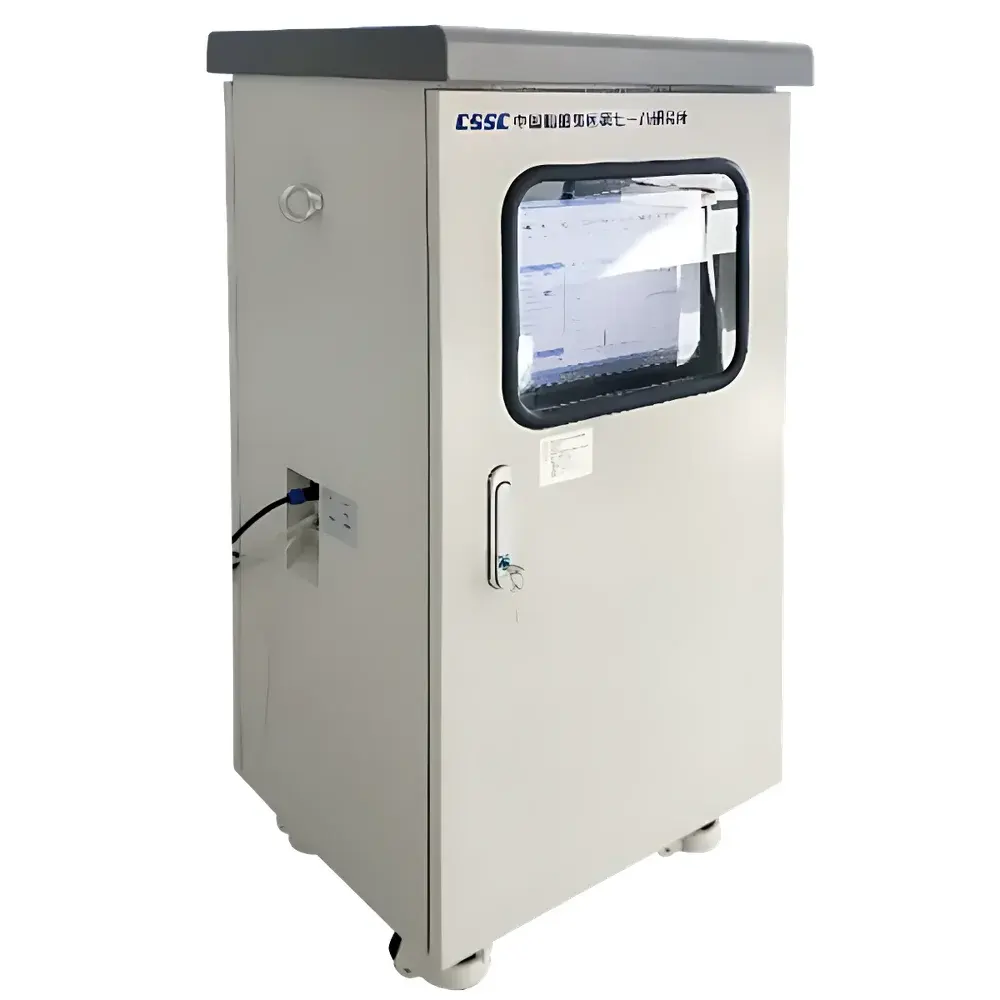
PERIC PR-RM Online Multi-Component Gas Laser Raman Spectrometer
| Brand | PERIC |
|---|---|
| Origin | Hebei, China |
| Manufacturer Type | Manufacturer |
| Product Category | Domestic |
| Model | PR-RM |
| Instrument Type | Online Raman Spectrometer |
| Gas Species | Benzene, Nitrogen, Hydrogen, Carbon Dioxide, Carbon Monoxide, Carbonyl Sulfide, Hydrogen Sulfide, Oxygen, Methane |
| Range | 0–100 %vol |
| Detection Limit | ≤50–100 ppm (gas-dependent) |
| Accuracy | ≤2 %FS |
| Measurement Cycle | 1–30 s (adjustable) |
| Sampling Method | Pump-aspirated with integrated pre-treatment |
| Environmental Robustness | Rated for high-pressure, high-temperature, high-humidity, high-dust, and hazardous-area operation |
| Maintenance | Consumable-free design |
Overview
The PERIC PR-RM Online Multi-Component Gas Laser Raman Spectrometer is an industrial-grade, process-integrated analytical system engineered for real-time, non-destructive quantification of up to nine gaseous components in demanding metallurgical and coking environments. Based on spontaneous Raman scattering spectroscopy, the system exploits the inelastic scattering of monochromatic laser light to generate unique vibrational “fingerprints” for each molecular species. Unlike absorption-based techniques (e.g., NDIR or FTIR), Raman detection enables simultaneous, interference-resistant measurement of gases with overlapping infrared bands—such as CO/CO2, H2/CH4, and COS/H2S—without cross-sensitivity or calibration drift induced by water vapor or particulates. The instrument integrates a Class 4 near-infrared laser source, thermally stabilized spectrograph, back-illuminated CCD detector, and sealed optical path optimized for long-term stability under thermal cycling and mechanical vibration.
Key Features
- Pump-aspirated sampling with integrated multi-stage pre-treatment: stainless-steel particulate filter, heated coalescing trap (to remove tar, oil mist, and condensed hydrocarbons), and temperature/pressure-controlled sample cell (operable up to 150 °C and 1.6 MPa).
- Real-time spectral acquisition at configurable intervals (1–30 s), enabling dynamic process monitoring of coke oven gas (COG) composition and calorific value estimation.
- Zero-consumables architecture: no reagents, carrier gases, or disposable sensors—reducing total cost of ownership and eliminating recalibration downtime.
- Multi-point capability via optional manifold valve system: single analyzer can serve up to four independent sampling locations without hardware duplication.
- ATEX/IECEx-certified enclosure (optional): designed for Zone 1/21 hazardous areas per EN 60079-0 and EN 60079-11 standards.
- Embedded spectral deconvolution engine: applies constrained non-negative least squares (NNLS) fitting to raw spectra using reference libraries traceable to NIST SRM 1971 and ISO 14111.
Sample Compatibility & Compliance
The PR-RM is validated for continuous analysis of raw coke oven gas, blast furnace top gas, and syngas streams containing high concentrations of H2, CH4, CO, CO2, N2, O2, H2S, COS, and C6H6. Its robust sample conditioning ensures compatibility with gas matrices containing up to 20 g/m³ particulate loading and 80% relative humidity at 80 °C. Analytical performance complies with ASTM D7165 (standard practice for Raman spectroscopy of gases), ISO 12099 (performance requirements for online gas analyzers), and meets data integrity requirements for GLP-compliant operations. Full audit trail, electronic signatures, and 21 CFR Part 11–compliant software modules are available upon configuration.
Software & Data Management
PERIC RamanView™ v3.2 provides browser-based configuration, spectral visualization, trend analysis, and OPC UA/Modbus TCP integration for DCS/SCADA systems. Raw spectra are stored in HDF5 format with embedded metadata (timestamp, pressure, temperature, laser power). Calibration models are version-controlled and locked against unauthorized modification. Historical data export supports CSV, XML, and ISA-95-compliant batch records. Remote diagnostics and firmware updates are performed over TLS-encrypted HTTPS channels with certificate-based authentication.
Applications
- Real-time calorific value calculation for coke oven gas via stoichiometric modeling of H2, CH4, CO, and C6H6 concentrations.
- Process optimization of by-product recovery units (e.g., benzene scrubbing efficiency, ammonia removal monitoring).
- Safety-critical H2S and O2 monitoring in gas holders and purification trains.
- Combustion control feedback for heating regenerators and waste heat boilers.
- Regulatory compliance reporting for SOx/NOx precursor tracking (COS, H2S) per EU Industrial Emissions Directive (2010/75/EU).
FAQ
Does the PR-RM require periodic calibration with certified gas standards?
Yes—initial factory calibration uses NIST-traceable multi-component gas mixtures; field verification is recommended every 90 days using a two-point span check (zero air + mid-range blend). Drift correction is automated via internal reference peak normalization.
Can the system operate unattended for extended periods in outdoor installations?
Yes—rated IP66 and equipped with active thermal management, the analyzer maintains optical alignment and detector stability across −20 °C to +55 °C ambient conditions. Optional solar radiation shield and purge-air cooling extend service life in direct sun exposure.
Is spectral interference from water vapor or dust a concern?
No—Raman cross-sections of H2O are orders of magnitude weaker than target analytes; combined with the integrated hot filtration and spectral deconvolution, moisture and particulates do not compromise quantitative accuracy.
What cybersecurity protocols are implemented?
The embedded Linux OS enforces role-based access control (RBAC), disables unused services, logs all user actions, and supports TLS 1.2+ encryption for remote sessions and data transmission.
How is measurement uncertainty quantified and reported?
Per ISO/IEC 17025:2017 Annex A, combined standard uncertainty (k = 2) is calculated from repeatability, calibration uncertainty, environmental influence factors, and model fitting residuals—reported alongside each concentration value in the historian database.





