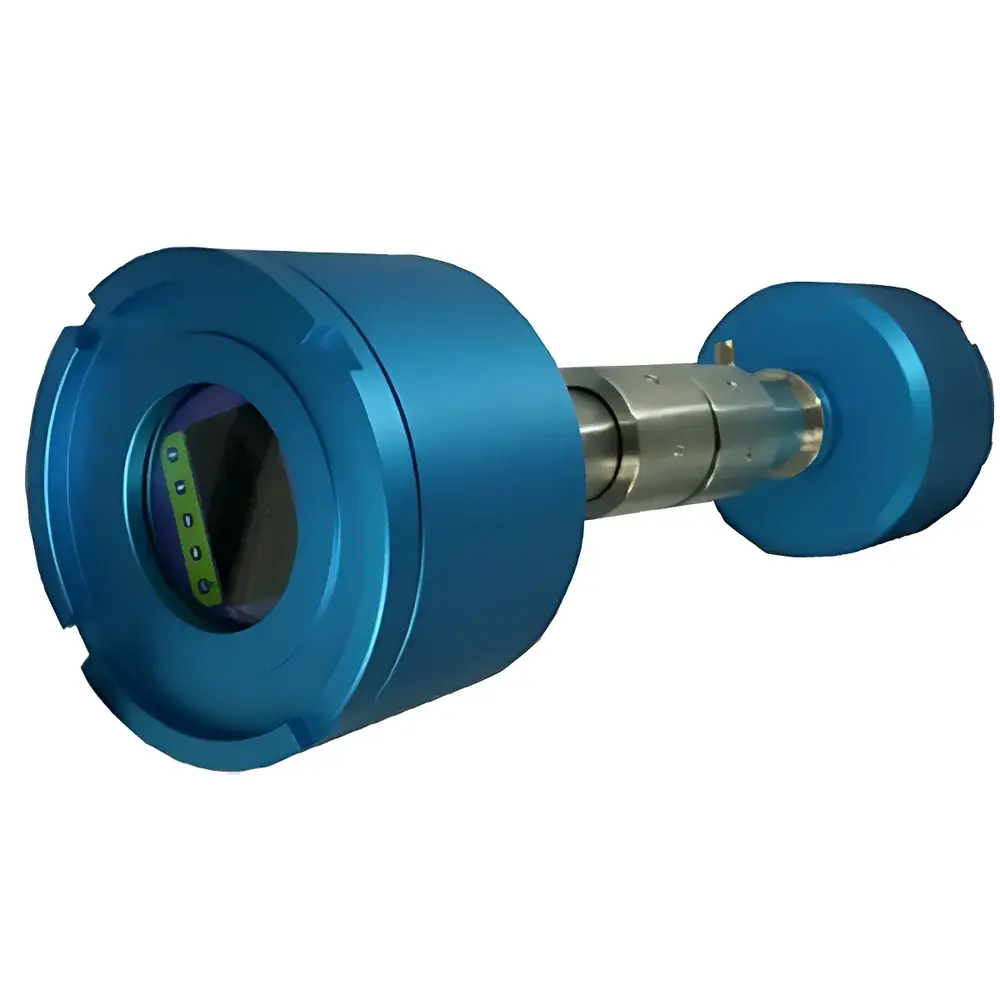
PERIC SLAS-01 In-Situ Tunable Diode Laser Absorption Spectroscopy (TDLAS) Gas Analyzer
| Brand | PERIC |
|---|---|
| Model | SLAS-01 |
| Measurement Principle | TDLAS |
| Detectable Gases | O₂, CO, CO₂, CH₄, C₂H₂, H₂S, NH₃, HCl, HF |
| Detection Limits | O₂: 0.01% vol |
| CO | 1 µmol/mol |
| CO₂ | 0.01% vol |
| CH₄ | 0.01% vol |
| C₂H₂ | 0.01% vol |
| H₂S | 1 µmol/mol |
| Full-Scale Ranges | O₂/CO/CO₂/CH₄: 0–99.99% vol |
| C₂H₂/H₂S | 0–10% vol |
| Linearity Error | ≤ ±1% FS |
| Repeatability & Drift | ≤ ±1% FS per 6 months |
| Optical Path Length | ≤20 m |
| Sample Temperature | ≤800 °C |
| Sample Pressure | ±5 kPa |
| Ambient Temperature | −20 to +60 °C |
| Ambient Humidity | ≤90% RH |
| Power Supply | DC 24 V |
| Relay Outputs | 3 × (24 V / 1 A) |
| Analog Outputs | 2 × 4–20 mA (max. load 750 Ω) |
| Digital Interface | RS485, Modbus RTU protocol |
| Display | Magnet-controlled graphical interface |
| Enclosure Rating | IP66 |
| Explosion Protection | Ex d IIC T6 |
Overview
The PERIC SLAS-01 In-Situ Tunable Diode Laser Absorption Spectroscopy (TDLAS) Gas Analyzer is an industrial-grade optical gas measurement system engineered for real-time, in-line quantification of specific trace and major gas species within hot, harsh process streams. Unlike extractive sampling systems requiring sample conditioning, the SLAS-01 performs direct, non-contact absorption spectroscopy across the process duct or stack—eliminating lag time, condensation artifacts, and calibration drift associated with gas transport lines. Its core measurement principle relies on wavelength-scanned near-infrared (NIR) or mid-infrared (MIR) diode lasers, precisely tuned to fundamental rotational-vibrational absorption lines of target molecules (e.g., O₂ at 760 nm, CO at 2.3 µm, H₂S at 2.6 µm). By analyzing Beer-Lambert law-based attenuation at selected spectral features—while actively compensating for interferences from water vapor, particulate scattering, and thermal emission—the analyzer delivers high-fidelity concentration data under dynamic industrial conditions.
Key Features
- In-situ optical path design enables direct installation across flue ducts, reactors, or combustion chambers—no sample probe, filter, or conditioning system required.
- Multi-gas capability with configurable laser modules supporting simultaneous or sequential measurement of up to nine gases: O₂, CO, CO₂, CH₄, C₂H₂, H₂S, NH₃, HCl, and HF.
- High-temperature optical transmitter/receiver units rated for continuous operation at sample temperatures up to 800 °C, with active air purge ports compatible with instrument air or nitrogen.
- Robust mechanical architecture compliant with IP66 ingress protection and Ex d IIC T6 explosion-proof certification for Zone 1 hazardous areas.
- Field-configurable analog outputs (2 × 4–20 mA), relay alarms (3 channels), and RS485 serial interface supporting Modbus RTU for seamless integration into DCS, PLC, or CEMS platforms.
- Self-diagnostic firmware with real-time signal quality monitoring—including beam alignment status, signal-to-noise ratio (SNR), and path loss compensation—ensuring measurement integrity over extended service intervals.
Sample Compatibility & Compliance
The SLAS-01 is validated for use in high-dust, high-moisture, and thermally unstable environments typical of iron & steel production, cement kilns, waste incineration, chemical synthesis, and refinery FCC units. It meets key regulatory and operational requirements for continuous emissions monitoring systems (CEMS), including EN 15267-3 (QAL1 certification readiness), EPA Performance Specification 18 (PS-18) for CO and NOx, and ISO 14064-1 GHG quantification guidelines for CO₂ reporting. Its non-intrusive measurement method inherently satisfies US EPA Method 10 and ISO 12039 for oxygen and combustible gas analysis without catalytic interference. All firmware and configuration logs support audit-ready timestamped records aligned with GLP/GMP documentation practices and FDA 21 CFR Part 11 electronic record controls when deployed with validated data acquisition software.
Software & Data Management
The embedded operating system supports local configuration via a magnet-actuated graphical LCD interface—enabling parameter setup, zero/span verification, and diagnostic review without external tools. Remote access is available through optional Ethernet gateway modules (not included), enabling secure HTTP/HTTPS-based configuration and live data streaming. Raw spectral data, concentration time-series, and instrument health metrics are exportable in CSV or XML format. When integrated with PERIC’s Analytical Data Hub (ADH) software suite, the SLAS-01 supports automated calibration event logging, trend-based anomaly detection, and compliance report generation aligned with EU IED BREF documents and China’s HJ 75–2017 technical specifications for CEMS.
Applications
- Iron & Steel: Real-time O₂ and CO monitoring in blast furnace top gas, converter off-gas recovery optimization, and hot stove combustion efficiency control.
- Power Generation: Ammonia slip measurement in SCR DeNOx systems; CO and O₂ co-monitoring for boiler combustion tuning.
- Cement & Lime: In-situ CO and NOx profiling in precalciner and clinker cooler exhausts for kiln optimization and emissions compliance.
- Chemical Processing: H₂S and NH₃ quantification in Claus tail gas units; CH₄ and C₂H₂ monitoring in ethylene cracking furnace effluents.
- Waste-to-Energy: Continuous HCl and HF tracking in municipal solid waste incinerator flue gas prior to wet scrubber inlet.
- Refining: In-stack CO and O₂ feedback for fired heater air/fuel ratio control and safety interlock triggering.
FAQ
Does the SLAS-01 require periodic calibration with certified gas standards?
Yes—while the TDLAS technique provides inherent stability, quarterly zero/span verification using NIST-traceable calibration gases is recommended per EN 14181 and EPA PS-18 to maintain QAL2 compliance.
Can the analyzer operate reliably in high-dust environments such as cement kiln exhaust?
Yes—its dual-beam optical architecture with active alignment monitoring and high-intensity laser source maintains signal integrity even at opacity levels exceeding 20 m⁻¹; optional air-purge collimators further enhance lens protection.
Is the SLAS-01 suitable for measuring NH₃ in SCR applications where water vapor and temperature gradients are extreme?
Yes—NH₃ measurement utilizes a temperature-stabilized 1.53 µm laser line with multi-point water vapor correction algorithms; field validation confirms 30% H₂O content.
What cybersecurity provisions are implemented for remote data interfaces?
Firmware v3.2+ includes TLS 1.2 encryption for HTTPS connections, role-based user authentication, and disabled default credentials—fully compliant with IEC 62443-3-3 SL2 requirements for industrial control systems.
How is optical path length verified during commissioning?
Path length is configured during setup based on physical duct geometry; the system validates alignment via reflected beam intensity mapping and auto-adjusts gain to maintain optimal SNR—no manual interferometric verification required.