
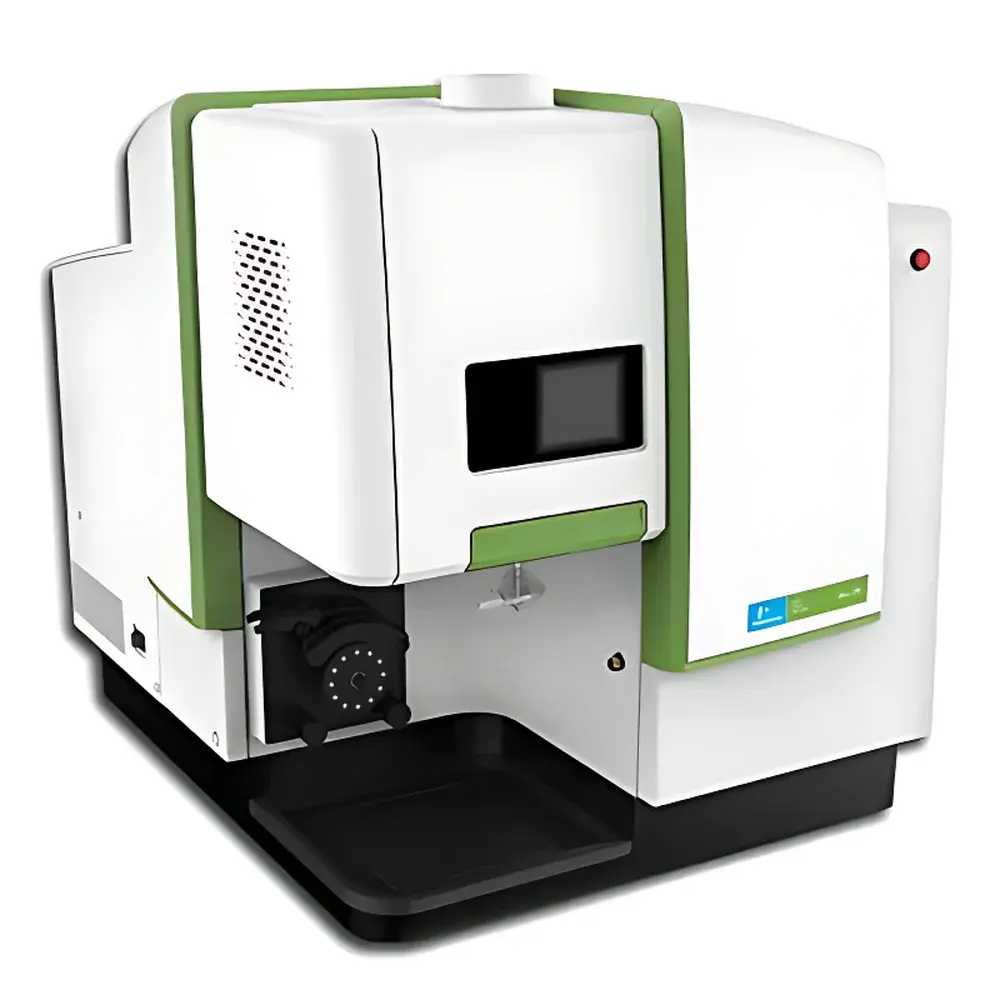
PerkinElmer Avio 200 Inductively Coupled Plasma Optical Emission Spectrometer
| Brand | PerkinElmer |
|---|---|
| Origin | Singapore |
| Manufacturer Type | Original Equipment Manufacturer (OEM) |
| Import Status | Imported |
| Model | Avio 200 |
| Instrument Type | Full-Spectrum Simultaneous ICP-OES |
| Gas Consumption | <8 L/min Ar (typical operational mode) |
| Startup Time | <5 minutes from cold start to analysis-ready |
| Dual-View Capability | Axial and Radial Simultaneous Observation without Sensitivity Loss |
| Linear Dynamic Range | Up to 9 orders of magnitude |
| Detector | Back-Illuminated CCD with On-Chip Background Correction |
| Plasma Technology | Flat Plate™ RF Generator and PlasmaShear™ Air-Based Tail Flame Elimination |
| Torch Orientation | Vertical, Tool-Free Adjustable Base with Interchangeable Injector Tubes |
| Software Platform | Syngistix for ICP-OES (21 CFR Part 11 Compliant) |
Overview
The PerkinElmer Avio 200 is a full-spectrum simultaneous inductively coupled plasma optical emission spectrometer (ICP-OES) engineered for high-throughput, high-fidelity elemental analysis across complex and high-matrix sample types—including undiluted brines, concentrated acids, organic solvents, and digested biological or environmental matrices. Unlike conventional sequential or hybrid scanning ICP-OES systems, the Avio 200 employs a robust, air-cooled Flat Plate™ RF generator to sustain a stable, high-energy argon plasma at significantly reduced gas consumption—typically below 8 L/min during routine operation. Its vertical torch configuration, combined with real-time PlasmaCam™ visual monitoring and automated PlasmaShear™ tail-flame suppression using ambient air (not auxiliary argon), enables reliable axial-view measurements down to sub-ppb levels—even for elements with spectral lines beyond 500 nm or below 200 nm—without sensitivity compromise or interferences from cold plasma regions.
Key Features
- Flat Plate™ RF Technology: Delivers stable, matrix-tolerant plasma with <50% lower argon consumption versus conventional helical coil ICP systems—reducing operational cost and dependency on high-purity gas supply infrastructure.
- PlasmaShear™ Interference Elimination: Patented air-driven axial tail-flame removal system; eliminates need for high-flow argon sheath gas or mechanical extraction, ensuring long-term stability and minimal maintenance.
- Dual-View Simultaneous Observation: Unique optical path design captures both axial and radial emissions concurrently across the full 165–900 nm wavelength range—no switching, no signal loss, no trade-off between sensitivity and robustness.
- Back-Illuminated CCD Detector: Enables true simultaneous multi-element acquisition with on-chip background correction, real-time spectral deconvolution, and high photon collection efficiency—critical for precision in regulated environments.
- Vertical Torch with Tool-Free Adjustment: Torch base allows rapid injector exchange and depth optimization—even during active analysis—supporting diverse nebulizers (e.g., microconcentric, V-groove, ultrasonic) and spray chambers (e.g., Scott-type, cyclonic, chilled).
- Cold-Start Rapid Readiness: Achieves plasma ignition and wavelength calibration in under 5 minutes from powered-off state, enabling on-demand usage and minimizing idle power consumption.
Sample Compatibility & Compliance
The Avio 200 is validated for direct analysis of high-solids content samples (up to 25% TDS), high-acid digests (e.g., 10% HNO₃, 5% HCl), and organic matrices (e.g., kerosene, biodiesel) without dilution or offline pre-treatment. Its robust plasma architecture meets ASTM D5185, ISO 11885, USP /, and EPA Methods 200.7, 200.8, and 6010D requirements. The system supports GLP/GMP workflows via Syngistix software with full 21 CFR Part 11 compliance—including electronic signatures, audit trails, user role management, and data integrity validation protocols.
Software & Data Management
Syngistix for ICP-OES provides an intuitive, workflow-driven interface for method development, calibration, QC monitoring, and reporting. It includes automated spectral interference correction, internal standard normalization, drift compensation, and customizable pass/fail criteria per analyte. All raw spectral data—including full 2D CCD frames—are stored in vendor-neutral formats (e.g., .csv, .xml) and can be exported for third-party statistical analysis or LIMS integration. Audit trails log every parameter change, calibration event, and user action with timestamp, operator ID, and reason-for-change fields—fully traceable for regulatory inspections.
Applications
- Environmental: Multi-element quantification in wastewater, soil extracts, and airborne particulate filters per EPA and ISO standards.
- Geochemical: Direct analysis of acid-digested rock, ore, and sediment samples with minimal dilution—preserving low-level REE and transition metal ratios.
- Pharmaceutical: Elemental impurity screening (As, Cd, Hg, Pb, etc.) in drug substances and excipients per ICH Q3D and USP /.
- Metallurgy: High-precision alloy composition verification and inclusion analysis in aluminum, titanium, and nickel-based superalloys.
- Food & Agriculture: Nutrient profiling (Ca, Mg, K, Fe, Zn) and contaminant screening (Al, Sn, Ni) in fortified foods, beverages, and plant tissues.
FAQ
What is the typical argon consumption during routine operation?
Typical consumption is ≤8 L/min in dual-view mode, enabled by the Flat Plate™ RF generator’s efficient energy coupling—approximately half that of conventional ICP-OES systems.
Does the Avio 200 support regulatory-compliant data handling?
Yes. Syngistix software is validated for 21 CFR Part 11 compliance, including electronic signatures, audit trails, and secure user authentication—suitable for FDA, EMA, and PMDA-regulated laboratories.
Can the system analyze high-salt or high-acid samples without clogging?
Yes. The vertical torch geometry, combined with optional high-solids nebulizers and chilled spray chambers, enables direct analysis of samples up to 25% TDS or 10% nitric acid without torch degradation or cone fouling.
Is method transfer possible from other ICP-OES platforms?
Yes. Syngistix supports import of wavelength lists, calibration curves, and QC templates from common industry formats (e.g., .csv, .xls), facilitating seamless migration from legacy instruments.
What maintenance intervals are recommended for the plasma torch and detector?
Torch inspection is recommended every 500–1000 hours of operation; CCD detector requires no routine maintenance and is sealed against humidity and particulate ingress—typical service life exceeds 10 years under normal laboratory conditions.




