
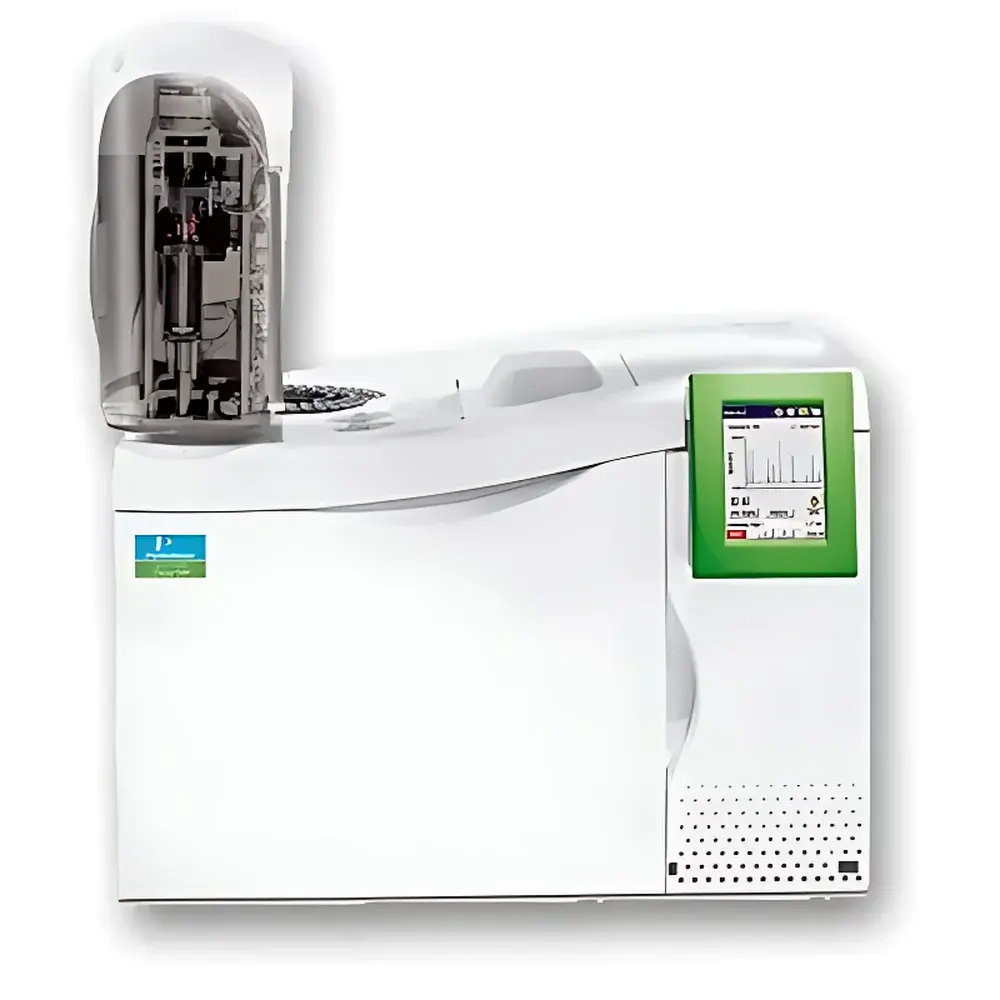
PerkinElmer Clarus 680 Gas Chromatograph
| Brand | PerkinElmer |
|---|---|
| Origin | USA |
| Manufacturer Type | Original Equipment Manufacturer (OEM) |
| Product Origin | Imported |
| Model | Clarus 680 |
| Instrument Type | Laboratory Gas Chromatograph |
| Application Scope | General-Purpose |
| Temperature Control Range | Not Specified |
| Oven Ramp Rate | Not Specified |
| Oven Cool-Down Rate | Not Specified |
| Carrier Gas Flow Range & Control | Not Specified |
| Carrier Gas Pressure Range & Control | Not Specified |
| Injector Maximum Operating Temperature | Not Specified |
| Injector Pressure Setting Range | Not Specified |
| Injector Total Flow Setting Range | Not Specified |
Overview
The PerkinElmer Clarus 680 Gas Chromatograph is a high-performance, general-purpose laboratory GC system engineered for robustness, reproducibility, and operational efficiency in regulated and non-regulated environments. Leveraging over five decades of chromatographic expertise, the Clarus 680 implements conventional packed and capillary column separation principles based on differential partitioning of analytes between a mobile phase (inert carrier gas) and a stationary phase (column coating). Its architecture supports standard GC methodologies—including split/splitless injection, programmed temperature vaporization (PTV), and cool-on-column—enabling precise retention time alignment and peak resolution across diverse compound classes. Designed for laboratories requiring high sample throughput without compromising method integrity, the Clarus 680 integrates thermal management innovations to minimize cycle time while maintaining column stability and detector sensitivity.
Key Features
- High-efficiency oven with rapid thermal response: Achieves cooling from 450 °C to 50 °C in under two minutes—significantly reducing turnaround time between runs.
- Programmable temperature-controlled inlet (PTC): Supports flexible injection modes including split, splitless, and cold-on-column, accommodating volatile, semi-volatile, and thermally labile compounds.
- Integrated autosampler compatibility: Enables unattended operation for up to 150 samples per sequence, supporting routine QC/QA workflows and multi-method scheduling.
- Wafer-based microchannel technology: Enhances carrier gas flow uniformity and pressure regulation precision, improving retention time repeatability and method transferability.
- Intuitive 7-inch capacitive touchscreen interface: Provides real-time status monitoring, method editing, and diagnostic feedback without external PC dependency.
- Modular detector support: Compatible with Flame Ionization Detector (FID), Thermal Conductivity Detector (TCD), Electron Capture Detector (ECD), and Nitrogen Phosphorus Detector (NPD); designed for future-ready coupling with mass spectrometry systems.
Sample Compatibility & Compliance
The Clarus 680 accommodates liquid, gaseous, and solid-phase extracted samples via multiple inlet configurations—including headspace samplers with cryogenic trapping and thermal desorption units. It meets essential regulatory requirements for analytical validation in accordance with ISO/IEC 17025, ASTM D3606/D5501, USP , and EPA Methods 502.2, 8021B, and 8260C. When operated with TotalChrom CDS under audit-trail-enabled configuration, the system supports 21 CFR Part 11 compliance through electronic signature enforcement, user-level access control, and immutable data archiving—facilitating GLP and GMP-aligned quality systems.
Software & Data Management
TotalChrom Chromatography Data System (CDS) serves as the native acquisition and reporting platform, offering method development wizards, automated calibration curve generation, peak integration with baseline correction algorithms, and customizable report templates compliant with LIMS integration standards (e.g., ASTM E1578, ANSI/NIST SP 500-291). The Clarus 680 also supports third-party CDS interoperability via industry-standard drivers—including Waters Empower™ 2 and Agilent EZChrom Elite™—enabling centralized instrument control within heterogeneous lab environments. All raw data files (.ch, .cdf) are stored in open-format repositories, ensuring long-term readability and cross-platform analysis portability.
Applications
The Clarus 680 delivers consistent performance across environmental testing (e.g., VOCs in water/soil, pesticide residues), food safety (fatty acid profiling, flavor compound quantitation), forensic toxicology (blood alcohol, drug metabolites), petrochemical QA (hydrocarbon distribution, sulfur speciation), polymer additive screening, and academic research in separation science education. Its modular design allows seamless adaptation to evolving method requirements—from single-component assays to complex multicomponent fingerprinting—without hardware replacement.
FAQ
Is the Clarus 680 compatible with mass spectrometry detection?
Yes—the system features standardized electrical and mechanical interfaces for direct coupling with PerkinElmer’s Torion® portable MS or third-party benchtop GC-MS platforms.
Does the instrument support remote monitoring and control?
When connected to a local network and configured with TotalChrom Enterprise Edition, users can perform method uploads, run initiation, and real-time chromatogram viewing from any authorized workstation.
What maintenance intervals are recommended for optimal performance?
Routine maintenance includes quarterly inlet liner replacement, biannual detector cleaning, and annual oven seal inspection—detailed in the manufacturer’s Preventive Maintenance Guide (P/N 0111-0225).
Can legacy methods developed on older Clarus models be transferred to the Clarus 680?
Yes—method migration is supported via TotalChrom’s backward-compatible method import function, preserving retention times, integration parameters, and calibration tables with minimal revalidation.
Is training provided with system installation?
PerkinElmer offers on-site installation qualification (IQ), operational qualification (OQ), and hands-on operator training covering method setup, troubleshooting, and compliance documentation—delivered by certified Field Application Scientists.





