
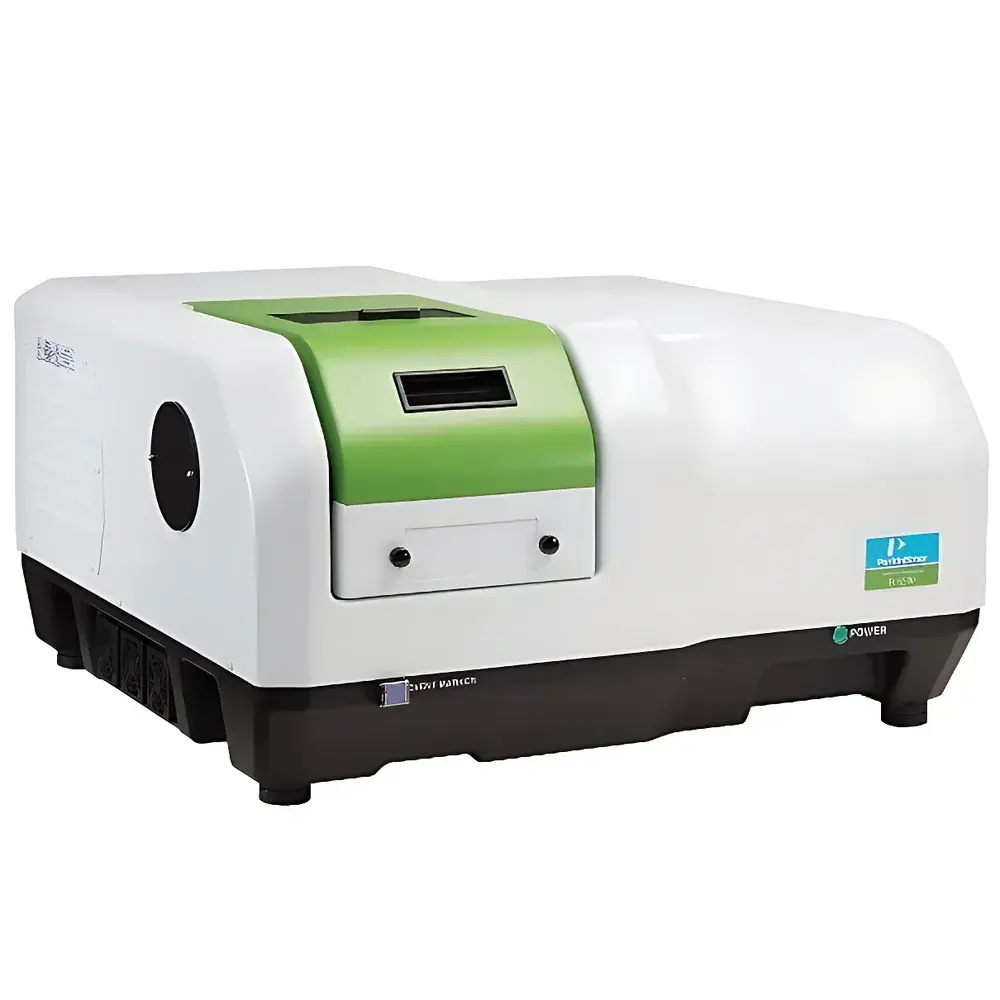
PerkinElmer FL 6500 Pulsed Xenon Fluorescence Spectrophotometer
| Brand | PerkinElmer |
|---|---|
| Origin | South Korea |
| Manufacturer Type | Original Equipment Manufacturer (OEM) |
| Import Status | Imported |
| Model | FL 6500 |
| Wavelength Accuracy | ±0.5 nm |
| Spectral Bandwidth (Slit Width) | 1, 2.5, 5, 10, 20 nm |
| Resolution | 1.0, 2.5, 5, 10, 20 nm |
| Sensitivity | >750:1 (RMS) |
| Dispersion Element | Grating |
| Light Source | Pulsed Xenon Lamp |
Overview
The PerkinElmer FL 6500 is a high-performance, benchtop molecular fluorescence spectrophotometer engineered for precision quantitative and qualitative analysis of fluorescent species across life sciences, pharmaceuticals, materials science, and environmental research. It operates on the principle of photoluminescence spectroscopy—exciting analytes with short-duration, high-intensity pulses of xenon light and detecting emitted photons across programmable emission wavelength ranges. Unlike continuous-source instruments, its pulsed xenon architecture minimizes sample photodegradation and photobleaching, preserving native conformational integrity in sensitive biomolecules such as proteins, enzymes, nucleic acids, and live-cell preparations. The system delivers high signal-to-noise ratio (SNR >750:1 RMS) and sub-nanometer wavelength accuracy (±0.5 nm), enabling reliable spectral deconvolution, multi-component quantification, and kinetic profiling under physiologically relevant conditions.
Key Features
- Pulsed xenon lamp with user-definable pulse energy and repetition rate—enabling dynamic range extension without saturation or photodamage
- Variable spectral bandwidth selection (1–20 nm) via motorized slits, supporting both high-resolution spectral fingerprinting and high-throughput screening modes
- Grating-based monochromator design ensuring long-term optical stability and reproducible wavelength calibration
- Compact footprint (66 cm width) optimized for space-constrained laboratories while maintaining full optical path integrity
- Modular, plug-and-play accessory architecture—including temperature-controlled cuvette holders, microvolume adapters, and solid-sample reflectance modules—for seamless workflow integration
- Compliance-ready hardware architecture supporting audit trails, electronic signatures, and secure data handling per regulatory requirements
Sample Compatibility & Compliance
The FL 6500 accommodates standard 1-cm quartz cuvettes, low-volume microcells (down to 50 µL), capillary cells, and solid samples via optional integrating sphere or reflection stage. Its non-destructive excitation profile ensures compatibility with labile biological matrices—including enzyme-substrate complexes, membrane-bound fluorophores, and intracellular ion indicators (e.g., Ca2+, Zn2+). From a regulatory standpoint, the instrument meets essential performance criteria outlined in USP General Chapter <1058> Analytical Instrument Qualification, ISO/IEC 17025:2017, and ASTM E275-22. When operated with PerkinElmer’s Enhanced Security (ES) software, it supports full 21 CFR Part 11 compliance—including role-based access control, immutable audit logs, electronic signature validation, and automated IQ/OQ/PQ documentation templates for GLP and GMP environments.
Software & Data Management
Instrument control, acquisition, and analysis are managed through PerkinElmer’s proprietary Fluorescence Software Suite—a Windows-based platform featuring intuitive workflow-driven navigation and context-sensitive help. The software includes dedicated modules for steady-state spectroscopy, time-resolved decay analysis (via external TCSPC integration), and kinetic acquisition with real-time curve fitting (first-order, Michaelis-Menten, sigmoidal, and custom equation support). All raw data are stored in vendor-neutral, metadata-rich formats compliant with FAIR principles (Findable, Accessible, Interoperable, Reusable). Export options include CSV, ASCII, JCAMP-DX, and PDF reports with embedded traceability metadata. Data integrity safeguards include automatic timestamping, user session logging, and checksum-verified file storage—all validated against ALCOA+ (Attributable, Legible, Contemporaneous, Original, Accurate, Complete, Consistent, Enduring, Available) principles.
Applications
- Nucleic Acid Analysis: Quantification of dsDNA/ssDNA/RNA using SYBR dyes; detection of base-pair mismatches via melting curve analysis
- Protein Characterization: Tryptophan fluorescence for conformational stability assessment; ANS binding assays for hydrophobic surface exposure
- Enzyme Kinetics: Real-time monitoring of NADH/NADPH turnover; inhibitor screening via IC50 determination with variable substrate concentrations
- Clinical Diagnostics: Porphyrin profiling in erythropoietic protoporphyria; vitamin D metabolite quantification in serum
- Materials Science: Quantum yield measurement of OLED emitters; photostability testing of UV-curable resins; pesticide residue detection in aqueous environmental extracts
- Forensics & Authentication: Fluorescent taggant analysis in currency security features; ink differentiation in questioned document examination
FAQ
What distinguishes the FL 6500 from continuous-source fluorescence spectrophotometers?
The pulsed xenon source eliminates thermal load and cumulative photobleaching, enabling repeated measurements on photolabile samples without signal decay—critical for live-cell imaging prep, enzyme kinetics, and low-abundance biomarker detection.
Can the FL 6500 perform absolute quantum yield measurements?
Yes—when coupled with the optional integrating sphere accessory and calibrated reference standards, the system calculates absolute quantum yield per ASTM E2634-21 and IUPAC recommendations.
Is method transfer possible between FL 6500 and FL 8500 platforms?
Method files, calibration tables, and report templates are fully interoperable between both models, minimizing revalidation effort during instrument upgrades or lab expansion.
Does the system support multi-user environments with differentiated permissions?
Yes—the Enhanced Security software enforces hierarchical user roles (Administrator, Analyst, Reviewer) with configurable access rights to instrument parameters, data export functions, and audit log visibility.
How is wavelength accuracy maintained over time?
The system performs automated internal wavelength calibration using a holmium oxide reference filter at startup and optionally at scheduled intervals, traceable to NIST SRM 2034.





