
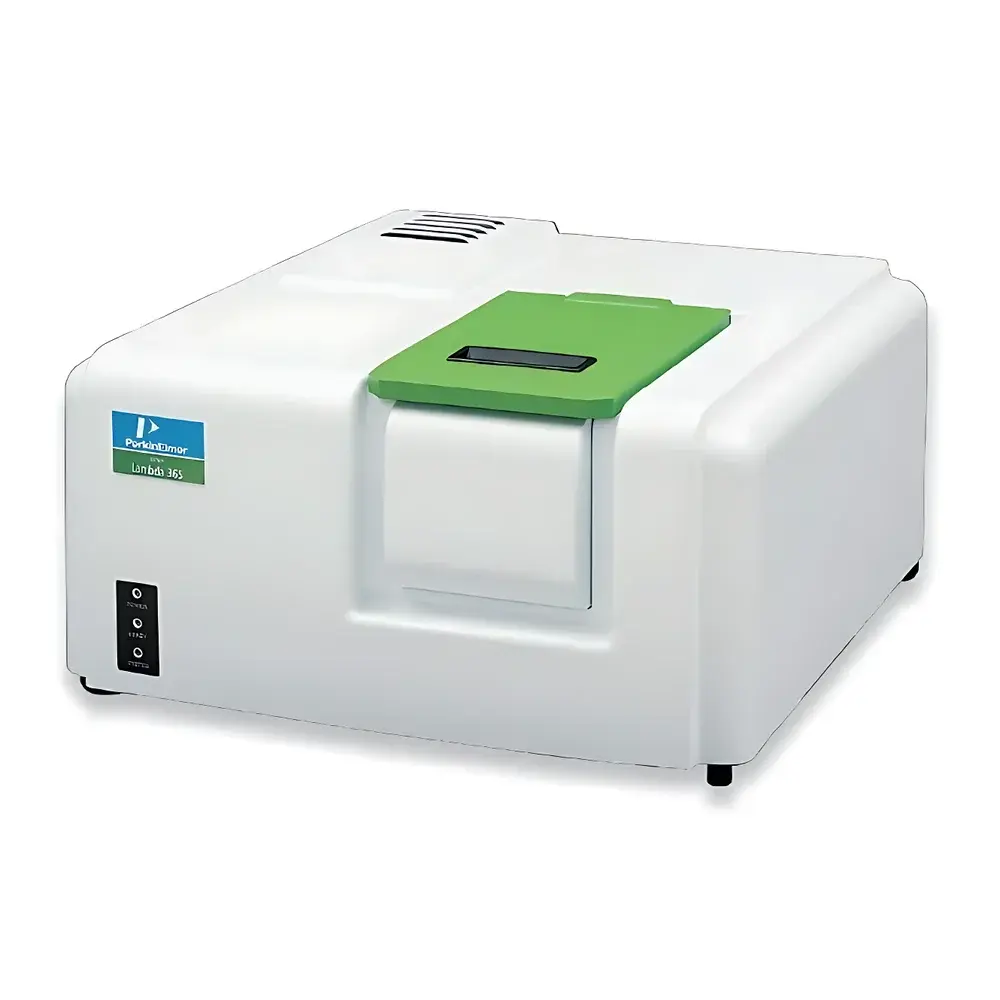
PerkinElmer LAMBDA 365 Dual-Beam Ultraviolet-Visible Spectrophotometer
| Brand | PerkinElmer |
|---|---|
| Origin | USA |
| Manufacturer Type | Original Equipment Manufacturer (OEM) |
| Product Origin | Imported |
| Model | LAMBDA 365 |
| Instrument Configuration | Dual-Beam |
| Detector Type | Photomultiplier Tube (PMT) |
| Wavelength Range | 190–1100 nm |
| Wavelength Scanning Mode | Automatic |
| Spectral Bandwidth | Selectable (0.5, 1, 2, 5, or 20 nm) |
| Wavelength Accuracy | ±0.1 nm |
| Stray Light | <0.02% T at 340 nm |
Overview
The PerkinElmer LAMBDA 365 is a dual-beam ultraviolet-visible (UV-Vis) spectrophotometer engineered for precision, stability, and regulatory compliance in demanding analytical environments. Based on classical double-monochromator optical architecture with beam-splitting optics, it delivers high photometric accuracy and exceptional baseline stability by simultaneously measuring sample and reference beams—effectively compensating for source drift, detector response variation, and environmental fluctuations. Its wavelength coverage spans 190–1100 nm, enabling quantitative and qualitative analysis across organic and inorganic compounds, biomolecules, nanoparticles, and colored materials. Designed for laboratories requiring trace-level detection and reproducible absorbance measurements under GLP, GMP, or ISO/IEC 17025 frameworks, the LAMBDA 365 integrates seamlessly into validated workflows where data integrity and audit readiness are non-negotiable.
Key Features
- Dual-beam optical design with real-time reference compensation ensures long-term photometric stability and minimizes baseline drift during extended acquisitions.
- High-sensitivity photomultiplier tube (PMT) detector provides low-noise signal acquisition across the full 190–1100 nm range, supporting high dynamic range measurements from 0.0001 to 4.0 A.
- Selectably variable spectral bandwidth (0.5, 1, 2, 5, or 20 nm) allows optimization of resolution versus signal-to-noise ratio depending on analyte specificity and matrix complexity.
- Wavelength accuracy of ±0.1 nm—verified via internal holmium oxide and didymium filters—meets ASTM E275 and ISO 9001 calibration traceability requirements.
- Stray light performance <0.02% T at 340 nm enables reliable quantitation of highly absorbing samples and accurate detection near UV cutoff regions.
- Large, modular sample compartment accommodates up to 12 accessories simultaneously without mechanical interference, supporting rapid method reconfiguration.
Sample Compatibility & Compliance
The LAMBDA 365 supports diverse sample formats—including cuvettes (1 mm to 100 mm pathlength), solid reflectance/transmission substrates, fiber-optic probes, integrating spheres (for diffuse reflectance and colorimetry), and temperature-controlled multicell changers (Peltier- or water-jacketed). Its hardware and optional software modules comply with FDA 21 CFR Part 11 requirements, including electronic signatures, role-based access control, full audit trail generation, and secure data archiving. The system is preconfigured for alignment with USP , EP 2.2.25, and ICH Q2(R2) validation guidelines, making it suitable for pharmaceutical release testing, raw material identification, and stability-indicating assays.
Software & Data Management
Controlled via PerkinElmer’s UV WinLab™ software suite, the LAMBDA 365 offers intuitive method development, automated calibration routines (including photometric and wavelength verification), and customizable reporting templates compliant with laboratory information management systems (LIMS). Data files are stored in vendor-neutral .spc format with embedded metadata (operator ID, timestamp, instrument serial number, parameter settings). Software validation packages—including IQ/OQ documentation, risk assessments, and change control logs—are available for regulated users. All software modules support ALCOA+ principles (Attributable, Legible, Contemporaneous, Original, Accurate, Complete, Consistent, Enduring, Available) throughout the data lifecycle.
Applications
- Pharmaceutical QA/QC: Active pharmaceutical ingredient (API) assay, excipient compatibility screening, dissolution profile monitoring, and cleaning validation swab analysis.
- Environmental testing: Nitrate/nitrite quantification in water, heavy metal complexation studies, and humic substance characterization.
- Academic research: Enzyme kinetics (NADH/NADPH monitoring), protein secondary structure estimation (via CD-coupled UV), and nanoparticle surface plasmon resonance analysis.
- Materials science: Thin-film thickness determination, bandgap energy calculation of semiconductors, and pigment concentration mapping in coatings.
- Food & beverage: Color value (CIE L*a*b*) measurement, antioxidant capacity (FRAP/DPPH assays), and adulterant detection in oils and juices.
FAQ
Is the LAMBDA 365 compliant with 21 CFR Part 11 out of the box?
Yes—the system ships with configurable Part 11-compliant software options, including electronic signature enforcement, audit trail logging, and user privilege management.
Can the instrument be integrated into an existing LIMS or ELN infrastructure?
Yes—UV WinLab supports standard data export protocols (CSV, XML, SPC) and offers optional OPC UA and REST API interfaces for bidirectional communication.
What is the recommended calibration frequency for routine QC use?
Per ASTM E275, wavelength calibration should be verified daily using certified reference filters; photometric calibration is recommended before each analytical session or per SOP-defined intervals.
Does the LAMBDA 365 support kinetic or time-resolved measurements?
Yes—software-enabled kinetic scanning supports acquisition rates up to 200 points per second across defined wavelength windows, suitable for fast-reacting systems.
Are NIST-traceable calibration standards supplied with the instrument?
A set of NIST-traceable holmium oxide and neutral density filters is included for initial qualification; additional certified standards are available through PerkinElmer’s Metrology Services division.



