
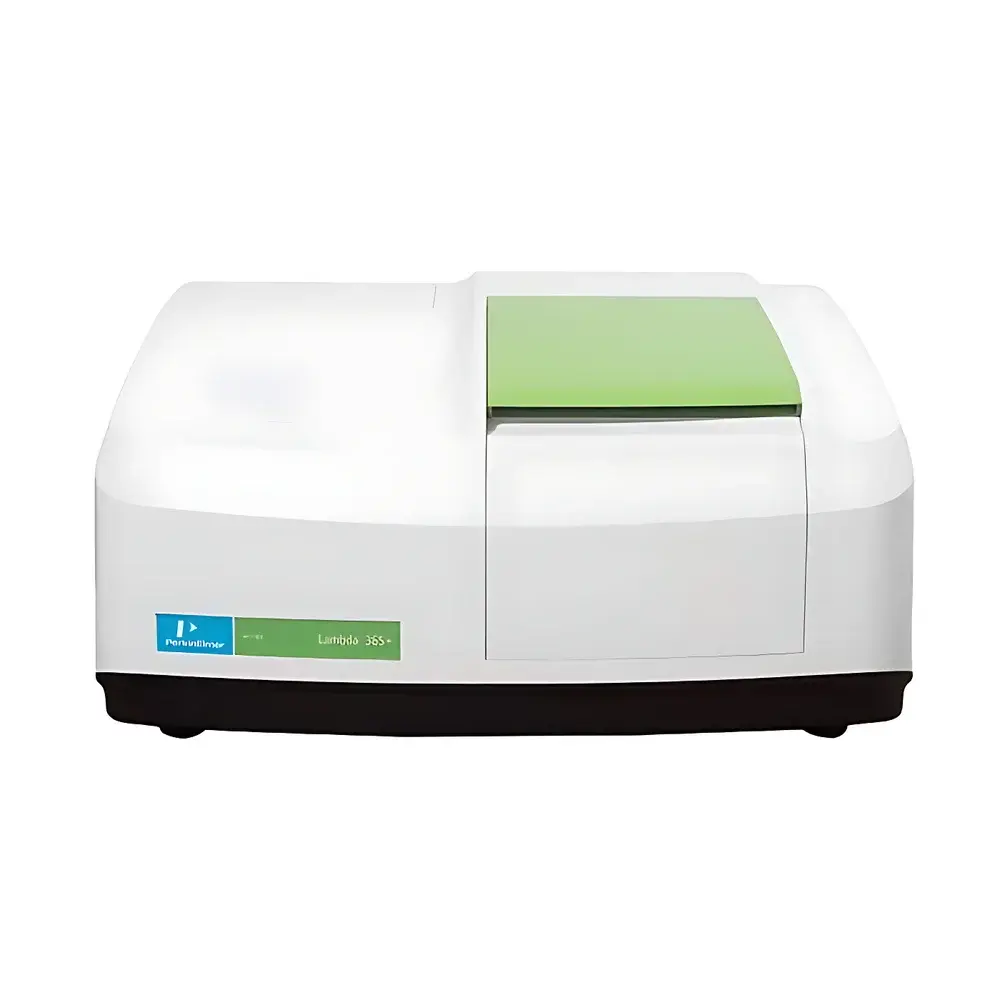
PerkinElmer LAMBDA 365+ UV/Vis Spectrophotometer
| Brand | PerkinElmer |
|---|---|
| Origin | Imported |
| Manufacturer Type | Manufacturer |
| Instrument Configuration | Double-Beam |
| Detector Type | Photomultiplier Tube (PMT) |
| Spectral Bandwidth | 0.5 nm to 20 nm |
| Wavelength Accuracy | ±0.1 nm |
| Wavelength Repeatability | ±0.02 nm |
| Stray Light | <0.00004% T at 220 nm and 340 nm |
| Absorbance Range | Up to 4.0 A |
| Automation Level | Fully Automated Wavelength Scanning & Parameter Control |
| Compliance | ASTM E275, ISO 9001, USP <857>, FDA 21 CFR Part 11 Ready |
Overview
The PerkinElmer LAMBDA 365+ UV/Vis Spectrophotometer is a high-performance double-beam instrument engineered for precision quantitative and qualitative analysis across research, quality control, and regulatory laboratories. Based on classical absorption spectroscopy principles—measuring the attenuation of ultraviolet and visible light as it passes through a sample—the system delivers exceptional photometric accuracy, low-noise spectral acquisition, and high optical stability. Its core optical architecture employs a high-efficiency Czerny-Turner monochromator with holographic gratings, coupled with a thermally stabilized double-beam path that continuously compensates for source drift and environmental fluctuations. This design ensures reproducible baseline stability and minimizes photometric error over extended measurement sessions—critical for kinetic studies, multi-point calibration, and compliance-driven workflows.
Key Features
- Variable spectral bandwidth (0.5–20 nm) optimized for resolution/sensitivity trade-off across diverse sample matrices—from highly absorbing pharmaceutical solutions to dilute biological extracts.
- Photomultiplier tube (PMT) detector with ultra-low dark current and high quantum efficiency across 190–1100 nm, enabling detection limits down to 0.0001 A in absorbance mode.
- Double-beam optics with real-time reference beam correction, delivering photometric repeatability better than ±0.001 A (RSD <0.1%) over 8-hour continuous operation.
- Automated wavelength scanning with programmable scan speeds up to 24,000 nm/min, supporting rapid kinetic profiling and high-throughput screening protocols.
- Integrated thermal management: Peltier-controlled sample compartment with optional N₂ purge line and internal liquid-cooling circuit for temperature-sensitive measurements (e.g., enzyme kinetics, polymer transitions).
- Tool-free, auto-recognized accessory interface—each module (e.g., thermostatted cuvette holders, stirrer-integrated flow cells, solid-sample reflectance stages) communicates its identity and calibration parameters directly to the software upon insertion.
Sample Compatibility & Compliance
The LAMBDA 365+ accommodates a broad range of sample formats—including standard 10-mm quartz/cuvettes, microvolume capillaries, fiber-optic probes, integrating spheres for diffuse reflectance, and custom flow cells. Its large sample compartment supports accessories with active temperature control (−10 °C to 100 °C), magnetic stirring, and gas purging—enabling rigorous method development per ICH Q2(R2) and USP general chapters. The system complies with ASTM E275 for spectrophotometer performance verification and supports GLP/GMP documentation requirements via audit-trail-enabled software (UV WinLab™ with 21 CFR Part 11 compliance option). All optical alignments and wavelength calibrations are traceable to NIST-certified holmium oxide and didymium filters.
Software & Data Management
Controlled by UV WinLab™ v7.x, the LAMBDA 365+ provides a modular, scriptable environment for method creation, sequence automation, and data validation. The software includes built-in pharmacopeial templates (USP, EP, JP), kinetic modeling tools (first-order, Michaelis-Menten, sigmoidal fitting), and customizable report generation with embedded metadata (operator ID, instrument serial number, calibration timestamp). Raw spectral data is stored in vendor-neutral .jdx format; audit trails record all parameter changes, user logins, and result modifications with time-stamped digital signatures. Optional integration with LIMS via ASTM E1384-compliant interfaces enables seamless data transfer into enterprise quality systems.
Applications
- Pharmaceutical: Assay quantitation, dissolution testing, excipient compatibility studies, and forced degradation monitoring per ICH guidelines.
- Materials Science: Bandgap determination of semiconductors, thin-film thickness calculation via interference fringes, and nanoparticle size estimation using Mie theory-based scattering models.
- Environmental: Nitrate/nitrite, phosphate, and heavy metal speciation (e.g., Cr(VI)) in aqueous matrices using EPA-approved colorimetric methods.
- Life Sciences: Protein concentration (A280), DNA purity (A260/A280 ratio), enzyme kinetics (NADH/NADPH oxidation), and cell culture density monitoring.
- Academic Research: Teaching spectroscopic fundamentals, method validation exercises, and collaborative instrumentation training programs requiring robust, serviceable hardware.
FAQ
What is the maximum absorbance range supported by the LAMBDA 365+?
The instrument reliably measures absorbance values up to 4.0 A with ≤0.3% photometric error, validated using neutral-density filters traceable to NIST SRM 930e.
Does the system support GMP-compliant data integrity requirements?
Yes—when configured with UV WinLab™ GxP Edition, it provides full 21 CFR Part 11 compliance including electronic signatures, role-based access control, and immutable audit trails.
Can the LAMBDA 365+ be integrated into automated lab workflows?
It features RS-232, USB, and Ethernet connectivity, plus native support for third-party robotic liquid handlers via ASCII command protocol and OPC UA interfaces.
Is routine calibration required between analyses?
No—auto-calibration occurs at system startup and before each measurement sequence; optional daily verification using holmium oxide reference standards satisfies ISO/IEC 17025 internal quality control requirements.
What maintenance is recommended for long-term optical stability?
Annual preventive maintenance includes grating alignment verification, PMT gain optimization, and lamp energy profiling—performed by PerkinElmer Field Service Engineers using factory-certified procedures.



