
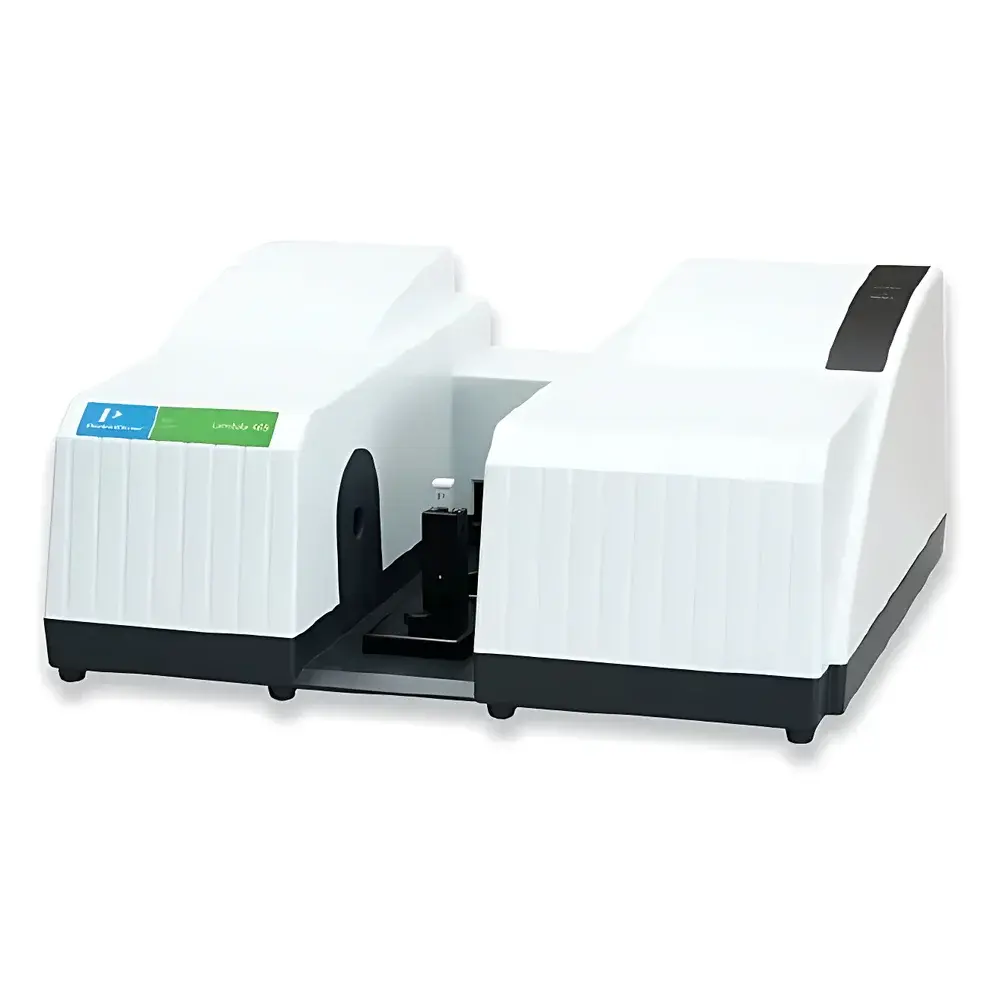
PerkinElmer Lambda 465 UV/Vis Spectrophotometer
| Brand | PerkinElmer |
|---|---|
| Origin | USA |
| Manufacturer | PerkinElmer, Inc. |
| Instrument Type | Imported |
| Model | LAMBDA 465 |
| Optical Design | Single-beam |
| Detector | Photodiode Array (PDA) |
| Wavelength Range | 190–1100 nm |
| Wavelength Accuracy | ±0.2 nm |
| Spectral Bandwidth | 1 nm |
| Stray Light | <0.03% T at 340 nm |
| Automation | Motorized Wavelength Scanning |
| Light Sources | Deuterium Lamp + Tungsten-Halogen Lamp |
| Regulatory Compliance | FDA 21 CFR Part 11–enabled Software |
Overview
The PerkinElmer Lambda 465 UV/Vis Spectrophotometer is a high-performance, single-beam photodiode array (PDA) spectrometer engineered for precision quantitative and qualitative analysis across research, pharmaceutical, environmental, and industrial laboratories. Based on fixed-grating PDA detection architecture, it captures full-spectrum absorbance, transmittance, or reflectance data from 190 nm to 1100 nm in as little as 20 ms—enabling rapid kinetic monitoring, dissolution profiling, and high-throughput screening without mechanical wavelength scanning delays. Its 1 nm spectral bandwidth meets pharmacopeial requirements (e.g., USP , EP 2.2.25), while the dual-lamp system (deuterium for UV, tungsten-halogen for visible/NIR) ensures stable, high-intensity illumination across the entire range—critical for low-noise measurements of dilute biological samples or highly scattering materials.
Key Features
- Photodiode array detector with real-time full-spectrum acquisition (190–1100 nm) and 20 ms scan speed
- Wavelength accuracy of ±0.2 nm and spectral bandwidth of 1 nm—validated per ISO 9001 and ASTM E275-21 calibration protocols
- Dual-source optical path: deuterium lamp (190–350 nm) and tungsten-halogen lamp (350–1100 nm), automatically switched with zero downtime
- Integrated self-diagnostic and auto-alignment routines—including automatic wavelength and photometric calibration using internal reference standards
- Compact benchtop footprint (44 × 54 × 28 cm) with modular accessory port for seamless integration of temperature-controlled cuvette holders, fiber-optic probes, integrating spheres, and microvolume platforms
- 21 CFR Part 11–compliant software suite with electronic signatures, audit trail, user role management, and secure data archiving
Sample Compatibility & Compliance
The Lambda 465 accommodates standard 10 mm square cuvettes (quartz, glass, or plastic), microvolume cells (down to 0.5 µL), solid reflective samples via optional integrating sphere, and liquid flow cells for continuous monitoring. It supports compliance-critical workflows under GMP/GLP environments: all measurement parameters, instrument status logs, and user actions are time-stamped and cryptographically secured in the audit trail. The system conforms to USP (Spectrophotometry and Light-Scattering), ISO/IEC 17025:2017 (testing laboratory competence), and ASTM E275-21 (standard practices for UV-Vis spectrophotometers). Optional IQ/OQ documentation packages are available for regulated pharmaceutical and biotech installations.
Software & Data Management
Controlled by PerkinElmer’s UV WinLab™ software, the Lambda 465 provides intuitive method development, multi-wavelength quantitation, kinetic time-course modeling, and advanced spectral math (e.g., first-derivative smoothing, baseline correction, peak deconvolution). Raw spectral data are stored in vendor-neutral .spc format; export options include CSV, XML, and PDF reports compliant with ALCOA+ principles (Attributable, Legible, Contemporaneous, Original, Accurate, Complete, Consistent, Enduring, Available). All software modules—including Dissolution, Enzyme Kinetics, and Color Analysis—are validated and version-controlled. Data integrity safeguards include write-protected archives, password-protected method templates, and configurable retention policies aligned with 21 CFR Part 11 Subpart B requirements.
Applications
- Pharmaceutical QA/QC: Active pharmaceutical ingredient (API) assay, excipient compatibility studies, dissolution testing per USP Apparatus II, and stability-indicating methods
- Life sciences: DNA/RNA quantification (A260/A280 ratio), protein concentration (Bradford/Lowry/BCA), enzyme kinetics (Michaelis-Menten analysis), and cell culture density monitoring
- Materials science: Thin-film optical coating characterization (transmittance/reflectance spectra), pigment dispersion analysis, and solar absorber efficiency evaluation
- Environmental testing: Heavy metal speciation (e.g., Cr(VI), As(III)/As(V)) via colorimetric derivatization, COD/BOD surrogate assays, and soil organic carbon estimation
- Food & beverage: Colorimetric quality control (CIELAB ΔE*), packaging barrier property assessment (UV transmission), and additive concentration verification (e.g., nitrites, sulfites)
FAQ
What regulatory standards does the Lambda 465 support for pharmaceutical use?
It supports USP , EP 2.2.25, JP 2.05, and FDA 21 CFR Part 11 through its validated software, secure audit trail, and documented calibration procedures.
Can the Lambda 465 perform kinetic measurements at sub-second intervals?
Yes—full-spectrum acquisition every 20 ms enables reliable monitoring of fast reactions, including enzymatic turnover and photochemical processes.
Is external calibration required before each analysis?
No—the instrument performs automated wavelength and photometric calibration using internal references prior to every measurement sequence.
Does the system support method transfer between instruments?
Yes—UV WinLab™ allows export of fully parameterized methods, including baseline settings, slit functions, and post-processing algorithms, ensuring reproducibility across labs.
What accessories are certified for GMP-compliant operation?
Temperature-controlled Peltier cuvette holders (±0.1 °C), 6-position autosamplers with barcode reading, and NIST-traceable quartz cuvettes are supplied with full qualification documentation (DQ/IQ/OQ).
Related Products






