
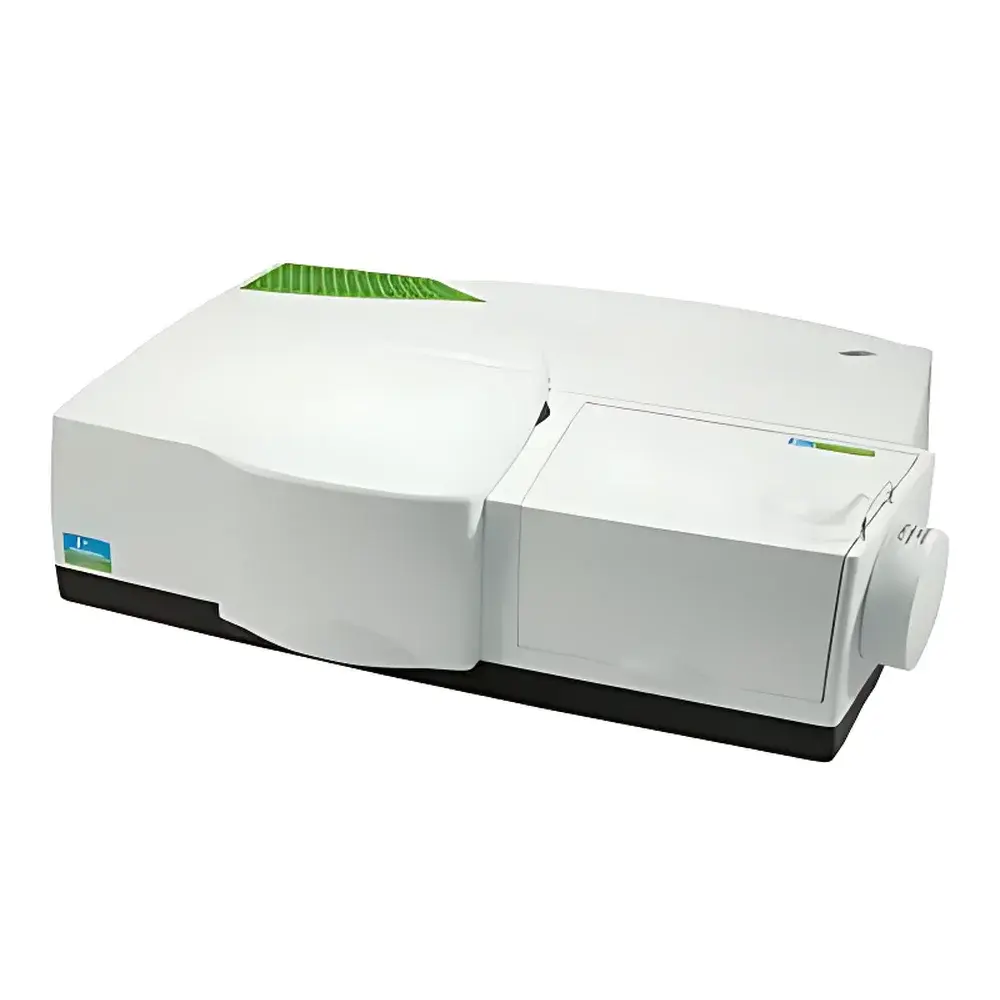
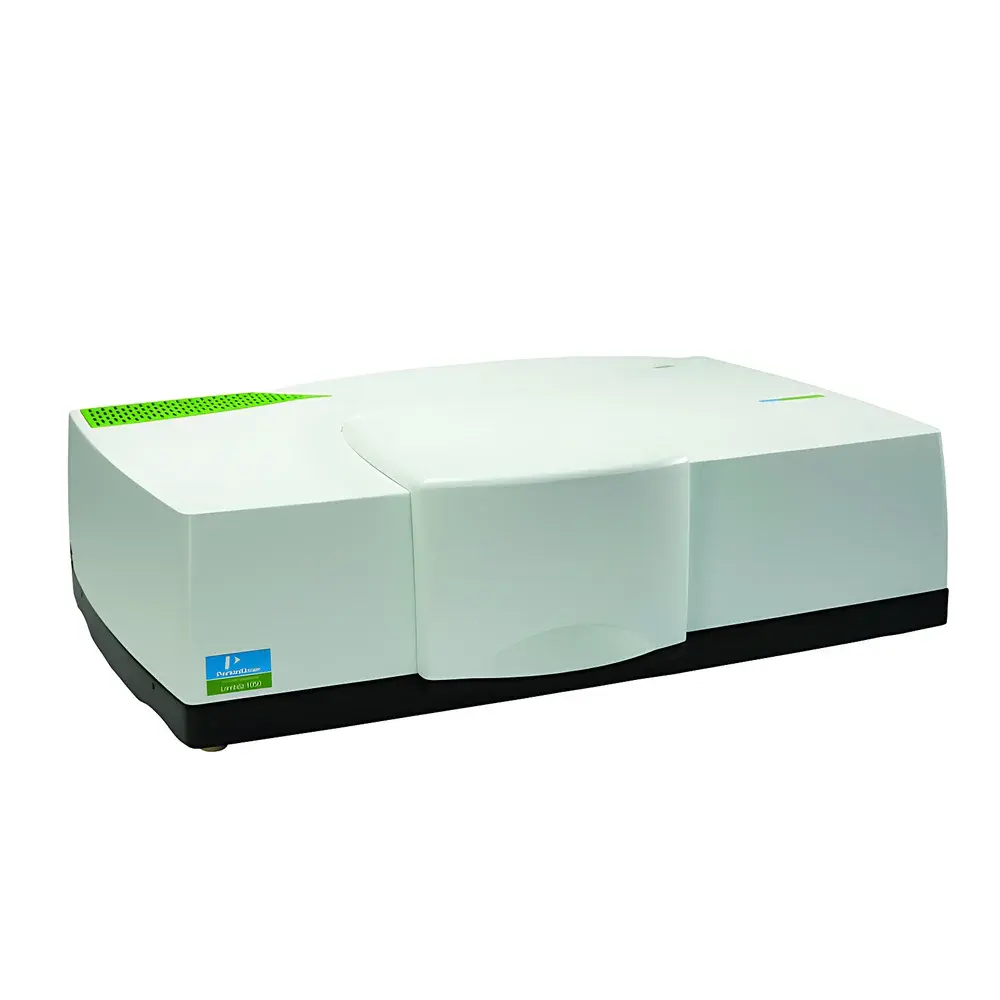
PerkinElmer Lambda 650/850/950 UV-Vis-NIR Spectrophotometer
| Brand | PerkinElmer |
|---|---|
| Origin | USA |
| Manufacturer Type | Original Equipment Manufacturer (OEM) |
| Product Category | Imported Instrument |
| Model | Lambda 650 / Lambda 850 / Lambda 950 |
| Optical Design | Double-Beam, Dual-Monochromator |
| Detector | Photomultiplier Tube (PMT) |
| Wavelength Scanning | Motorized & Auto-Calibrated |
| Wavelength Range | 175 nm to 3300 nm (model-dependent: Lambda 650: 190–900 nm |
| Lambda 850 | 175–900 nm |
| Lambda 950 | 175–3300 nm) |
| Linear Dynamic Range | Up to 8 A (Lambda 850/950), 6 A (Lambda 650) |
| Wavelength Accuracy | ±0.08 nm (UV-Vis region) |
| Stray Light | < 0.00008% T at 220 nm (typical) |
| Beam Geometry | Ratio-recording, chopper-synchronized dual-beam |
Overview
The PerkinElmer Lambda 650/850/950 UV-Vis-NIR spectrophotometers are high-performance, double-beam, dual-monochromator instruments engineered for precision quantitative and qualitative analysis across the ultraviolet, visible, and near-infrared spectral regions. Based on aerospace-grade optical architecture, these systems employ holographic, SiO₂-coated gratings (1440 lines/mm in UV-Vis; 360 lines/mm in NIR) and a proprietary four-segment扇-shaped chopper with Coded Sector Signal Correction (CSSC) technology. This design enables sequential acquisition of sample, black-reference, reference, and second black-reference signals—ensuring real-time dark-current compensation and eliminating drift-induced photometric error. The instruments operate on ratio-recording principles, delivering exceptional baseline flatness (< ±0.0005 A over full scan range), low stray light performance, and long-term photometric stability required for regulatory-compliant applications in pharmaceuticals, materials science, and optical coatings.
Key Features
- Double-beam, dual-monochromator optical path with automated wavelength calibration and motorized slit control
- Holographic gratings with dielectric SiO₂ overcoat for enhanced reflectivity, durability, and thermal stability
- CSSC chopper mechanism enabling simultaneous, time-synchronized correction of detector dark current for both sample and reference beams
- Pre-aligned, auto-switching deuterium and tungsten-halogen lamps with integrated warm-up and stabilization routines
- High-sensitivity R6872 photomultiplier tube (4× gain vs. legacy R928) for superior signal-to-noise ratio without data smoothing
- Large, modular sample compartment accommodating accessories up to 300 mm × 300 mm; compatible with Q-COM (Quick Change Optical Mount) interface for rapid accessory exchange
- Extended linear dynamic range of up to 8 absorbance units (A), validated per ASTM E275 and ISO 9022-3, enabling accurate measurement of highly absorbing or scattering samples
Sample Compatibility & Compliance
The Lambda platform supports diverse sample formats—including liquids, solids, thin films, optical filters, and large-area components—via interchangeable accessories such as 60 mm and 150 mm integrating spheres, universal reflection/transmission accessories (URA), variable-angle mirror reflectance stages, and the GPOB (General Purpose Optical Bench). All configurations maintain traceability to NIST-traceable standards. The system complies with key international regulatory frameworks: FDA 21 CFR Part 11 (when used with UV WinLab v6.3+ and audit trail-enabled configuration), ISO/IEC 17025 (for accredited testing laboratories), USP and , and ASTM E387, E1421, and E275 for spectrophotometer performance verification. Optional nitrogen purge capability (for operation below 185 nm) ensures compliance with vacuum-UV spectroscopy requirements in advanced materials characterization.
Software & Data Management
UV WinLab software is supplied as standard, offering instrument control, method development, kinetic and multi-wavelength scanning, and embedded modules including KinLab (enzyme kinetics), BioLab (biomolecular quantitation), and spectral database management. The optional Advanced Spectroscopy Software Package (ASSP) extends functionality with application-specific toolsets for colorimetry (CIE 1931/1976, ISO 11664), architectural glass evaluation (NFRC, EN 410), optical filter certification (ISO 9050), and mathematical operations (derivative spectroscopy, curve fitting, multivariate analysis). All software versions support GLP/GMP audit trails, electronic signatures, and secure user-role permissions aligned with ALCOA+ data integrity principles.
Applications
These spectrophotometers serve critical roles in QC/QA labs and R&D environments across multiple sectors: pharmaceutical dissolution and content uniformity testing; thin-film thickness and refractive index determination via interference fringe analysis; solar control and low-emissivity coating characterization per ISO 9050 and EN 673; reflectance and transmittance mapping of automotive glazing; NIR-based polymer identification and moisture quantification; and high-precision transmission measurements of laser optics and semiconductor wafers. The URA accessory enables automated angle-resolved reflectometry from 8° to 70° across 185–3200 nm, supporting ISO 13697 and ASTM E2028 for specular reflectance validation.
FAQ
What is the difference between Lambda 650, 850, and 950 models?
The primary distinction lies in spectral coverage: Lambda 650 operates from 190–900 nm; Lambda 850 extends to 175 nm (requiring nitrogen purge below 185 nm); Lambda 950 adds NIR capability up to 3300 nm using an InGaAs detector module.
Is nitrogen purging mandatory for all models?
Nitrogen purge is only required for measurements below 185 nm—thus essential for Lambda 850/950 when accessing the deep-UV region, but not for standard UV-Vis work above 190 nm.
Can the Lambda system meet FDA 21 CFR Part 11 requirements?
Yes—when configured with UV WinLab v6.3 or later, enabled audit trail logging, electronic signature workflows, and role-based access control, the system supports Part 11 compliance for regulated pharmaceutical and biotech applications.
What accessories enable absolute reflectance measurement?
The Universal Reflection Accessory (URA), VW-series absolute reflectance stage, and 150 mm integrating sphere—each calibrated against NIST-traceable standards—support absolute bidirectional reflectance distribution function (BRDF) and total hemispherical reflectance (THR) measurements.
How is photometric linearity validated on these instruments?
Linearity is verified using neutral density filters and step wedge standards per ASTM E275; the reported 8 A range reflects measured performance under conditions of < 0.00008% stray light at 220 nm, ensuring accuracy for high-absorbance samples without extrapolation.
Related Products






