
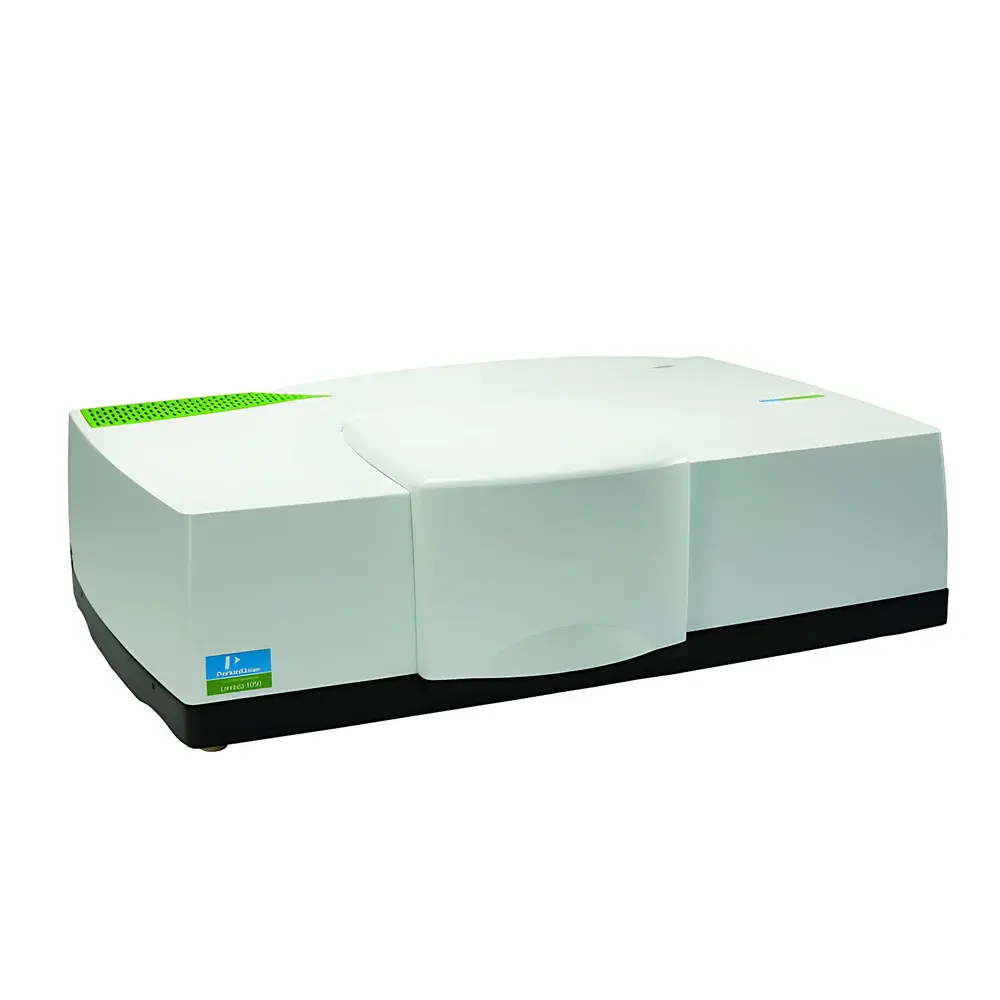
PerkinElmer Lambda 750 UV/Vis/NIR Spectrophotometer
| Brand | PerkinElmer |
|---|---|
| Origin | United Kingdom |
| Manufacturer Type | Original Equipment Manufacturer (OEM) |
| Import Status | Imported |
| Model | LAMBDA 750 |
| Instrument Architecture | Double-Beam |
| Detector Type | Photomultiplier Tube (PMT) |
| Wavelength Scanning | Motorized Automatic |
| Wavelength Range | 175 nm to 3300 nm |
Overview
The PerkinElmer Lambda 750 UV/Vis/NIR Spectrophotometer is a high-performance, double-beam, dual-monochromator spectrophotometer engineered for precision quantitative and qualitative analysis across the ultraviolet, visible, and near-infrared spectral regions. Utilizing a robust optical architecture based on all-reflective optics — including SiO₂-coated mirrors and high-line-density holographic gratings (1440 lines/mm in UV/Vis, 360 lines/mm in NIR) — the instrument delivers exceptional photometric accuracy, low stray light (< 0.00008% at 220 nm), and long-term wavelength stability. Its core measurement principle relies on ratioed beam detection via a four-segment chopper, where sample and reference beams are alternately directed onto separate black-reference sectors for real-time dark-signal correction. This design ensures high signal fidelity, minimizes baseline drift, and supports trace-level absorbance measurements down to < 0.0001 AU with excellent reproducibility. Designed specifically for demanding research environments in chemistry, materials science, pharmaceutical development, and advanced coatings characterization, the Lambda 750 meets the stringent requirements of method validation under ISO 17025, ASTM E275, and USP for spectrophotometric instrumentation.
Key Features
- Double-beam, dual-monochromator optical path with automatic beam balancing and real-time reference correction
- Extended spectral coverage from 175 nm to 3300 nm — among the broadest in its class — enabling seamless UV/Vis/NIR analysis without hardware reconfiguration
- High-efficiency photomultiplier tube (PMT) detector optimized for UV/Vis sensitivity and extended InGaAs detector option for NIR performance
- Four-sector chopper with segmented black-reference calibration zones for continuous dark-current compensation during scanning
- All-reflective optical train with fused silica and aluminum-coated optics protected by durable SiO₂ anti-reflective and environmental barrier layers
- Motorized, computer-controlled wavelength drive with ±0.08 nm wavelength accuracy and < 0.02 nm repeatability
- Integrated slit-width control (0.05–4.0 nm) for adaptive resolution selection across spectral ranges
Sample Compatibility & Compliance
The Lambda 750 accommodates a wide range of sample formats including cuvettes (1 mm–100 mm pathlength), integrating spheres (for diffuse reflectance/transmission), fiber-optic probes, temperature-controlled cells (−10 °C to 110 °C), and automated solid-sample holders. It complies with international regulatory frameworks governing analytical instrumentation: fully supports 21 CFR Part 11-compliant audit trails when used with validated UV WinLab software configurations; aligns with GLP/GMP documentation workflows through electronic signature-enabled method storage and execution logs; and satisfies ISO/IEC 17025 calibration traceability requirements when paired with NIST-traceable standards. Optional accessories include a 60-position autosampler, polarization modulator, and variable-angle specular reflectance stage — all mechanically synchronized and software-integrated.
Software & Data Management
Controlled exclusively via PerkinElmer’s UV WinLab software platform, the Lambda 750 provides both intuitive wizard-driven operation and full expert-mode parameter access. The software includes built-in tools for spectral deconvolution, Kubelka-Munk transformation, colorimetric analysis (CIE 1931/1976, ASTM E308), thin-film interference modeling, and multivariate calibration (PLS, PCR). The Advanced Spectroscopy Software Package (ASSP) extends functionality for specialized applications including architectural glass solar heat gain coefficient (SHGC) calculation, optical filter spectral certification per ISO 9050, and protective eyewear transmittance profiling compliant with EN 166 and ANSI Z87.1. All data files are saved in vendor-neutral .spc format with embedded metadata (instrument ID, operator, timestamp, calibration history), supporting interoperability with third-party chemometric platforms such as MATLAB, Python (SciPy), and Unscrambler.
Applications
- Quantitative determination of transition metal complexes and organic chromophores in pharmaceutical intermediates
- Bandgap and Urbach tail analysis of semiconductor thin films (e.g., TiO₂, perovskites) via Tauc plot derivation
- Real-time kinetic monitoring of photochemical reactions using time-resolved scanning modes
- Optical density profiling of multilayer dielectric stacks for laser cavity design verification
- Compliance testing of UV-blocking additives in polymers per ASTM D4329 and ISO 4892-3
- Reference-standard certification for national metrology institutes requiring sub-0.1 nm wavelength verification
FAQ
What is the certified wavelength accuracy specification for the Lambda 750?
The instrument achieves ±0.08 nm wavelength accuracy across the full 175–3300 nm range when calibrated using holmium oxide and didymium reference filters traceable to NIST SRM 2034 and SRM 2035.
Can the Lambda 750 be integrated into an automated laboratory workflow?
Yes — it supports RS-232, USB, and Ethernet communication protocols and is compatible with LabWare LIMS, Thermo Fisher SampleManager, and custom SCADA systems via OPC UA drivers.
Is GMP-compliant data archiving supported out-of-the-box?
UV WinLab software can be configured with role-based user accounts, electronic signatures, and immutable audit trails meeting FDA 21 CFR Part 11 Annex 11 and EU GMP Annex 11 requirements — subject to site-specific IQ/OQ/PQ validation.
What maintenance intervals are recommended for optimal photometric stability?
PerkinElmer recommends annual preventive maintenance including grating alignment verification, PMT gain calibration, and optical path cleanliness inspection — documented in the instrument’s service log within UV WinLab.





