
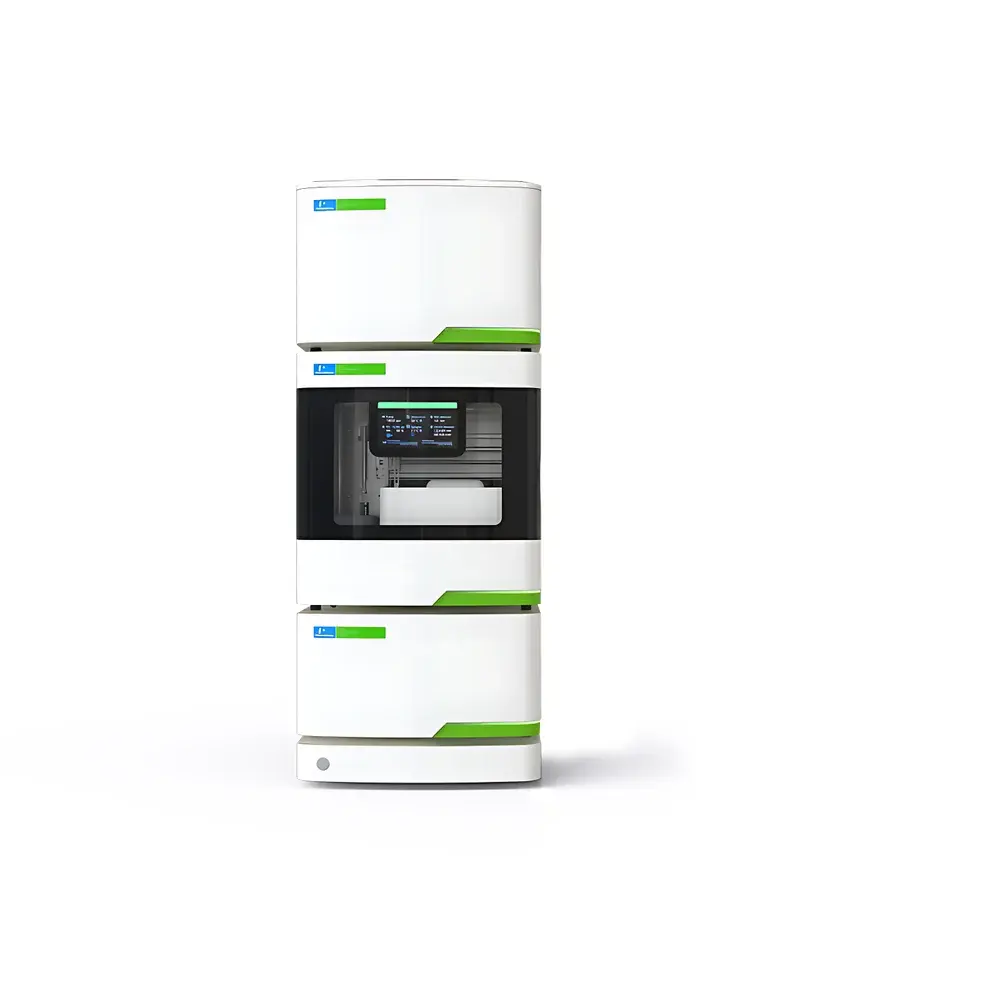
PerkinElmer LC 300 UHPLC/HPLC System
| Brand | PerkinElmer |
|---|---|
| Origin | USA |
| Manufacturer Type | Original Equipment Manufacturer (OEM) |
| Import Status | Imported |
| Model | LC 300 |
| Instrument Type | Ultra-High Performance Liquid Chromatograph (UHPLC) / High-Performance Liquid Chromatograph (HPLC) |
| Pressure Rating Options | 10,000 psi (HPLC mode) or 18,000 psi (UHPLC mode) |
| Detector Options | PDA, Multi-Channel UV/Vis, Single-Channel UV/Vis, Fluorescence, Refractive Index |
| Software Platform | Simplicity™ Chrom CDS |
| Gradient Accuracy | <0.2% RSD |
| System Dispersion Volume | <12 µL (typical, full system configuration) |
| Autosampler Features | Integrated color touchscreen display, programmable sample cooling (4–40 °C), low carryover (<0.005%) |
| Column Oven Temperature Range | 5–90 °C |
| Compliance | Designed for GLP/GMP environments |
Overview
The PerkinElmer LC 300 UHPLC/HPLC System is an engineered platform for high-resolution, high-throughput liquid chromatographic analysis in regulated and research laboratories. Built on a modular architecture, it supports both conventional HPLC (up to 10,000 psi) and ultra-high performance liquid chromatography (up to 18,000 psi) operation—enabling seamless method transfer and scalability across analytical workflows. Its core design principle centers on minimizing extra-column band broadening: the system achieves a total system dispersion volume of less than 12 µL (typical, with standard detector flow cell and capillary routing), ensuring optimal resolution when paired with sub-2-µm particle columns. This low-diffusion architecture directly enhances peak capacity, improves detection sensitivity, and reduces limits of detection without compromising retention time reproducibility. The LC 300 operates on the fundamental principles of reversed-phase, normal-phase, ion-exchange, and size-exclusion chromatography, delivering robust separation performance across small molecules, peptides, natural products, and synthetic intermediates.
Key Features
- Configurable pressure rating: Select between 10,000 psi (HPLC-grade stability) or 18,000 psi (UHPLC-grade efficiency) at point-of-purchase—no hardware retrofit required.
- Patented valve-switching architecture enabling multi-dimensional LC, heart-cutting, column backflushing, and automated solvent recycling—designed for evolving method development needs.
- Integrated autosampler with color touchscreen interface, real-time status monitoring, temperature-controlled sample tray (4–40 °C), and validated carryover <0.005% (measured per USP ).
- Column oven with precise temperature control (5–90 °C, ±0.2 °C stability), supporting method robustness across thermal gradients and retention time locking applications.
- Modular detector suite: Interchangeable PDA, multi-channel UV/Vis, single-wavelength UV/Vis, fluorescence, and refractive index detectors—each optimized for signal-to-noise ratio and linear dynamic range.
- Gradient delivery system with <0.2% RSD gradient accuracy and ≤100 ms dwell time variation—critical for method reproducibility in multi-laboratory settings.
Sample Compatibility & Compliance
The LC 300 accommodates a broad range of sample matrices—including pharmaceutical actives and impurities, food allergens and contaminants, cannabis-derived cannabinoids and residual solvents, environmental pollutants (e.g., PAHs, pesticides), and biopharmaceutical aggregates. It complies with instrumental requirements outlined in ASTM D7777, ISO 17025 (for accredited testing labs), USP , and ICH Q2(R2) guidelines for method validation. When operated with Simplicity™ Chrom CDS in audit-trail-enabled mode, the system meets FDA 21 CFR Part 11 criteria for electronic records and signatures, including role-based access control, immutable audit logs, and electronic signature workflows. Hardware modules are constructed to IEC 61010-1 safety standards and feature CE, UL, and CSA certifications.
Software & Data Management
Simplicity™ Chrom CDS provides a unified, intuitive interface for instrument control, sequence management, data acquisition, processing, and reporting. It supports AIA/ANDI file formats for cross-platform data exchange and integrates natively with LIMS and ELN systems via OPC UA and RESTful API protocols. The software includes built-in tools for peak integration (tangent skim, valley-to-valley, exponential curve fitting), system suitability assessment (theoretical plates, tailing factor, resolution), and automated report generation compliant with ALCOA+ principles. All user actions—including method edits, sequence changes, and reprocessing events—are logged with timestamp, operator ID, and contextual metadata in a tamper-evident audit trail.
Applications
- Pharmaceutical quality control: Assay, related substances, residual solvents, and extractables/leachables per ICH Q3C/Q5C guidelines.
- Cannabis compliance testing: Quantification of Δ9-THC, CBD, and minor cannabinoids; pesticide screening per state-mandated MRLs.
- Food safety: Detection of mycotoxins (aflatoxin B1, ochratoxin A), artificial colors, preservatives, and undeclared allergens.
- Environmental analysis: PAHs in soil extracts, per- and polyfluoroalkyl substances (PFAS) in water, and flame retardants in consumer goods.
- Academic and contract research: Method development for complex natural product isolations, peptide mapping, and chiral separations.
FAQ
Can the LC 300 operate as both an HPLC and UHPLC system?
Yes—the system is factory-configured for either 10,000 psi or 18,000 psi maximum pressure; the selected rating determines pump, injector, and detector flow cell specifications at time of order.
Is Simplicity™ Chrom CDS validated for GxP use?
Yes—validated installation qualification (IQ) and operational qualification (OQ) documentation packages are available; the software supports 21 CFR Part 11 compliance when deployed with appropriate IT infrastructure controls.
What detector options support quantitative fluorescence analysis?
The optional fluorescence detector offers excitation/emission wavelength programming (200–700 nm), variable slit widths, and synchronous scanning—optimized for trace-level analysis of polycyclic aromatic hydrocarbons, vitamins, and amino acid derivatives.
How does the LC 300 minimize carryover in high-sensitivity applications?
The autosampler employs dual-needle wash stations with programmable solvent selection, active needle seat cleaning, and pressure-assisted purging—validated to achieve <0.005% carryover per USP .
Does the system support column switching and multidimensional LC?
Yes—its patented valve manifold enables up to 12-position, 3-port switching with <10 ms actuation time, supporting comprehensive 2D-LC (LC×LC), heart-cutting, and online sample cleanup configurations.
Related Products




