
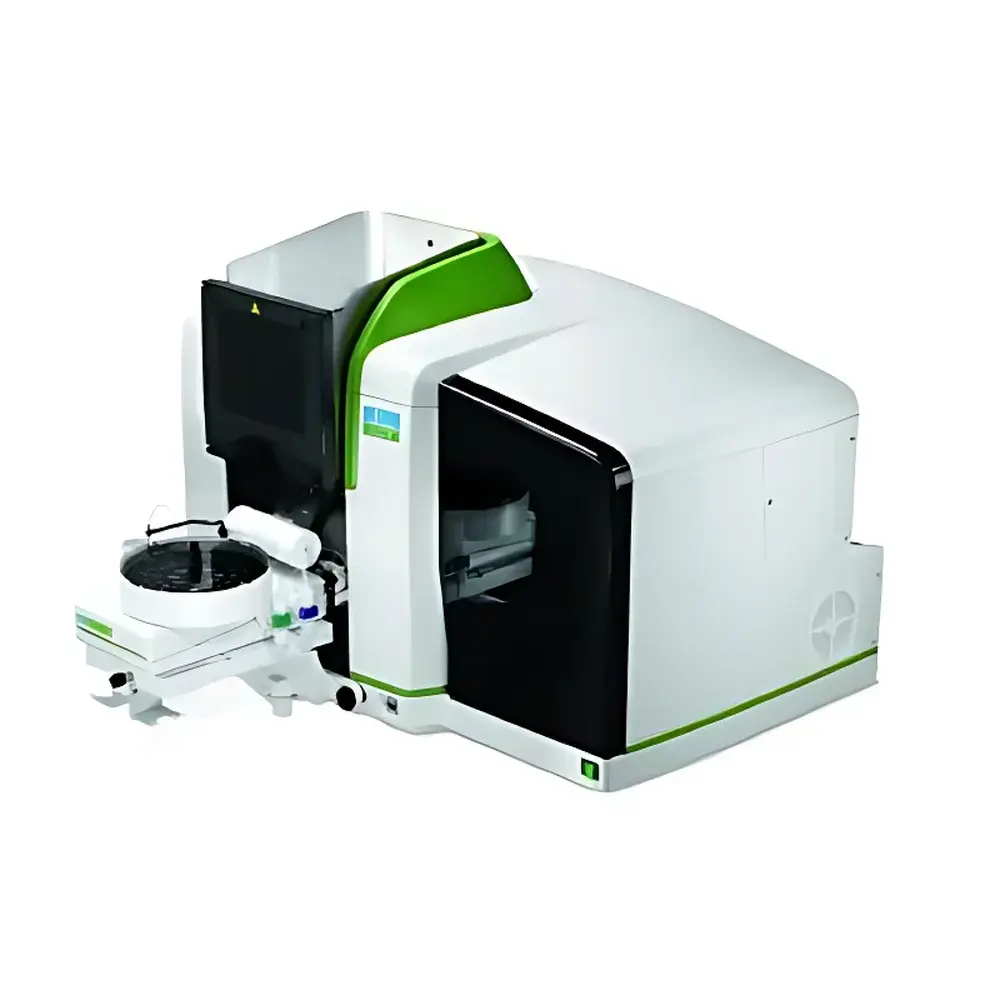
PerkinElmer PinAAcle 900 Flame and Graphite Furnace Atomic Absorption Spectrometer
| Brand | PerkinElmer |
|---|---|
| Origin | Singapore |
| Manufacturer | PerkinElmer |
| Country of Origin | Imported |
| Model | PinAAcle 900 |
| Instrument Type | Flame and Graphite Furnace AAS |
| Monochromator | Plane Grating |
| Optical System | Double-Beam |
| Detector | Solid-State Detector |
| Background Correction | D₂ Lamp + Longitudinal Zeeman |
Overview
The PerkinElmer PinAAcle 900 is a dual-mode atomic absorption spectrometer engineered for high-precision elemental quantification in demanding laboratory environments. It integrates flame atomic absorption (FAA) and graphite furnace atomic absorption (GFAA) into a single, compact stackable platform—enabling seamless method switching without hardware reconfiguration. The instrument operates on the fundamental principle of atomic absorption spectroscopy: ground-state free atoms in a flame or graphite furnace absorb characteristic radiation from a hollow cathode lamp (HCL) or electrodeless discharge lamp (EDL), with absorbance directly proportional to analyte concentration per Beer-Lambert law. Its double-beam optical architecture compensates for source intensity drift and lamp aging, ensuring long-term photometric stability. Designed for routine and regulated analysis—including environmental monitoring, clinical toxicology, food safety, and pharmaceutical impurity testing—the PinAAcle 900 delivers robust performance across diverse sample matrices while maintaining compliance readiness for GLP, GMP, and ISO/IEC 17025 workflows.
Key Features
- Integrated flame and graphite furnace atomization in one instrument chassis—eliminates inter-system calibration drift and reduces footprint by up to 40% versus standalone configurations.
- Modular background correction: user-selectable deuterium (D₂) lamp or longitudinal Zeeman effect correction—optimized for complex matrices with structured or non-structured background absorption.
- Plane grating monochromator with automatic wavelength selection and slit width adjustment (0.1–2.0 nm), supporting high spectral resolution for adjacent line separation in multi-element applications.
- Solid-state detector array with low-noise amplification and real-time signal processing—enhances signal-to-noise ratio and enables rapid transient signal capture during GFAA temperature programs.
- Automated gas control system with integrated flow sensors and pressure regulation for acetylene, nitrous oxide, and argon—ensuring reproducible flame stoichiometry and furnace purge consistency.
- Stackable design supports optional integration of Flow Injection Analysis (FIA) and Hydride Generation (HG)/Cold Vapor (CV) modules—extending capabilities to ultra-trace As, Se, Hg, Pb, and Cd determination.
Sample Compatibility & Compliance
The PinAAcle 900 accommodates liquid samples across wide concentration ranges—from sub-ppt levels (via GFAA with platform stabilization and integrated graphite tube modifiers) to high ppm concentrations (via flame mode with dilution or air-acetylene/nitrous oxide-acetylene combustion). It accepts standard 13 mm × 100 mm borosilicate glass tubes and disposable graphite cuvettes compliant with ASTM D396, EPA Method 200.7/200.9, and ISO 8288. All operational parameters—including lamp current, burner height, furnace ramp rates, and background correction mode—are logged with time stamps and user IDs, satisfying FDA 21 CFR Part 11 requirements when paired with Syngistix™ AA software audit trail functionality. Instrument qualification documentation aligns with IQ/OQ/PQ protocols per USP and ICH Q2(R2) guidelines.
Software & Data Management
Syngistix™ for AA is a workflow-driven, Windows-based software platform designed for analytical traceability and regulatory compliance. It provides method templates for EPA, ASTM, and pharmacopeial procedures; automated calibration curve generation with forced zero and multi-point weighting options; and real-time QC monitoring via Levey-Jennings charts and Westgard rules. Raw data files (.raw) are stored in encrypted, tamper-evident format with embedded metadata (instrument ID, operator, date/time, sequence log). Electronic signatures, role-based access control, and full audit trail—including parameter changes, result overrides, and report exports—are enabled by default. Data export formats include CSV, PDF, and XML for LIMS integration (e.g., Thermo Fisher SampleManager, LabVantage).
Applications
- Environmental: Quantification of heavy metals (Pb, Cd, Cr, Ni, Cu, Zn) in wastewater, soil digests, and airborne particulate filters per EPA Methods 200.7, 200.9, and 6020B.
- Clinical & Toxicology: Blood lead (Pb-B) and urinary cadmium (Cd-U) analysis following CLIA and CAP requirements.
- Food & Agriculture: Determination of essential (Fe, Zn, Cu) and toxic (As, Hg, Cd) elements in infant formula, cereals, and animal feed per AOAC 984.27 and ISO 11885.
- Pharmaceuticals: Catalyst residue testing (Pd, Pt, Rh) in active pharmaceutical ingredients (APIs) per ICH Q2(R2) and USP .
- Geological & Mining: Multi-acid digest analysis of ores and exploration samples using GFAA with matrix-matched calibration and Zeeman background correction.
FAQ
Does the PinAAcle 900 support both flame and graphite furnace analysis simultaneously?
Yes—the dual-atomizer design allows concurrent installation and automated switching between flame and graphite furnace modes without manual hardware replacement.
What background correction methods are available—and how do they differ?
Users may select either deuterium (D₂) continuum source correction for broad-band background or longitudinal Zeeman correction for structured background and high-sensitivity GFAA applications.
Is the instrument compatible with third-party LIMS systems?
Yes—Syngistix™ supports ODBC-compliant database connections and generates standardized XML reports for direct ingestion into major LIMS platforms.
Can the PinAAcle 900 be qualified for 21 CFR Part 11 compliance?
When deployed with Syngistix™ AA’s full audit trail, electronic signature, and access control modules, it meets all technical and procedural requirements for Part 11 validation.
What maintenance is required for the graphite furnace system?
Routine maintenance includes periodic cleaning of the autosampler probe, replacement of graphite tubes every 200–500 firings (depending on matrix), and annual calibration verification using NIST-traceable standards.





