
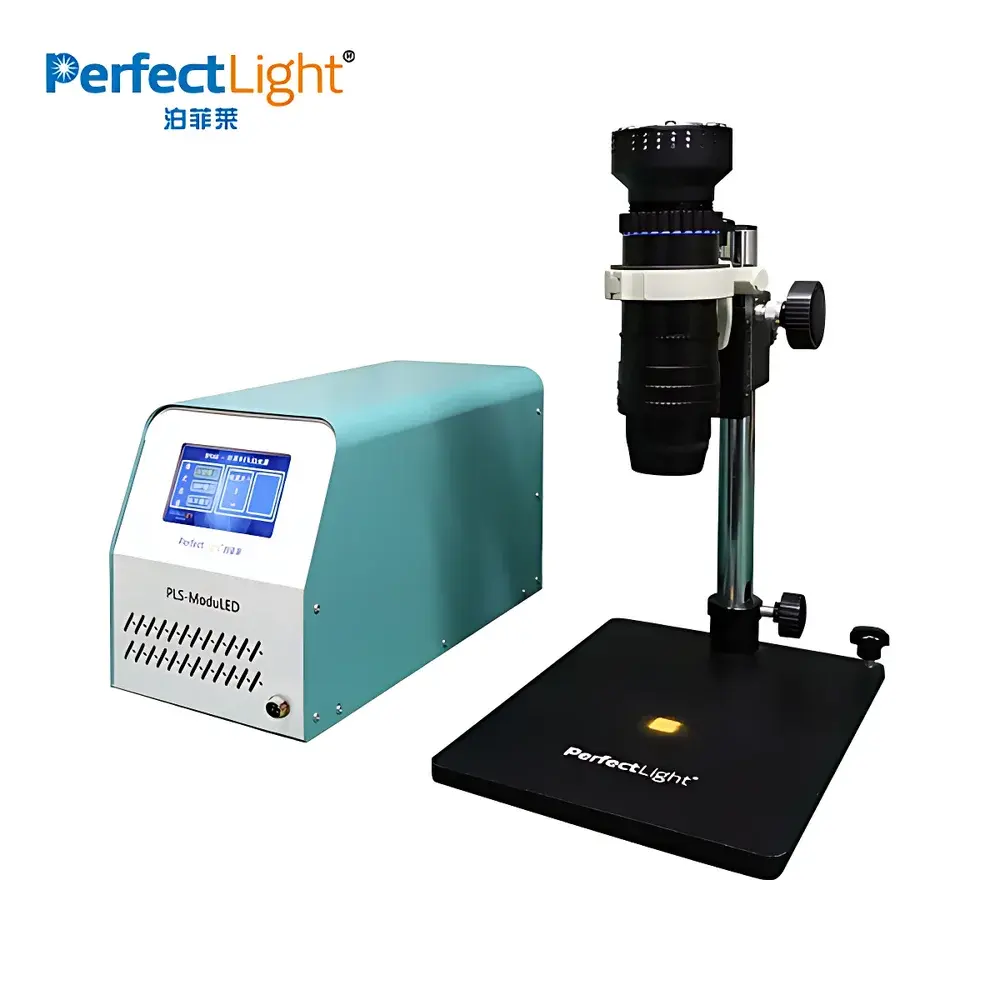
PerkinElmer PLS-ModuLED Parallel-Modulated LED Light Source
| Brand | PerkinElmer |
|---|---|
| Model | PLS-ModuLED |
| Light Source Type | High-Power Tunable LED Array |
| Illumination Mode | External (Top-Down or Side-Illumination) |
| Wavelength Options | 455–460 nm (Blue), 520–525 nm (Green), 620–625 nm (Red), 2700–3000 K (Warm White), 5000–6000 K (Cool White) |
| Max. Single-LED Power | 20 W |
| Max. Single-LED Current | 1500 mA |
| Current Control Resolution | 0.4 mA |
| Absolute Current Accuracy | ±1 mA |
| Luminous Flux Range | 333–1530 lm (model-dependent) |
| Operating Modes | Continuous, Modulated (square-wave, frequency-tunable), and Single-Pulse (programmable pulse width & delay) |
Overview
The PerkinElmer PLS-ModuLED Parallel-Modulated LED Light Source is an engineered optical excitation platform designed for precision photochemical, photobiological, and materials characterization applications requiring stable, spectrally defined, and dynamically controllable illumination. Unlike broadband arc lamps or unmodulated LEDs, the PLS-ModuLED integrates high-power monochromatic and white-light LED modules with a proprietary parallel current-driving architecture that enables synchronized, low-jitter modulation across multiple wavelengths—without cross-channel interference. Its core operation relies on constant-current regulation with sub-millisecond temporal fidelity, supporting experiments governed by photon dose (J/cm²), irradiance (W/cm²), and precise temporal profiles—critical for quantum yield determination, photocatalytic kinetics, optogenetics validation, and accelerated aging studies under ISO 4892-2 or ASTM G154 protocols.
Key Features
- Three operational modes: Continuous (DC), square-wave modulated (1 Hz–10 kHz adjustable frequency), and single-pulse (pulse width 10 µs–10 s; inter-pulse delay 1 ms–3600 s)
- Five interchangeable spectral configurations: Narrowband blue (455–460 nm), green (520–525 nm), red (620–625 nm), warm white (2700–3000 K), and cool white (5000–6000 K), each with calibrated luminous flux and radiometric output data traceable to NIM (National Institute of Metrology, China)
- High-resolution current control (0.4 mA step size) with absolute accuracy of ±1 mA—enabling reproducible irradiance tuning across intensity ranges without thermal drift compensation artifacts
- External illumination geometry optimized for integration with quartz cuvette holders, gas-phase reaction cells, thin-film reactors, and microscope stages; includes collimated output optics for uniform irradiance distribution (±3% spatial non-uniformity over Ø25 mm area)
- Rugged aluminum housing with active thermal management (PID-controlled fan + heatsink), rated for continuous operation at ambient temperatures up to 35°C
Sample Compatibility & Compliance
The PLS-ModuLED is compatible with standard optical bench components including fiber-coupled adapters (SMA905), liquid light guides, and custom collimation mounts. Its external illumination design supports transparent, semi-transparent, and reflective sample geometries—including suspended colloids, immobilized catalysts on quartz substrates, microbial cultures in Petri dishes, and OLED test pixels. All models comply with IEC 61000-6-3 (EMC emission limits) and IEC 62471 (Photobiological Safety Classification — Risk Group 1 or 2 depending on configuration and exposure duration). Output stability meets GLP requirements for photoreactor qualification per USP Analytical Instrument Qualification, with documented linearity (R² > 0.9998 over 10–100% current range) and 8-hour drift < ±0.5% at rated power.
Software & Data Management
The system interfaces via USB 2.0 to the PerkinElmer LightControl Suite—a Windows-based application supporting script-driven experiment sequencing, real-time current/temperature logging (100 Hz sampling), and export of timestamped irradiance profiles in CSV and HDF5 formats. The SDK (C/C++, Python 3.8+) enables integration into LabVIEW, MATLAB, or custom Python automation frameworks. Audit trails record all parameter changes with user ID, timestamp, and checksum-verified configuration snapshots—fully compliant with FDA 21 CFR Part 11 requirements when deployed with validated electronic signatures and role-based access controls.
Applications
- Quantitative photocatalysis: TiO₂, g-C₃N₄, and MOF-based degradation kinetics under monochromatic excitation
- Photoelectrochemical cell (PEC) testing with wavelength-resolved incident photon-to-current efficiency (IPCE) mapping
- Photostability assessment of pharmaceuticals per ICH Q1B guidelines using controlled UV-free visible spectra
- Time-resolved fluorescence lifetime imaging (FLIM) excitation source for gated detection systems
- Calibration reference for spectroradiometers and integrating sphere systems (NIST-traceable spectral irradiance data available upon request)
FAQ
Is the PLS-ModuLED suitable for use in inert-atmosphere gloveboxes?
Yes—the unit operates at low voltage (<24 V DC input) and generates negligible outgassing; optional feedthrough-compatible mounting brackets are available.
Can multiple PLS-ModuLED units be synchronized for multi-wavelength excitation sequences?
Yes—via TTL trigger inputs/outputs and shared master clock signals; jitter between units is <50 ns when configured in daisy-chain mode.
Does the system include NIST-traceable calibration certificates?
Standard shipment includes factory calibration reports (current vs. radiant flux); full NIST-traceable spectral irradiance certification is available as an optional add-on service.
What is the expected LED lifetime under continuous operation at 80% nominal current?
L70 lifetime exceeds 25,000 hours for all spectral variants, verified per TM-21-11 extrapolation from LM-80 stress testing at 85°C junction temperature.
Is remote operation supported over Ethernet or Wi-Fi?
Native support is USB-only; Ethernet connectivity requires an external USB-to-Ethernet server (e.g., Digi AnywhereUSB) validated per PerkinElmer’s interoperability matrix.





