
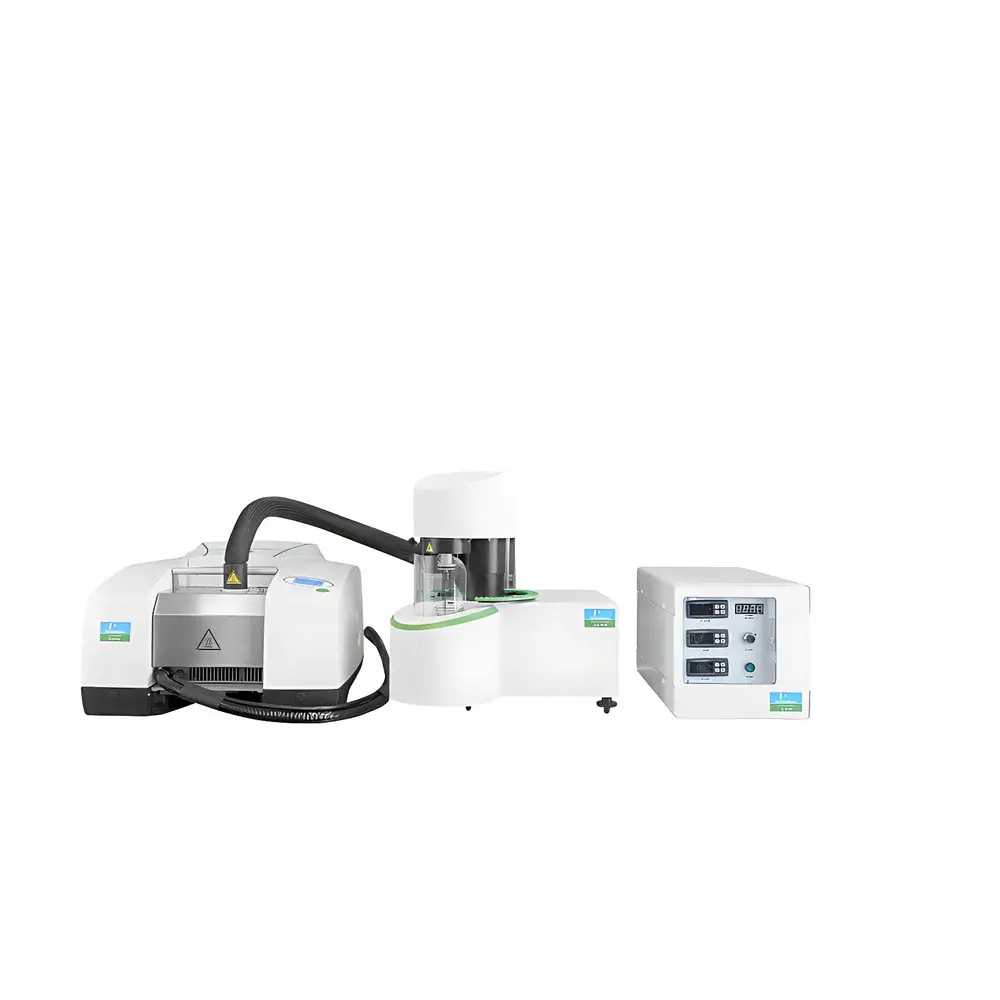
PerkinElmer TG-IR Thermal Gravimetric Analysis–Fourier Transform Infrared Spectroscopy Coupled System
| Brand | PerkinElmer |
|---|---|
| Origin | USA |
| Manufacturer Type | Original Equipment Manufacturer (OEM) |
| Import Status | Imported |
| Model | TG-IR |
| Pricing | Upon Request |
Overview
The PerkinElmer TG-IR system is a rigorously engineered thermal analysis coupled platform integrating a high-precision thermogravimetric analyzer (TGA) with a Fourier transform infrared (FTIR) spectrometer for real-time evolved gas analysis (EGA). This hyphenated technique enables simultaneous measurement of mass loss kinetics and molecular identification of volatile decomposition products across controlled temperature ramps or isothermal holds. The core principle relies on quantitative coupling: gaseous species liberated during thermal degradation—such as H₂O, CO₂, NH₃, aldehydes, hydrocarbons, or halogenated organics—are transported via a thermostatically stabilized transfer line directly into a heated, low-volume FTIR gas cell. Unlike passive off-gas sampling methods, the PerkinElmer TG-IR architecture maintains thermal integrity and chemical fidelity throughout the transfer path, minimizing condensation, adsorption, or secondary reactions that compromise spectral fidelity and quantitation accuracy.
Key Features
- PerkinElmer TL8000 insulated heated transfer line with interchangeable SilcoSteel™ liner—engineered to prevent analyte adsorption and ensure quantitative transport of reactive and condensable species from TGA furnace to FTIR cell
- Heated zero-gravity effect (ZGCell™) FTIR gas cell: actively temperature-controlled (up to 250 °C), featuring ultra-low dead volume (<1 mL), rapid purge kinetics, and automatic accessory recognition via SmartConnect™ interface
- Integrated control unit housing mass flow controller (MFC), particulate filter, flow-smoothing manifold, independent transfer line heater controller, ZGCell temperature regulator, and dedicated vacuum exhaust management
- Synchronized data acquisition: Pyris™ TGA software triggers Spectrum™ TimeBase FTIR software automatically at user-defined thermal events (e.g., onset of mass loss, derivative peak maxima), enabling time-resolved spectral collection with millisecond-level temporal alignment
- Full compliance with GLP/GMP documentation requirements—including electronic audit trails, user access controls, and 21 CFR Part 11–ready configuration options when deployed with validated software packages
Sample Compatibility & Compliance
The TG-IR system accommodates solid and powdered samples (typically 1–20 mg) across polymers, pharmaceuticals, catalysts, battery materials, and inorganic hydrates. It supports ASTM E1131 (standard test method for compositional analysis by thermogravimetry), ISO 11358 (polymer thermal degradation characterization), and USP residual solvent profiling workflows. All hardware components—including SilcoSteel liners and ZGCell optical windows—are inert, low-background, and compatible with aggressive analytes (e.g., HCl, HF, SO₂). System validation protocols align with ICH Q5C (stability testing of biotechnological/biological products) and FDA guidance on thermal degradation pathway elucidation in drug substance development.
Software & Data Management
Data correlation is performed within PerkinElmer’s unified software ecosystem. Pyris™ provides full TGA control, derivative (DTG) calculation, and kinetic modeling (e.g., Flynn–Wall–Ozawa, Kissinger). Spectrum™ TimeBase enables time-stamped spectral acquisition, dynamic baseline correction, and multivariate analysis (PCA, MCR-ALS) for component deconvolution in complex EGA profiles. Raw and processed datasets are stored in vendor-neutral .spc and .xml formats, supporting third-party integration via ASTM E1394-compliant data exchange. Audit trail logs record all parameter changes, calibration events, and user actions—essential for regulatory submissions under FDA, EMA, or PMDA review.
Applications
- Identification of decomposition intermediates in polymer thermal stability studies (e.g., PVC dehydrochlorination, polyimide imidization)
- Residual solvent mapping and quantification in active pharmaceutical ingredients (APIs) per ICH Q3C guidelines
- Monitoring catalytic coke formation and regeneration chemistry in zeolite-supported systems
- Characterizing hydration/dehydration steps in metal–organic frameworks (MOFs) and layered double hydroxides (LDHs)
- Elucidating pyrolysis mechanisms in biomass-derived chars and carbonaceous electrode materials
FAQ
How does the TL8000 transfer line differ from conventional heated capillaries?
The TL8000 incorporates active zone heating, pressure-balanced flow dynamics, and SilcoSteel surface passivation—eliminating cold spots and minimizing wall-catalyzed reactions that distort speciation profiles.
Can the ZGCell operate under vacuum or controlled purge gas environments?
Yes—the ZGCell supports both dynamic N₂/He purge and static vacuum configurations, with programmable flow rates (0–500 mL/min) and pressure monitoring integrated into the control unit.
Is spectral library matching supported for evolved gas identification?
Spectrum software includes built-in libraries (e.g., Hummel Polymer Additives, NIST EPA, and PerkinElmer EGA Reference Collection) with customizable search parameters including spectral subtraction and band ratio analysis.
What level of synchronization accuracy is achieved between TGA mass loss and FTIR spectral acquisition?
Hardware-triggered acquisition ensures sub-second temporal alignment; timebase resolution is configurable down to 100 ms per spectrum, synchronized to TGA temperature ramp rate and mass change thresholds.
Does the system support compliance with 21 CFR Part 11 for regulated laboratories?
When deployed with validated Pyris and Spectrum installations—including role-based access, electronic signatures, and immutable audit trails—the system meets predicate rule requirements for electronic records and signatures in FDA-regulated environments.



