
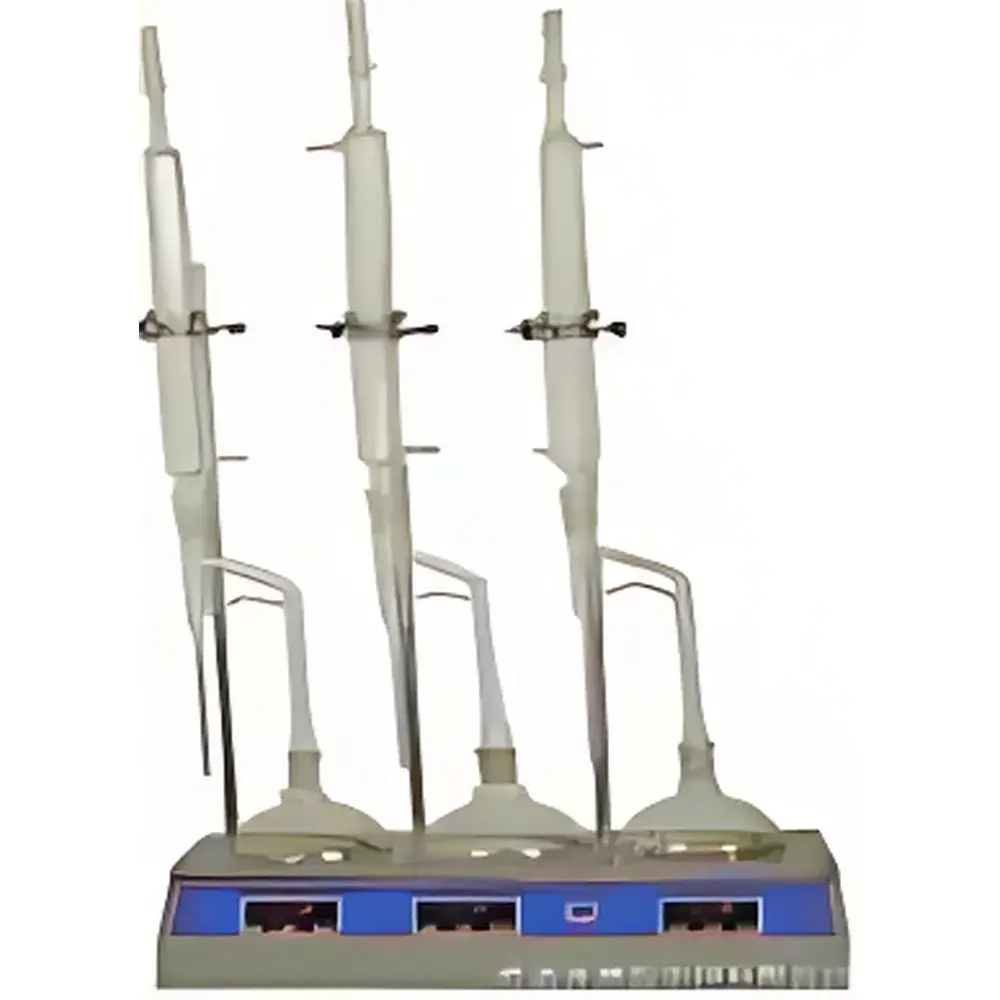
Petroleum Products Water Determination Apparatus PLD-260C
| Origin | Shaanxi, China |
|---|---|
| Manufacturer Type | Authorized Distributor |
| Origin Classification | Domestic (China) |
| Model | PLD-260C |
| Price | USD 780 (FOB Shanghai) |
Overview
The PLD-260C Petroleum Products Water Determination Apparatus is a laboratory-grade distillation-based instrument engineered for quantitative measurement of water content in petroleum products—including crude oil, gasoline, diesel, lubricating oils, and jet fuels—according to the principle and procedural requirements specified in GB/T 260–2016, “Standard Test Method for Water in Petroleum Products by Distillation.” The apparatus operates on the classical azeotropic distillation principle: a representative sample is mixed with a water-immiscible solvent (typically xylene or toluene), heated under controlled reflux, and the evolved water vapor is condensed and collected in a calibrated receiver. The volume of condensed water is read directly from the graduated scale, enabling gravimetric or volumetric calculation of water concentration (reported as % v/v or mg/kg). Designed as a single-station (monoblock) unit, the PLD-260C integrates a precision-controlled heating assembly with standardized ASTM/GB-compliant glassware—ensuring repeatability, traceability, and compliance with routine QC workflows in refinery labs, third-party testing facilities, and petrochemical R&D centers.
Key Features
- Compliance-certified design aligned with GB/T 260–2016 and functionally equivalent to ASTM D95–18 (Standard Test Method for Water in Petroleum Products by Distillation), supporting cross-reference validation.
- Integrated control cabinet housing solid-state temperature regulation circuitry, digital timer, and over-temperature cut-off protection—eliminating manual flame adjustment and reducing operator variability.
- Fire-retardant heating mantle constructed from high-resistance alloy wire embedded in ceramic-fiber insulation; replaces open electric coil or gas burner systems—significantly lowering fire hazard and improving thermal uniformity across the round-bottom flask.
- Optimized borosilicate glass assembly including 500 mL distillation flask, condenser, and 10 mL graduated receiver with 0.05 mL刻度 divisions (per GB/T 260 specification), all supplied with ground-glass joints (ISO K 29/32) for leak-tight sealing.
- Compact monoblock footprint (W × D × H: 320 × 240 × 480 mm) minimizes bench space requirement while maintaining ergonomic access to all operational points.
- No external cooling water connection required—air-cooled condenser design reduces infrastructure dependency and supports mobile or field-deployable lab configurations.
Sample Compatibility & Compliance
The PLD-260C accommodates standard sample volumes of 50–100 mL, compatible with transparent and moderately viscous petroleum liquids per GB/T 260 scope. It is not intended for use with highly volatile solvents (e.g., pentane), emulsified heavy crudes, or samples containing volatile organic compounds that co-distill with water below 100 °C. All glass components conform to ISO 3585 (borosilicate 3.3) specifications for thermal shock resistance and chemical inertness. The electrical subsystem meets GB 4793.1–2019 (IEC 61010-1) safety requirements for laboratory equipment. Documentation includes factory calibration certificate for receiver graduation accuracy (±0.02 mL tolerance at 20 °C), traceable to CNAS-accredited metrology labs.
Software & Data Management
As a manually operated distillation apparatus, the PLD-260C does not incorporate embedded firmware or digital data output. However, it is fully compatible with LIMS-integrated laboratory documentation practices: test parameters (sample ID, solvent type, distillation time, ambient temperature), raw receiver readings, and calculated water content can be recorded in structured electronic worksheets compliant with GLP and ISO/IEC 17025 documentation requirements. Optional accessories include a certified Class A digital thermometer (range –10 to +110 °C, ±0.1 °C) and a NIST-traceable volumetric pipette set for solvent delivery—both supporting audit-ready data capture.
Applications
- Routine quality control of finished fuels prior to pipeline transfer or marine loading (e.g., verifying water ≤ 0.05% v/v in aviation turbine fuel per ASTM D1655 Annex A1).
- Monitoring dehydration efficiency during crude desalting operations.
- Verification of additive package stability in lubricants exposed to humid storage conditions.
- Supporting root-cause analysis of filter plugging or microbial growth in diesel distribution systems.
- Educational use in petroleum engineering laboratories for teaching fundamental distillation thermodynamics and phase behavior.
FAQ
Is the PLD-260C suitable for testing biodiesel blends (e.g., B5 or B20)?
Yes—provided the blend exhibits sufficient immiscibility with xylene/toluene and does not form stable emulsions. Pre-test centrifugation may be required for high-FAME content samples.
Can I use solvents other than xylene or toluene?
Only solvents explicitly permitted in GB/T 260 or ASTM D95 may be used; alternatives must demonstrate azeotropic behavior with water and non-reactivity with sample matrix—validation data required per ISO/IEC 17025 clause 7.2.2.
Does the unit include a calibration certificate?
Yes—a factory-issued certificate for the graduated receiver is supplied, covering linearity and meniscus readability at defined reference points (20 °C), traceable to national standards.
What maintenance is required?
Routine cleaning of glassware with appropriate solvents; annual verification of heating mantle output stability and timer accuracy using external calibrated references.
Is CE or UKCA marking available?
Not applicable—the PLD-260C is designed and certified for domestic Chinese market use per GB standards; export configurations require customer-specified conformity assessment per destination regulatory framework (e.g., EU Declaration of Conformity with notified body involvement).



