
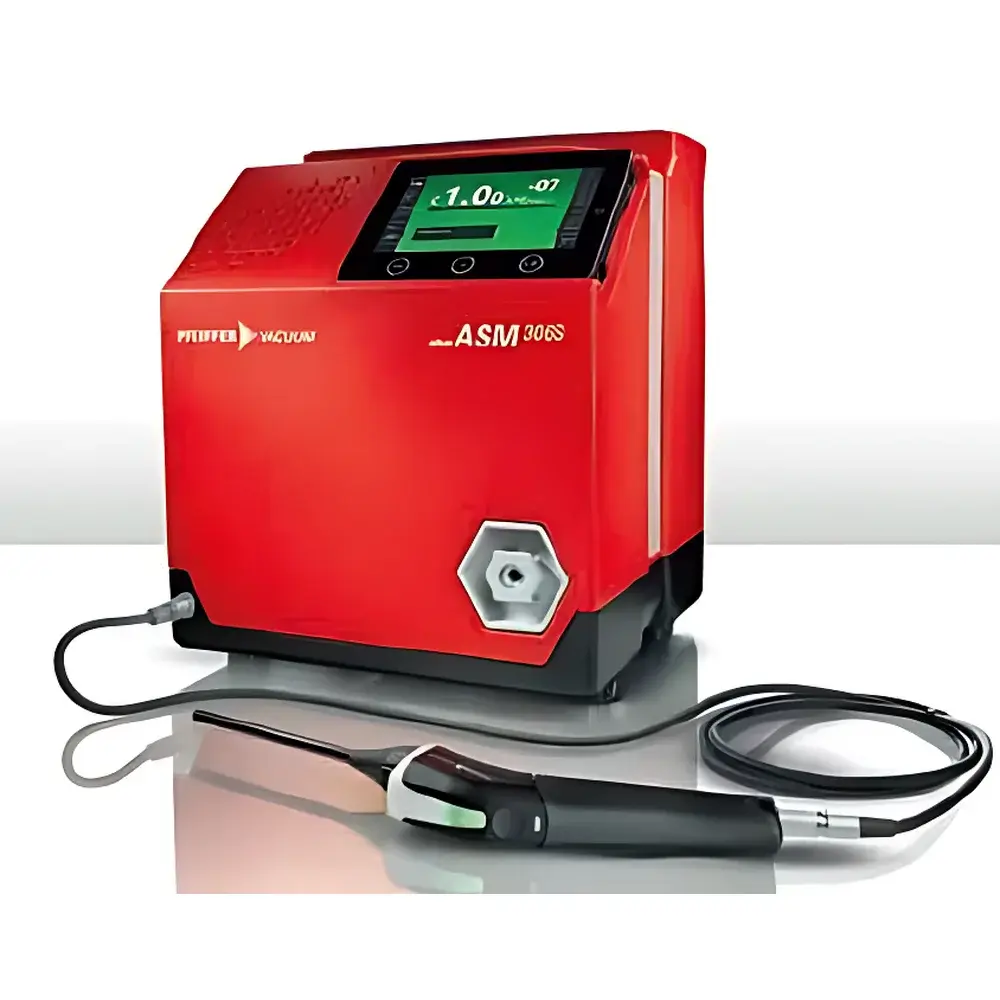
Pfeiffer ASM 306S Helium-Hydrogen Dual-Gas Sniffer Leak Detector
| Brand | Pfeiffer Vacuum |
|---|---|
| Origin | France |
| Model | ASM 306S |
| Minimum Detectable Leak Rate (He) | 1×10⁻⁷ mbar·L/s |
| Minimum Detectable Leak Rate (H₂) | 5×10⁻⁷ mbar·L/s |
| Sensitivity | 0.2 g/y (refrigerant loss equivalent) |
| Startup Time | 2 min |
| Response Time | < 1 s |
| Sniffer Probe Flow Rate | 300 sccm ±10% |
| Noise Level | 55 dB(A) |
| Interfaces | RS-232, Digital I/O, Fieldbus Options |
| Operating Temperature | 10–40 °C |
| Power Supply | 100–240 V, 50/60 Hz |
| Max. Power Consumption | 300 VA |
| Weight | 22 kg |
| Dimensions (L×W×H) | 350 × 305 × 421 mm |
Overview
The Pfeiffer ASM 306S is a high-performance, dual-gas sniffer-type helium mass spectrometer leak detector engineered for precision, reliability, and operational continuity in industrial and manufacturing environments. Based on quadrupole mass spectrometry with optimized ion optics and differential pumping architecture, the ASM 306S detects trace concentrations of helium (⁴He) and hydrogen (H₂) as tracer gases—enabling quantitative assessment of absolute leak rates down to 1×10⁻⁷ mbar·L/s (He) and 5×10⁻⁷ mbar·L/s (H₂). Its core application domain spans refrigeration system integrity verification, HVAC component validation, vacuum chamber commissioning, and hermetic seal testing in automotive, medical device, and electronics assembly lines. Unlike pressure-rise or bubble-test methods, the ASM 306S delivers real-time, localized, and quantifiable leak identification—critical for compliance with ISO 13373-2 (condition monitoring), ISO 9001 process control requirements, and industry-specific refrigerant containment standards such as EN 378-2 and EPA SNAP regulations.
Key Features
- Dual-tracer capability: Simultaneous support for helium and hydrogen as test gases—hydrogen offering cost-effective operation while maintaining metrological traceability to helium-based calibration.
- High-flow sniffer probe: Adjustable-length probes (standard and extended variants) deliver stable 300 sccm ±10% sampling flow, minimizing signal attenuation and enabling robust performance in dusty or humid ambient conditions.
- Human-centered ergonomics: Lightweight (22 kg) benchtop design with compact footprint (350 × 305 × 421 mm) facilitates integration into production cells, mobile QA stations, or service vans.
- Rapid analytical response: <1 second detection latency and 2-minute cold-start time ensure minimal downtime between sequential tests—essential for high-throughput line-side inspection.
- Industrial-grade interface suite: Native RS-232 serial output, programmable digital I/O (for pass/fail signaling and external valve control), and optional Fieldbus protocols (e.g., Profibus DP, EtherCAT) enable seamless PLC integration and automated test logging.
- Acoustically optimized operation: 55 dB(A) noise emission permits continuous use in shared laboratory or factory-floor environments without requiring dedicated acoustic enclosures.
Sample Compatibility & Compliance
The ASM 306S is validated for use with standard industrial tracer gases (helium ≥99.999%, hydrogen 5% in nitrogen) and compatible with common refrigerants including R134a, R410A, R32, and natural refrigerants (R290, R744). Its measurement methodology adheres to ASTM E1514–22 (Standard Practice for Determining Leak Rates Using Mass Spectrometer Leak Detectors) and supports audit-ready documentation per ISO/IEC 17025 and FDA 21 CFR Part 11 when paired with compliant data acquisition software. The instrument meets CE marking requirements under the EU Machinery Directive 2006/42/EC and EMC Directive 2014/30/EU. All critical parameters—including sensitivity drift, background stability, and response linearity—are subject to factory calibration traceable to PTB (Physikalisch-Technische Bundesanstalt) reference standards.
Software & Data Management
The ASM 306S operates via an integrated 7-inch capacitive touchscreen interface with intuitive icon-driven navigation and multilingual UI (English, German, French, Chinese). Firmware supports configurable alarm thresholds, pass/fail logic trees, and timestamped event logging (including probe trigger events, leak rate values, and operator ID). Raw data export is available via USB or RS-232 in CSV format for post-processing in LIMS or MES platforms. Optional Pfeiffer Vacuum Control Software (PVCS) enables remote configuration, batch report generation, trend analysis over time, and GLP/GMP-compliant electronic signatures with full audit trail functionality—including user login history, parameter change logs, and calibration certificate linkage.
Applications
- Refrigeration & HVAC: Quantitative verification of compressor housings, heat exchanger brazed joints, expansion valves, and refrigerant circuit welds against regulatory leakage limits (e.g., ≤0.2 g/y for residential units per EN 378-2 Annex C).
- Automotive: In-line testing of EV battery coolant manifolds, fuel cell stack end plates, and ADAS sensor housings under simulated thermal cycling conditions.
- Medical Devices: Final acceptance testing of hermetically sealed implantable electronics (e.g., pacemakers, neurostimulators) per ISO 11607-2 and AAMI TIR17.
- Vacuum Equipment Manufacturing: Commissioning of diffusion pumps, turbomolecular pump casings, and UHV flange seals prior to system bake-out.
- Aerospace Components: Inspection of cryogenic fluid transfer lines, satellite propulsion system manifolds, and composite pressure vessel interfaces.
FAQ
What tracer gases are supported—and how does hydrogen compare to helium in sensitivity?
The ASM 306S supports both helium (⁴He) and hydrogen (H₂) as tracer gases. While helium offers superior baseline sensitivity (1×10⁻⁷ mbar·L/s), hydrogen achieves 5×10⁻⁷ mbar·L/s—sufficient for most refrigerant leak quantification tasks where g/y-equivalent sensitivity (0.2 g/y) is the governing specification.
Is the instrument suitable for unattended 24/7 operation?
Yes. Designed for industrial duty cycles, the ASM 306S features thermally stabilized electronics, redundant vacuum protection logic, and self-diagnostic routines that maintain measurement integrity during extended runtime—even in ambient temperatures up to 40 °C.
How is calibration maintained in production environments?
Factory calibration is performed using NIST-traceable helium permeation standards. Users may perform field verification using certified leak standards (e.g., VCR-type calibrated leaks); full recalibration is recommended annually or after 2,000 operating hours, whichever occurs first.
Can the sniffer probe be used in wet or oily environments?
The probe’s gas inlet is fitted with a hydrophobic particulate filter (10 µm rating) and optional moisture trap accessory—enabling reliable operation in non-submerged, high-humidity settings. Direct immersion or exposure to liquid refrigerant is not permitted.
Does the ASM 306S comply with FDA 21 CFR Part 11 requirements?
When operated with Pfeiffer Vacuum Control Software (PVCS) v3.2 or later and configured with role-based access control, electronic signatures, and immutable audit trails, the system satisfies predicate rule requirements for electronic records and signatures in regulated pharmaceutical and medical device manufacturing.






